17.4 Alcohols from Carbonyl Compounds: Reduction

🥼Organic Chemistry Unit 17 Review
17.4 Alcohols from Carbonyl Compounds: Reduction
🥼 Organic Chemistry
17.1
Naming Alcohols and Phenols
17.2
Properties of Alcohols and Phenols
17.3
Preparation of Alcohols: A Review
17.4
Alcohols from Carbonyl Compounds: Reduction
17.5
Alcohols from Carbonyl Compounds: Grignard Reaction
17.6
Reactions of Alcohols
17.7
Oxidation of Alcohols
17.8
Protection of Alcohols
17.9
Phenols and Their Uses
17.10
Reactions of Phenols
17.11
Spectroscopy of Alcohols and Phenols
Carbonyl compounds can be transformed into alcohols through reduction reactions. In organic chemistry, "reduction" means adding hydrogen (or removing oxygen) from a molecule, which lowers the oxidation state of carbon. The reducing agent you pick determines which carbonyl compounds you can reduce and what products you get.
Aldehydes reduce to primary alcohols, ketones reduce to secondary alcohols, and carboxylic acids and esters also reduce to primary alcohols (though they need a stronger reagent). Understanding the differences between and is central to this topic.
Reduction of Carbonyl Compounds to Alcohols

Top images from around the web for Reduction of aldehydes and ketones
NaBH4/NaNO3/H2O: A Convenient System for Selective Reduction of Aldehydes VS. Ketones to their ... View original
Is this image relevant?
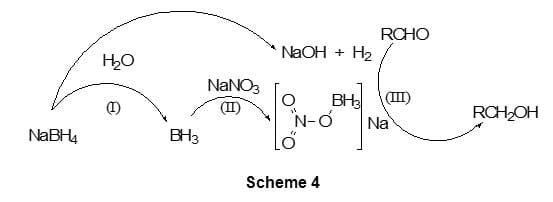
NaBH4/NaNO3/H2O: A Convenient System for Selective Reduction of Aldehydes VS. Ketones to their ... View original
Is this image relevant?
Reduction of aldehydes and ketones
Aldehydes and ketones are both reduced to alcohols using hydride reducing agents ( or ). The type of alcohol you get depends on the starting carbonyl:
- Aldehydes → primary alcohols (the carbonyl carbon has one alkyl/aryl group and one H, so after reduction it ends up with two H's)
- Ketones → secondary alcohols (the carbonyl carbon has two alkyl/aryl groups, so after reduction it has one H)
The mechanism is a nucleophilic addition of hydride () to the electrophilic carbonyl carbon. Here's how it works:
- The hydride ion () from the reducing agent attacks the carbonyl carbon, breaking the pi bond.
- The electrons from the pi bond shift onto the oxygen, forming an alkoxide intermediate ().
- In a separate protonation step (aqueous workup), the alkoxide picks up a proton () to give the alcohol ().
The net result is a new bond where the pi bond used to be, plus a hydroxyl group on that same carbon.
Example: Reduction of acetone (a ketone) with gives 2-propanol (a secondary alcohol).
NaBH4 vs LiAlH4 as reducing agents
Both and deliver hydride (), but they differ significantly in reactivity. Choosing between them is one of the most common decisions in synthesis problems.
(sodium borohydride) — the milder reagent:
- Selectively reduces aldehydes and ketones to alcohols
- Does not reduce carboxylic acids, esters, or amides
- Can be used in protic solvents like methanol or ethanol (it reacts slowly with these solvents but fast enough with carbonyls to be useful)
- Easier to handle and safer in the lab
(lithium aluminum hydride) — the stronger reagent:
- Reduces aldehydes, ketones, carboxylic acids, esters, and amides to alcohols
- Must be used in aprotic solvents like diethyl ether or THF because it reacts violently with water and protic solvents (it generates gas)
- Requires a separate aqueous acid workup step after the reaction to protonate the alkoxide
Why the difference? is a much more powerful nucleophile and a stronger hydride donor than . The bond is weaker and more reactive than the bond, so can force hydride delivery into less electrophilic carbonyls like those in esters and carboxylic acids.
Example: Ethyl acetate (an ester) is not reduced by , but converts it to ethanol (a primary alcohol).
Reduction of carboxylic acids and esters
Carboxylic acids and esters require for reduction. is simply not reactive enough to reduce these functional groups.
Reduction of carboxylic acids to primary alcohols:
- first deprotonates the of the carboxylic acid (generating gas), forming a carboxylate salt.
- A second equivalent of hydride attacks the carbonyl carbon, ultimately passing through an aldehyde intermediate.
- The aldehyde intermediate is immediately reduced again by another hydride to give the primary alcohol.
- Aqueous acid workup protonates the alkoxide to yield the final product.
Overall:
Example: Acetic acid is reduced to ethanol using .
Reduction of esters to primary alcohols:
- Hydride attacks the carbonyl carbon of the ester.
- The tetrahedral intermediate collapses, expelling the alkoxide leaving group () and forming an aldehyde intermediate.
- The aldehyde is immediately reduced by a second hydride to give a primary alkoxide.
- Aqueous acid workup gives the final products.
Overall:
Notice that ester reduction produces two alcohols: one from the acyl portion () and one from the alkoxy group ().
Example: Reduction of methyl benzoate with gives benzyl alcohol (from the acyl side) and methanol (from the group).
Stereochemistry and Oxidation State in Carbonyl Reductions
Oxidation state changes: Reduction of a carbonyl compound decreases the oxidation state of the carbonyl carbon. Going from a carboxylic acid or ester all the way to a primary alcohol is a larger change in oxidation state than going from an aldehyde or ketone to an alcohol, which is why the former requires the stronger reagent.
Stereochemistry of ketone reduction: When a ketone is reduced, the carbonyl carbon goes from trigonal planar () to tetrahedral (). If the ketone is not symmetric, this creates a new stereocenter. Hydride delivery can occur from either face of the planar carbonyl, so with simple reagents like or , you typically get a racemic mixture (equal amounts of R and S enantiomers).
If the molecule already has a nearby stereocenter, the two faces of the carbonyl may not be equally accessible. In that case, hydride tends to attack the less hindered face, giving unequal amounts of diastereomers. This is where steric effects in the transition state influence the stereochemical outcome.
See Fiveable more often in Google
Mark Fiveable as a preferred source and Google is more likely to show you our guides in Top Stories, with a "preferred" badge in AI Mode and AI Overviews.