11.9 The E2 Reaction and Cyclohexane Conformation

🥼Organic Chemistry Unit 11 Review
11.9 The E2 Reaction and Cyclohexane Conformation
🥼 Organic Chemistry
11.1
The Discovery of Nucleophilic Substitution Reactions
11.2
The SN2 Reaction
11.3
Characteristics of the SN2 Reaction
11.4
The SN1 Reaction
11.5
Characteristics of the SN1 Reaction
11.6
Biological Substitution Reactions
11.7
Elimination Reactions: Zaitsev’s Rule
11.8
The E2 Reaction and the Deuterium Isotope Effect
11.9
The E2 Reaction and Cyclohexane Conformation
11.10
The E1 and E1cB Reactions
11.11
Biological Elimination Reactions
11.12
A Summary of Reactivity: SN1, SN2, E1, E1cB, and E2
The E2 Reaction and Cyclohexane Conformation
E2 eliminations in cyclohexane systems are governed by a strict geometric requirement: the leaving group and the proton being removed must be antiperiplanar (180° dihedral angle). In a cyclohexane ring, this geometry is only possible when both groups occupy axial positions on adjacent carbons. This constraint makes conformational analysis essential for predicting which isomers react quickly and which products form.
Antiperiplanar Geometry in Cyclohexane Eliminations
E2 reactions are concerted: the base abstracts a proton at the same time the leaving group departs. For the orbital overlap that drives this process, the C–H bond and the C–LG (leaving group) bond must be antiperiplanar, meaning a 180° dihedral angle between them.
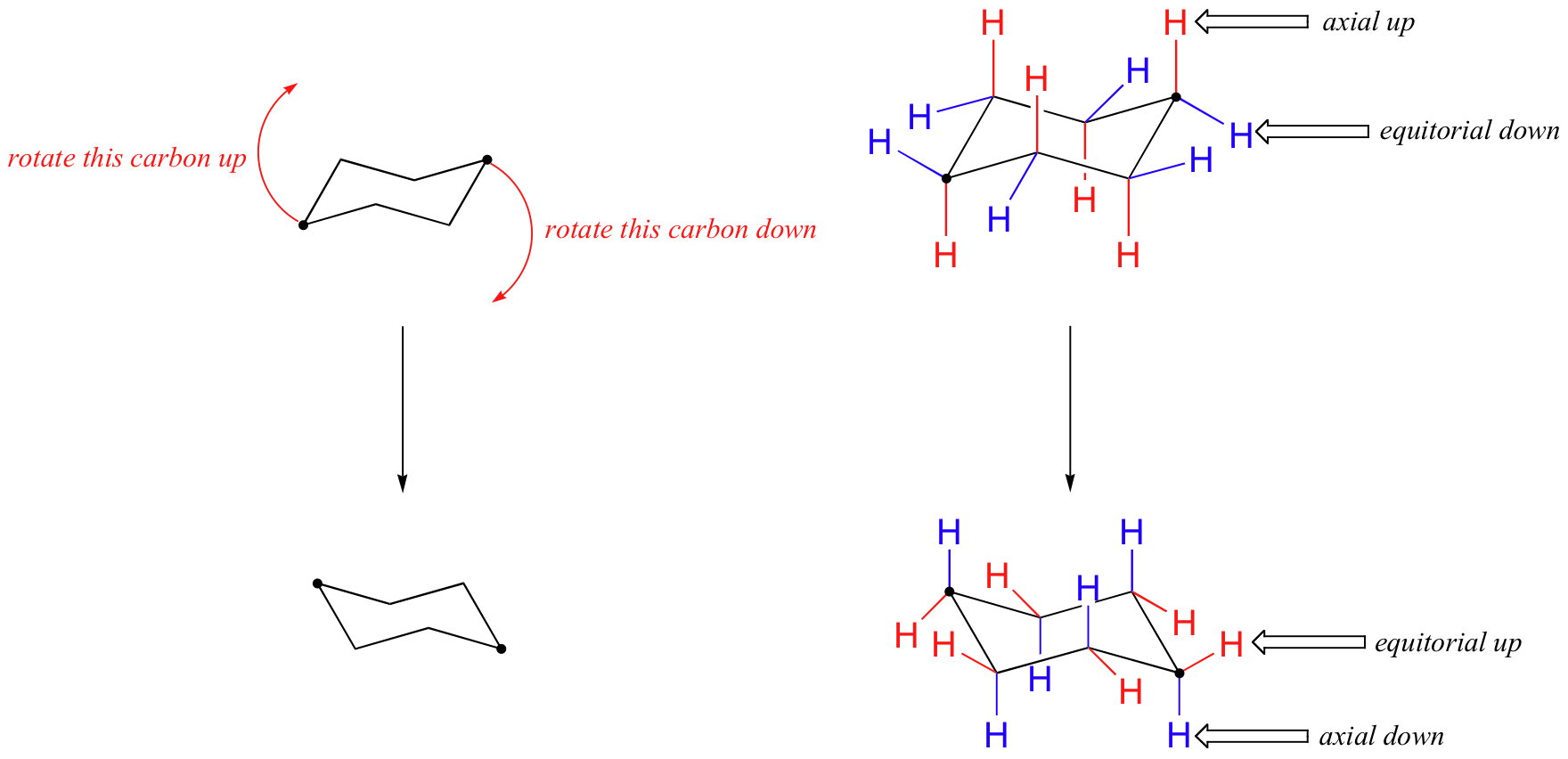
In acyclic systems, free rotation around C–C bonds makes it easy to reach this geometry. Cyclohexane rings are different. The only way two substituents on adjacent carbons can be antiperiplanar is if both are axial (one pointing up, one pointing down on neighboring carbons). Equatorial substituents sit roughly in the plane of the ring and cannot achieve the required 180° alignment.
This creates a problem: diaxial conformations are often less stable than diequatorial ones because of 1,3-diaxial interactions (steric strain between axial substituents and other axial hydrogens on the same face of the ring). The molecule may need to flip to a higher-energy chair to place the leaving group axial, and that energy cost slows the reaction. As a result, E2 eliminations in cyclohexane systems are generally slower than in comparable acyclic substrates.
Neomenthyl vs. Menthyl Chloride Eliminations
This classic comparison illustrates how conformational analysis directly predicts E2 reactivity.
Neomenthyl chloride has its chlorine atom axial in the more stable chair conformation. An adjacent hydrogen on the more substituted carbon is also axial. That means antiperiplanar geometry is already satisfied without a ring flip. The reaction proceeds quickly and predominantly gives the Zaitsev product (the more substituted alkene), because the axial proton on the more substituted carbon is the one aligned for elimination.
Menthyl chloride has its chlorine atom equatorial in the more stable chair. None of the adjacent protons are antiperiplanar to it in this conformation. To react via E2, the ring must flip to the less stable chair where chlorine becomes axial. This ring flip costs energy (the molecule fights 1,3-diaxial strain from the isopropyl and methyl groups), so the reaction is much slower. Additionally, in the flipped conformation, only the proton on the less substituted adjacent carbon is axial and antiperiplanar, so menthyl chloride gives the Hofmann product (the less substituted alkene).
Key comparison: Neomenthyl chloride reacts faster and gives a different product than menthyl chloride, even though they're diastereomers with the same functional groups. The difference comes entirely from which chair conformation places the C–Cl bond axial.

Predicting Elimination Rates in Cyclohexane Isomers
When comparing E2 rates across cyclohexane isomers, follow these steps:
- Draw the most stable chair conformation for each isomer (larger substituents prefer equatorial positions).
- Check whether the leaving group is axial. If it is, antiperiplanar elimination can proceed directly from the stable chair.
- Count how many adjacent axial protons are antiperiplanar to the axial leaving group. More available protons means more possible elimination pathways.
- If the leaving group is equatorial, the ring must flip to the less stable chair. Estimate the energy cost of that flip (consider 1,3-diaxial strain from all substituents forced axial). A larger energy penalty means a slower rate.
- Rank the isomers. The isomer with the most favorable antiperiplanar geometry in its most stable chair reacts fastest. Isomers requiring a costly ring flip react slowest.
Stereochemistry and Product Outcomes
Because E2 is concerted, the stereochemistry of the starting material directly controls the product geometry. In cyclohexane systems, the specific axial proton that gets removed determines whether the resulting alkene is cis or trans (in cases where geometric isomers are possible).
The stability of the alkene product also matters. More substituted alkenes are generally more stable, but the antiperiplanar requirement can override thermodynamic preference. If the only available axial proton leads to a less substituted alkene, that's the product you get, regardless of Zaitsev's rule. The transition state reflects both the electronic demands of the E2 mechanism and the conformational constraints of the ring, making cyclohexane eliminations one of the clearest examples of stereoelectronic control in organic chemistry.
See Fiveable more often in Google
Mark Fiveable as a preferred source and Google is more likely to show you our guides in Top Stories, with a "preferred" badge in AI Mode and AI Overviews.