12.1 Mass Spectrometry of Small Molecules: Magnetic-Sector Instruments

🥼Organic Chemistry Unit 12 Review
12.1 Mass Spectrometry of Small Molecules: Magnetic-Sector Instruments
🥼 Organic Chemistry
12.1
Mass Spectrometry of Small Molecules: Magnetic-Sector Instruments
12.2
Interpreting Mass Spectra
12.3
Mass Spectrometry of Some Common Functional Groups
12.4
Mass Spectrometry in Biological Chemistry: Time-of-Flight (TOF) Instruments
12.5
Spectroscopy and the Electromagnetic Spectrum
12.6
Infrared Spectroscopy
12.7
Interpreting Infrared Spectra
12.8
Infrared Spectra of Some Common Functional Groups
Mass Spectrometry Fundamentals
Mass spectrometry works by breaking molecules into charged fragments and then sorting those fragments by their mass-to-charge ratio (). From the resulting spectrum, you can determine a compound's molecular weight, elemental composition, and structural features. For organic chemists, it's one of the most direct ways to identify an unknown compound or confirm a proposed structure.
This section focuses on how magnetic-sector instruments work, how ions are generated through electron-impact ionization, and how to read the spectra they produce.

Top images from around the web for Parts of a mass spectrometer
Atomic Structure and Symbolism – Atoms First / OpenStax View original
Is this image relevant?
Mass Spectrometry to Measure Mass | Introduction to Chemistry View original
Is this image relevant?
Atomic Structure and Symbolism | Introductory Chemistry – Lecture & Lab View original
Is this image relevant?
Atomic Structure and Symbolism – Atoms First / OpenStax View original
Is this image relevant?
Mass Spectrometry to Measure Mass | Introduction to Chemistry View original
Is this image relevant?
Parts of a Mass Spectrometer
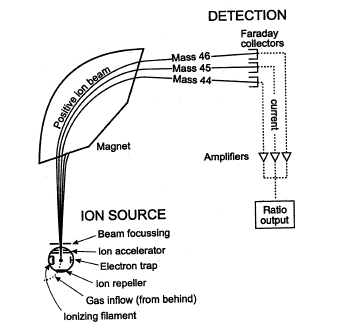
Every mass spectrometer has three core components, and understanding what each one does will help you follow the logic of the whole technique.
- Ionization source: Converts neutral sample molecules into gaseous ions. Common methods include electron ionization (EI) and chemical ionization (CI). Without this step, the mass analyzer has nothing to work with.
- Mass analyzer: Separates the resulting ions based on their ratio. Different instrument types use different separation strategies: magnetic-sector analyzers use a magnetic field, quadrupole analyzers use oscillating electric fields, and time-of-flight (TOF) analyzers measure how long ions take to travel a fixed distance.
- Detector: Records how many ions arrive at each value. Common detectors include the electron multiplier and the Faraday cup. The output is a mass spectrum, a plot with on the x-axis and relative abundance on the y-axis.

Electron-Impact Ionization and Magnetic-Sector Analyzers
These are two separate parts of the process, so it helps to think about them in sequence: ionization happens first, then mass analysis.
Electron-Impact Ionization (EI)
The sample is first vaporized, then bombarded with high-energy electrons (typically 70 eV). That's far more energy than needed to ionize most organic molecules, which is why EI causes extensive fragmentation. The process knocks an electron off the molecule, producing a radical cation (), along with various fragment ions.
A key advantage of EI is reproducibility. Because 70 eV is standard across instruments, the fragmentation pattern for a given compound is consistent. That means you can match an unknown spectrum against a database of known EI spectra. The trade-off is that some molecules fragment so readily that the molecular ion peak is weak or absent entirely.
Magnetic-Sector Mass Analyzer
After ionization, ions are accelerated through a voltage and then enter a curved flight tube within a magnetic field. The magnetic field exerts a force on the moving ions, bending their paths into arcs. How much an ion curves depends on its ratio: lighter ions (lower ) curve more, and heavier ions (higher ) curve less.
Here's how separation works step by step:
- Ions are accelerated to a uniform kinetic energy by an electric field.
- The accelerated ions enter the magnetic-sector region, where the magnetic field deflects them along curved paths.
- Ions with the same follow the same radius of curvature and reach the detector.
- By scanning (gradually changing) the magnetic field strength, different values are brought into focus at the detector one at a time.
Magnetic-sector instruments are known for high resolution, meaning they can distinguish between ions with very similar values. This matters when you need an exact mass to pin down a molecular formula.

Interpretation of Mass Spectra
Reading a mass spectrum is about identifying a few key features and then working out what they tell you about structure.
Molecular Ion Peak ()
This peak corresponds to the intact molecule with one electron removed. It appears at the highest value in the spectrum (ignoring isotope peaks) and directly gives you the molecular weight. Not every spectrum shows a strong molecular ion peak, though. Molecules with weak bonds or many fragmentation pathways may show a very small , or none at all.
Base Peak
The tallest peak in the spectrum is called the base peak and is assigned a relative abundance of 100%. Every other peak's intensity is reported as a percentage of the base peak. The base peak may or may not be the molecular ion peak; it simply represents the most stable (and therefore most abundant) ion formed during fragmentation.
Fragment Peaks
These arise when the molecular ion breaks apart. Each fragment peak tells you something about the molecule's structure. Common fragmentation pathways include:
- Loss of small neutral molecules such as (loss of 18), (loss of 28), or (loss of 17). Seeing a gap of 18 between the molecular ion and a prominent fragment, for example, strongly suggests an group was present.
- Carbon-carbon bond cleavage, which tends to occur at branching points where the resulting carbocation is more stable (tertiary > secondary > primary).
- Cleavage adjacent to heteroatoms (N, O, S), because the heteroatom can stabilize the positive charge on the fragment through lone-pair donation.
By mapping out which fragments are lost and which ions are most abundant, you can piece together the connectivity of the original molecule.
Advanced Mass Spectrometry Concepts
Mass Resolution
Resolution describes the instrument's ability to tell apart two ions with nearly identical values. It's defined as , where is the smallest mass difference the instrument can resolve. A magnetic-sector instrument might achieve a resolution of 10,000 or higher, which is enough to distinguish ( = 27.9949) from ( = 28.0313). This capability is what makes high-resolution mass spectrometry (HRMS) so useful for determining exact molecular formulas.
Isotope Peaks
Most elements have more than one naturally occurring isotope, and these show up as small peaks one or two mass units above the molecular ion. For example, about 1.1% of carbon atoms are , so a molecule with 6 carbons will show an peak that's roughly 6.6% the intensity of the peak. Chlorine and bromine are especially distinctive: chlorine's two isotopes ( and ) appear in roughly a 3:1 ratio, producing a characteristic and pattern. These isotope signatures are a quick way to identify which elements are present.
Mass Calibration
To trust the values your instrument reports, it needs to be calibrated against compounds with known, precise masses. Common calibrants include perfluorotributylamine (PFTBA) for EI sources. Calibration is especially critical for high-resolution work, where even small errors in mass assignment can lead to an incorrect molecular formula.
See Fiveable more often in Google
Mark Fiveable as a preferred source and Google is more likely to show you our guides in Top Stories, with a "preferred" badge in AI Mode and AI Overviews.