11.2 The SN2 Reaction

🥼Organic Chemistry Unit 11 Review
11.2 The SN2 Reaction
🥼 Organic Chemistry
11.1
The Discovery of Nucleophilic Substitution Reactions
11.2
The SN2 Reaction
11.3
Characteristics of the SN2 Reaction
11.4
The SN1 Reaction
11.5
Characteristics of the SN1 Reaction
11.6
Biological Substitution Reactions
11.7
Elimination Reactions: Zaitsev’s Rule
11.8
The E2 Reaction and the Deuterium Isotope Effect
11.9
The E2 Reaction and Cyclohexane Conformation
11.10
The E1 and E1cB Reactions
11.11
Biological Elimination Reactions
11.12
A Summary of Reactivity: SN1, SN2, E1, E1cB, and E2
The SN2 Reaction Mechanism and Kinetics
The SN2 reaction is one of the most fundamental ways a nucleophile can replace a leaving group on a carbon. Understanding this mechanism gives you a framework for predicting products, stereochemistry, and reaction rates across a huge range of organic transformations. This section covers how the mechanism works, its kinetics, its stereochemical outcome, and the factors that control how fast it goes.

Top images from around the web for Mechanism of SN2 reactions
Organic chemistry 12: SN2 substitution - nucleophilicity, epoxide electrophiles View original
Is this image relevant?
4.5. Stereochemistry of reactions | Organic Chemistry 1: An open textbook View original
Is this image relevant?
Organic chemistry 12: SN2 substitution - nucleophilicity, epoxide electrophiles View original
Is this image relevant?
4.5. Stereochemistry of reactions | Organic Chemistry 1: An open textbook View original
Is this image relevant?
Mechanism of SN2 Reactions
SN2 stands for Substitution, Nucleophilic, Bimolecular. The "bimolecular" part means both the nucleophile and the substrate (typically an alkyl halide or tosylate) are involved in the single, rate-determining step.
Here's how it proceeds:
- The nucleophile approaches the electrophilic carbon from the backside, directly opposite the leaving group.
- As the nucleophile begins forming a bond with the carbon, the carbon-leaving group bond starts to break simultaneously.
- The reaction passes through a single transition state where the carbon is partially bonded to both the nucleophile and the leaving group. This transition state has a trigonal bipyramidal geometry, with the nucleophile and leaving group at the two axial positions and the three remaining substituents fanning out in a plane.
- The leaving group departs, and the new bond to the nucleophile is fully formed.
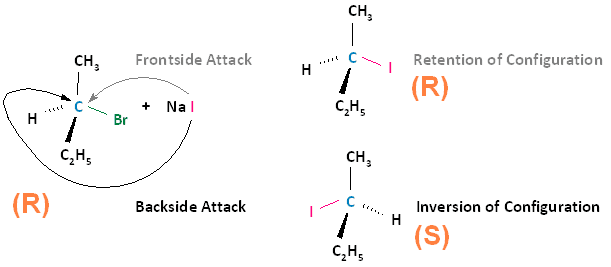
Because the nucleophile attacks from the backside, the three substituents on the carbon "flip" to the other side, like an umbrella inverting in the wind. This causes inversion of configuration (sometimes called Walden inversion) at the electrophilic carbon. If the substrate is chiral, an R center becomes S, and vice versa.
The SN2 mechanism is concerted: bond formation and bond breaking happen in one step. There is no intermediate, only a transition state.
Kinetics of SN2 Reactions
Because both the nucleophile and the substrate participate in the single rate-determining step, the rate depends on the concentration of both:
- = rate constant (depends on temperature, solvent, and the specific reactants)
- = concentration of the nucleophile
- = concentration of the alkyl halide substrate
The reaction is first-order in the nucleophile and first-order in the substrate, making it second-order overall (1 + 1 = 2). In practical terms:
- Doubling alone doubles the rate.
- Doubling alone doubles the rate.
- Doubling both concentrations quadruples the rate.
This second-order kinetics is what distinguishes SN2 from SN1, where the rate depends only on the substrate concentration.

Stereochemistry in SN2 Products
Predicting the stereochemical outcome of an SN2 reaction is straightforward:
- Assign the absolute configuration (R or S) of the starting alkyl halide at the electrophilic carbon.
- The product will have the opposite configuration at that carbon, because backside attack always causes inversion.
A few things to watch out for:
- Inversion of configuration does not automatically mean R becomes S in the naming. If the nucleophile has a different priority than the leaving group, you need to reassign priorities using Cahn-Ingold-Prelog rules. The spatial arrangement always inverts, but the R/S label depends on the priority ranking of the new set of substituents.
- If the electrophilic carbon is not a stereocenter (e.g., a group), inversion still occurs geometrically, but there's no observable stereochemical change in the product.
Example: (R)-2-bromobutane reacts with via SN2. The nucleophile attacks from the backside, displacing . The configuration at carbon 2 inverts, giving (S)-butan-2-ol.
Factors Affecting SN2 Reactions
Three main factors control how fast an SN2 reaction goes.
Nucleophile strength. Stronger nucleophiles accelerate SN2 reactions. Nucleophilicity generally increases with negative charge ( is a better nucleophile than ), with larger atomic size going down a group in polar protic solvents ( > > > ), and with lower electronegativity across a row ( > ).
Steric hindrance at the electrophilic carbon. The nucleophile needs clear access to the backside of the carbon. As substitution increases, the transition state becomes more crowded and the rate drops dramatically:
- Methyl (): fastest SN2 reactions
- Primary (): fast
- Secondary (): slow, often competing with elimination
- Tertiary (): SN2 essentially does not occur (too sterically hindered)
Solvent choice. Polar aprotic solvents (like DMSO, DMF, and acetone) are best for SN2 reactions. These solvents dissolve ionic nucleophiles but don't form strong hydrogen bonds around them, leaving the nucleophile "naked" and highly reactive. Polar protic solvents (like water and alcohols) solvate the nucleophile through hydrogen bonding, which stabilizes it and reduces its reactivity.
See Fiveable more often in Google
Mark Fiveable as a preferred source and Google is more likely to show you our guides in Top Stories, with a "preferred" badge in AI Mode and AI Overviews.