22.4 Alpha Bromination of Carboxylic Acids

🥼Organic Chemistry Unit 22 Review
22.4 Alpha Bromination of Carboxylic Acids
🥼 Organic Chemistry
Alpha Bromination of Carboxylic Acids
The Hell-Volhard-Zelinsky (HVZ) reaction places a bromine atom selectively at the alpha carbon of a carboxylic acid. This selectivity matters because carboxylic acids don't undergo direct alpha bromination the way ketones and aldehydes do. The HVZ reaction also serves as a gateway to further transformations, since the alpha-bromo product can be converted into amino acids, hydroxy acids, and other useful compounds through nucleophilic substitution.

Top images from around the web for Mechanism of HVZ reaction
A H 2 O 2 /HBr system – several directions but one choice: oxidation–bromination of secondary ... View original
Is this image relevant?
Hell-Volhard-Zelinsky halogenation - wikidoc View original
Is this image relevant?
22.1. Introduction | Organic Chemistry II View original
Is this image relevant?
A H 2 O 2 /HBr system – several directions but one choice: oxidation–bromination of secondary ... View original
Is this image relevant?
Hell-Volhard-Zelinsky halogenation - wikidoc View original
Is this image relevant?
Mechanism of the HVZ Reaction
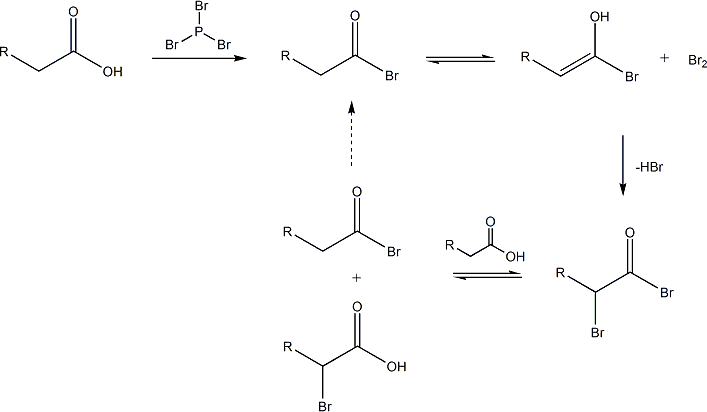
The reason carboxylic acids need special treatment is that they don't enolize easily on their own. The HVZ reaction solves this by first converting the acid into a more reactive acyl bromide, which enolizes much more readily.
Here's how the mechanism works, step by step:
- Formation of acyl bromide: The carboxylic acid () reacts with (or red phosphorus + , which generates in situ) to form an acyl bromide intermediate ().
- Enolization: The acyl bromide tautomerizes to its enol form. The alpha hydrogens of an acyl bromide are more acidic than those of the parent carboxylic acid, so enolization is now feasible.
- Electrophilic bromination: reacts with the nucleophilic enol double bond at the alpha carbon, producing an alpha-brominated acyl bromide ().
- Hydrolysis: Treatment with water converts the acyl bromide back to a carboxylic acid, giving the final alpha-brominated product ().
A catalytic amount of is often sufficient because the generated during the reaction can convert additional carboxylic acid molecules into acyl bromides, keeping the cycle going.

Reagent Effects in the HVZ Reaction
The acyl bromide intermediate () from step 3 is a versatile branch point. Depending on what nucleophile you use to quench it, you get different products:
- Water () → alpha-brominated carboxylic acid ()
- Alcohol (), such as methanol or ethanol → alpha-brominated ester ()
- Amine ( or ) → alpha-brominated amide ()
This flexibility is one of the most useful features of the HVZ reaction. You run the same bromination, then choose your final product by picking the right nucleophile at the end.

HVZ vs. Other Carbonyl Brominations
Ketones and aldehydes undergo alpha bromination directly using under acidic or basic conditions, without needing . So why do carboxylic acids require the HVZ approach?
- Carboxylic acids have very low enol content, so direct bromination with alone is extremely slow. Converting to the acyl bromide makes enolization practical.
- Under acid-catalyzed conditions, ketone bromination tends to stop at monosubstitution. Under base-catalyzed conditions, ketones can undergo polyhalogenation (leading to the haloform reaction with methyl ketones). The HVZ reaction gives clean monobromination at the alpha position.
Key comparison: Ketones and aldehydes brominate directly with + acid or base catalyst. Carboxylic acids require (or + ) to go through the acyl bromide intermediate first.
Stereochemistry and Downstream Reactions
The HVZ reaction does not proceed through a radical mechanism. It follows an ionic pathway through the enol intermediate, as described above. Because the enol is planar at the alpha carbon, bromination produces a racemic mixture when a new stereocenter is created.
The alpha-bromo carboxylic acid product is a useful synthetic intermediate. The – bond at the alpha position is activated toward displacement because of the adjacent electron-withdrawing carbonyl group. Common follow-up reactions include:
- Treatment with → alpha-amino acid synthesis
- Treatment with → alpha-hydroxy acid
- Treatment with → nitrile for chain extension
These downstream substitutions are why the HVZ reaction shows up frequently in synthesis problems.
See Fiveable more often in Google
Mark Fiveable as a preferred source and Google is more likely to show you our guides in Top Stories, with a "preferred" badge in AI Mode and AI Overviews.