9.1 Components of Nonverbal Communication

📞Intro to Public Speaking Unit 9 Review
9.1 Components of Nonverbal Communication
📞 Intro to Public Speaking
Nonverbal Communication Elements
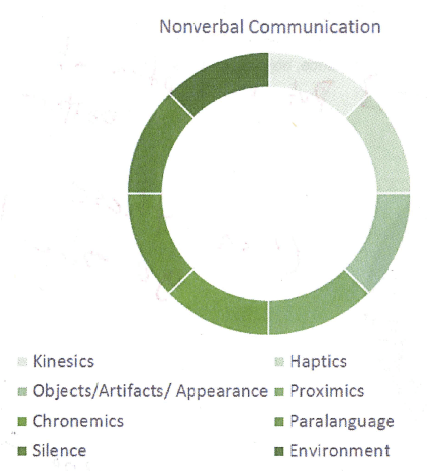
Nonverbal communication covers everything you do as a speaker besides the words themselves: your gestures, facial expressions, vocal tone, use of space, and even your clothing. In public speaking, these signals shape how your audience perceives both you and your message. Getting them right can reinforce your points and build trust; getting them wrong can undermine even the best-written speech.

Top images from around the web for Body Language and Spatial Communication
Proxemics - Wikipedia View original
Is this image relevant?
Differences Between Verbal and Nonverbal Communication | Introduction to Communication View original
Is this image relevant?
Unit 43: Non-verbal Communication – Communication Skills View original
Is this image relevant?
Proxemics - Wikipedia View original
Is this image relevant?
Differences Between Verbal and Nonverbal Communication | Introduction to Communication View original
Is this image relevant?
Body Language and Spatial Communication
Kinesics is the study of body movements, gestures, and facial expressions as they convey meaning. In a speech, deliberate use of kinesics strengthens your delivery. Pointing to the audience when you say "you," opening your palms when presenting an idea, or letting your face reflect the emotion of a story all help your audience stay engaged.
Proxemics refers to how you use space. This includes the distance between you and your audience and how you move around the speaking area. Standing too far away can feel detached; crowding the front row can feel aggressive. Moving purposefully across the stage during transitions signals a shift in ideas and keeps visual interest high.
Haptics refers to communication through touch. It's less common in public speaking, but it shows up in handshakes before or after a speech, or when guiding a volunteer during a demonstration. Be aware that norms around touch vary widely across cultures, so err on the side of caution.
Vocal and Temporal Aspects
Paralanguage includes all the vocal qualities that accompany your words: pitch, tone, volume, and rate of speech. These cues carry emotional weight. Dropping your voice low and slowing down signals seriousness. Picking up speed and raising your volume conveys excitement. A flat, unchanging delivery, no matter how good the content, will lose your audience fast.
Chronemics is about how you use time. In public speaking, this means your pacing, your use of pauses, and how you allocate time across sections of your speech. A well-placed pause after a key statement gives the audience a moment to absorb it. Rushing through your conclusion because you spent too long on your introduction is a chronemic problem. Planning your timing in advance and practicing with a stopwatch helps you stay in control.
Visual Elements and Eye Contact
Appearance and artifacts are the visual elements that shape your audience's first impression. Your clothing, accessories, and any visual aids you use all send nonverbal messages about your credibility and professionalism. Dressing appropriately for the occasion matters: a suit at a formal event, business casual for a class presentation. Cluttered or poorly designed slides can distract from your message just as easily as a wrinkled shirt.
Eye contact is one of the most powerful nonverbal tools a speaker has. It establishes a sense of connection, conveys confidence, and lets you read the room. Rather than staring at one person or fixating on your notes, practice scanning the room in a relaxed pattern. Make brief eye contact with individuals in different sections of the audience, especially during your most important points.
Nonverbal Cues and Audience Perception
Impact and Congruence
Nonverbal cues often carry more weight than the words themselves when audiences interpret a message. You may have heard the claim that 93% of communication is nonverbal. That figure comes from Albert Mehrabian's 1967 research, but it specifically applies to situations where someone is expressing feelings or attitudes and their words and tone conflict. It doesn't mean words are irrelevant in a speech. The real takeaway: when your nonverbal signals contradict your words, audiences tend to believe the nonverbal signals.
Congruence is the alignment between what you say and how you say it. Telling your audience "I'm thrilled to be here" while slouching with a flat expression creates dissonance, and the audience will trust the body language over the words. Congruent delivery, where your voice, face, and posture match your message, builds credibility.
Micro-expressions are brief, involuntary facial expressions that flash across your face in a fraction of a second. They can reveal emotions you're trying to hide. A flicker of anxiety before a tough Q&A section or a flash of annoyance at a disruption can register with your audience even if they can't consciously name what they saw.

Impression Formation and Audience Engagement
The halo effect occurs when one positive quality colors the audience's overall impression of you. A speaker with confident, warm body language may get the benefit of the doubt on a minor factual slip, simply because the audience already has a favorable impression. This doesn't mean style replaces substance, but it does mean strong nonverbal delivery gives you a cushion.
Nonverbal immediacy behaviors are actions that reduce the perceived distance between you and your audience. Leaning slightly forward, orienting your body directly toward the audience, and using open gestures all increase warmth and approachability. These behaviors make the audience feel like you're speaking with them rather than at them.
The primacy effect means your first impression carries outsized influence. The way you walk to the podium, your posture as you begin, and your opening facial expression set the tone for everything that follows. A confident stance and a genuine smile in the first few seconds can shape how the audience receives the rest of your speech.
Audience Mirroring and Feedback
When your audience starts mirroring your nonverbal behavior, that's a strong sign of rapport. If you notice listeners leaning forward, nodding, or matching your energy, you've connected. On the other hand, crossed arms, wandering eyes, or slumped posture may signal disengagement or disagreement.
Skilled speakers treat audience body language as real-time feedback. If you see confused expressions, slow down and rephrase. If people are checking their phones, you might increase your vocal variety or move to a more engaging section. This kind of responsiveness is a skill that develops with practice, and it's one of the things that separates good speakers from great ones.
Cultural Differences in Nonverbal Communication
Cultural Context and Symbolic Gestures
Cultures differ in how much meaning they pack into nonverbal channels. High-context cultures (such as Japanese or Arab cultures) rely heavily on implicit cues like tone, silence, and body language to convey meaning. Low-context cultures (such as German or American cultures) tend to spell things out more explicitly in words. When speaking to a culturally diverse audience, you can't assume everyone reads your nonverbal signals the same way.
Emblems are gestures that function like words and have specific, widely understood meanings within a culture. The problem is that the same gesture can mean very different things elsewhere. The "thumbs up" sign is positive in most Western countries but considered offensive in parts of the Middle East and West Africa. If you're speaking to a multicultural audience, stick to gestures that are unlikely to be misread.
Spatial and Temporal Norms
Proxemic norms vary significantly. In Latin American and Middle Eastern cultures, people tend to stand closer together during conversation, while Northern European and East Asian cultures generally prefer more personal space. As a speaker, being aware of these differences helps you gauge appropriate distance, especially during Q&A or interactive portions of a presentation.
Time expectations also differ across cultures. In some cultures (Germany, Japan), starting and ending precisely on schedule signals professionalism and respect. In others (many Mediterranean and Latin American cultures), a more flexible approach to timing is normal. When speaking to a diverse audience, sticking to your allotted time is generally the safest approach, since going over is more likely to be seen as disrespectful than finishing a minute early.

Nonverbal Expression and Interpretation
Eye contact norms are one of the most common sources of cross-cultural misunderstanding. In many Western cultures, direct eye contact signals confidence and honesty. In some East Asian, Indigenous, and West African cultures, sustained direct eye contact with an authority figure can be seen as disrespectful. Knowing your audience helps you calibrate.
Display rules are the culturally learned norms about when and how to express emotions. A smile in response to criticism might signal politeness and acceptance in one culture but be read as dismissive in another. Similarly, an animated, expressive delivery style might feel engaging to one audience and overwhelming to another.
Paralinguistic features like volume, pitch, and intonation also carry different connotations across cultures. A loud, energetic speaking voice might be interpreted as passionate in some settings and aggressive in others. When in doubt, aim for moderate vocal energy and watch your audience's reactions for cues.
Verbal vs. Nonverbal Communication in Public Speaking
Complementarity and Functions
The principle of complementarity says that your nonverbal cues should align with and reinforce your verbal message. When you describe something growing, an upward hand gesture reinforces the concept visually. When you say "there are three reasons," holding up three fingers gives the audience a visual anchor.
Nonverbal communication serves several distinct functions relative to your words:
- Reinforcing: Nodding while saying "yes" strengthens the message
- Punctuating: A pause or a step forward adds emphasis to a key point
- Substituting: A shrug can replace the words "I don't know"
- Contradicting: Nervous fidgeting while saying "I'm confident" sends a mixed signal (usually unintentional, and something to watch for)
Metacommunication and Credibility
Metacommunication is communication about communication. It's the layer of meaning that tells the audience how to interpret your words. A sarcastic tone, for instance, tells the audience that the literal meaning of your words is the opposite of what you actually mean. Most metacommunication happens through nonverbal channels.
Nonverbal leakage occurs when involuntary cues reveal what you're actually feeling, contradicting your verbal message. Fidgeting with a pen while claiming to be relaxed, or avoiding eye contact while insisting you're being honest, are common examples. Audiences pick up on these inconsistencies, and they erode trust. The solution isn't to suppress all nervous habits (that's nearly impossible under pressure) but to become aware of your tendencies through practice and video review so you can manage them.
Integration and Skill Development
Strategic, consistent use of nonverbal cues helps your audience remember your content. If you use a specific gesture every time you return to your central theme, that gesture becomes a visual anchor that reinforces the idea. This technique works because it gives the audience both a verbal and a physical cue to associate with the concept.
The interplay between verbal and nonverbal communication is dynamic. You can plan your gestures and vocal variety in advance, but the best speakers also adapt in real time based on audience feedback. Noticing confused faces and responding by slowing down, rephrasing, or using more expansive gestures is a skill that develops over time.
Building this skill takes deliberate practice. Two of the most effective methods:
- Video review: Record your practice speeches and watch them with the sound off to focus purely on body language, then watch again with sound to check for congruence.
- Peer feedback: Ask a classmate to watch specifically for nonverbal habits you might not notice yourself, like swaying, avoiding eye contact, or speaking in a monotone.
Nonverbal communication isn't something you master once and forget about. It's an ongoing process of self-awareness and adjustment that improves every time you speak.
See Fiveable more often in Google
Mark Fiveable as a preferred source and Google is more likely to show you our guides in Top Stories, with a "preferred" badge in AI Mode and AI Overviews.