14.1 Active Listening Techniques

📞Intro to Public Speaking Unit 14 Review
14.1 Active Listening Techniques
📞 Intro to Public Speaking
Active listening goes beyond simply hearing words. It's a deliberate process of fully engaging with a speaker, understanding their message, and responding in ways that show genuine comprehension. In a public speaking course, this matters on both sides of the podium: strong listeners give better feedback, and understanding how listening works makes you a more effective speaker.
Key Components of Active Listening

Top images from around the web for Fundamental Elements of Active Listening
The Three A’s of Active Listening | Public Speaking View original
Is this image relevant?
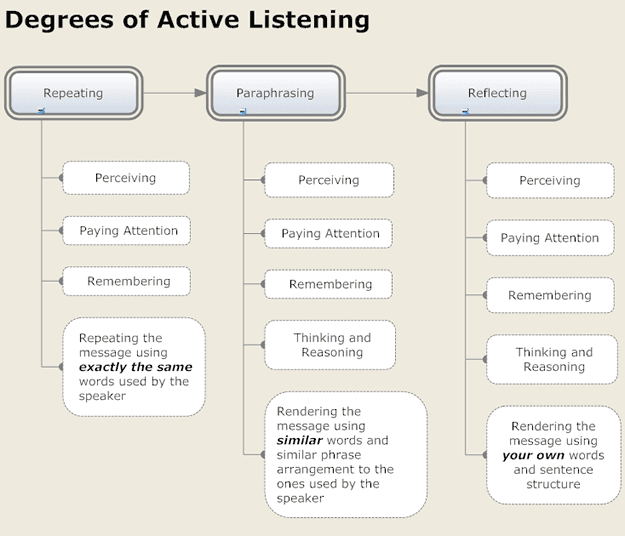
Understanding Listening | Boundless Communications View original
Is this image relevant?
One-on-One Audio Calls | Business Communication Skills for Managers View original
Is this image relevant?
The Three A’s of Active Listening | Public Speaking View original
Is this image relevant?
Understanding Listening | Boundless Communications View original
Is this image relevant?
Fundamental Elements of Active Listening
Active listening has five core components: paying attention, showing attentiveness, providing feedback, deferring judgment, and responding appropriately. Each one builds on the others.
Paying attention means more than just facing the speaker. You're maintaining eye contact, silencing distractions (put your phone away), and tracking both the speaker's words and their body language.
Showing attentiveness is how you signal to the speaker that you're engaged. This happens through nonverbal cues like nodding, maintaining an open posture (uncrossed arms, leaning slightly forward), and using facial expressions that match the tone of the conversation.
Providing feedback means actively checking your understanding through clarifying questions and paraphrasing:
- "Could you elaborate on how that process works?"
- "So, if I understand correctly, you're saying that..."
These aren't interruptions. They're tools that keep both people on the same page.
Advanced Techniques for Effective Listening
Deferring judgment means holding back your opinions or criticisms until the speaker finishes their thought. This does two things: it gives you a more complete picture of their perspective, and it signals that you respect what they have to say. People communicate more openly when they don't feel like they're about to be evaluated mid-sentence.
Responding appropriately means your feedback is honest but also considers the speaker's feelings. A few practical strategies:
- Use "I" statements to express your thoughts ("I understand," "I see what you mean")
- Acknowledge emotions directly ("It sounds like you're feeling frustrated about that")
Reflective listening takes this further by mirroring the speaker's tone and energy level. If someone is discussing a sensitive topic in a calm, serious voice, matching that tone helps build rapport. Responding with high energy in that moment would feel jarring and dismissive.
Nonverbal Cues in Listening

Body Language and Facial Expressions
A huge portion of communication is nonverbal. Your body language tells the speaker whether you're truly engaged or just going through the motions.
- Eye contact signals interest and respect, but cultural norms matter here. In some cultures, sustained direct eye contact can feel confrontational. Be aware of your audience.
- Open posture (uncrossed arms and legs) indicates you're receptive to the message. Crossed arms can unintentionally signal defensiveness or disagreement.
- Leaning slightly forward shows active engagement rather than passive reception.
- Facial expressions should be congruent with the speaker's message. Furrowing your brows shows concern; raising your eyebrows shows surprise. If your face is blank while someone shares something emotional, the disconnect undermines trust.
- Mirroring the speaker's body language (adopting a similar posture or gesturing style) naturally builds rapport and a sense of connection.
Paralinguistic Features and Gestures
Paralinguistic cues are the vocal elements beyond the words themselves: tone, pitch, volume, and pacing.
- Nod at appropriate intervals to acknowledge understanding and encourage the speaker to continue. Constant nodding, though, can seem automatic and insincere.
- Manage your vocal tone when responding. Monotone replies suggest boredom, even if your words say otherwise.
- Use hand gestures sparingly to emphasize points. Open palms, for instance, convey openness and honesty.
- Pay attention to the speaker's paralinguistic cues. A raised voice might indicate excitement or frustration, and the surrounding context tells you which. A drop in volume might signal vulnerability or uncertainty. These cues carry meaning that the words alone don't capture.
Paraphrasing and Summarizing for Understanding

Effective Paraphrasing Techniques
Paraphrasing means restating the speaker's message in your own words. The goal is to confirm that you actually understood what they meant, not just what they said.
The key is capturing the essence without parroting back their exact phrasing:
- Speaker: "I'm feeling overwhelmed with all the work I have to do."
- Paraphrase: "It sounds like you're experiencing a lot of stress due to your workload."
Notice how the paraphrase reflects both the content and the emotion. That's what makes it effective.
A few useful lead-in phrases:
- "So, what I'm hearing is..."
- "If I understand correctly, you're saying..."
Use paraphrasing at natural pauses rather than cutting the speaker off mid-thought. And always leave room for correction: "Is that an accurate reflection of what you meant?" This turns paraphrasing into a two-way check rather than a one-sided interpretation.
Summarizing for Clarity and Retention
While paraphrasing targets a specific point, summarizing condenses a longer stretch of information into its key ideas. Think of it as zooming out.
Summarizing is useful in several situations:
- After a complex explanation: "Let me make sure I've got this right. The process involves three main steps..."
- At the end of a conversation: "To recap the main points we've discussed..."
- When transitioning between topics: "Now that we've covered the project timeline, let's move on to resource allocation."
Summarizing in your own words also reinforces your own retention. You're not just passively receiving information; you're actively processing and organizing it. In a public speaking context, this is exactly the kind of listening that produces useful, specific feedback for a speaker.
Empathy in Active Listening
Understanding and Demonstrating Empathy
Empathy in listening means understanding and sharing the speaker's feelings, not just their ideas. It creates a supportive, non-judgmental space where people feel safe communicating honestly.
To practice empathetic listening, pay attention to emotional cues in the speaker's tone, body language, and word choice. A slight tremor in someone's voice might indicate nervousness. A long pause before answering might signal discomfort. These details matter.
Demonstrating empathy doesn't mean you have to agree with the speaker. It means you acknowledge their experience as valid:
- "I can see this situation is really challenging for you."
- "It sounds like you're feeling really frustrated with how things are going."
These reflective statements show the speaker that their emotions have been heard, which builds trust and encourages more open communication.
Balancing Empathy and Professionalism
Empathetic listening makes conversations more productive, but in professional or academic settings, you also need to balance compassion with objectivity.
For example, in a peer feedback session, you might acknowledge that a classmate feels nervous about their speech while still offering constructive criticism about their delivery. The empathy comes first, then the actionable feedback.
A practical sequence for balancing the two:
- Acknowledge the emotion: "I appreciate you sharing this with me. It must have been difficult to bring up."
- Validate the experience: Show that you understand their perspective, even briefly.
- Transition to action: "What do you think would be a good first step to address this?"
Recognizing when to shift from emotional support to problem-solving is a skill in itself. Staying in empathy mode too long can stall a conversation, while jumping to solutions too quickly can make the speaker feel dismissed. The goal is to make the person feel heard before you move toward next steps.
See Fiveable more often in Google
Mark Fiveable as a preferred source and Google is more likely to show you our guides in Top Stories, with a "preferred" badge in AI Mode and AI Overviews.