14.2 Barriers to Effective Listening

📞Intro to Public Speaking Unit 14 Review
14.2 Barriers to Effective Listening
📞 Intro to Public Speaking
Barriers to Effective Listening
Listening sounds passive, but it actually takes real mental effort. Several types of barriers can get in the way, from what's happening inside your own head to what's going on in the room around you. Understanding these barriers is the first step toward catching yourself when they show up.

Top images from around the web for Internal Obstacles
Elements of Speech Communication | Boundless Communications View original
Is this image relevant?
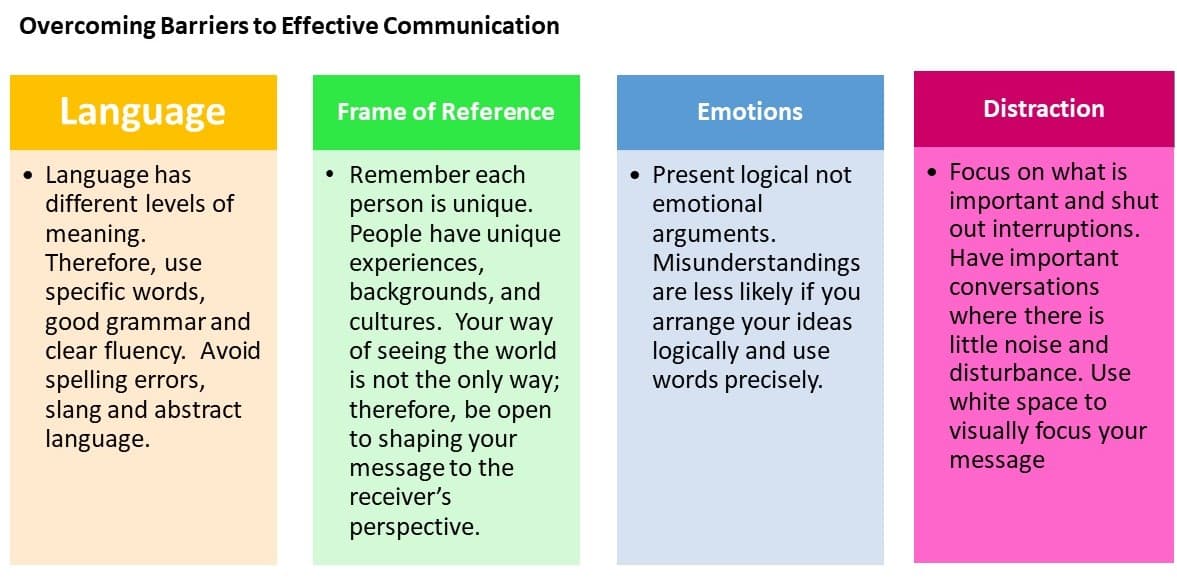
Unit 3: Troubleshooting Miscommunication – Communication Skills View original
Is this image relevant?
Elements of Speech Communication | Boundless Communications View original
Is this image relevant?
Unit 3: Troubleshooting Miscommunication – Communication Skills View original
Is this image relevant?
Internal Obstacles
Psychological noise refers to the mental chatter that pulls your attention away from a speaker. If you're worrying about a deadline or replaying an argument from that morning, you're not truly processing what someone is saying. This is probably the most common listening barrier, and it's the hardest to spot because it happens silently.
Physiological factors are the physical states that make it tough to concentrate:
- Fatigue from lack of sleep
- Hunger during a long class or meeting
- Physical discomfort from an awkward chair or a too-warm room
These seem minor, but they drain the mental energy you need for focused listening.
Selective perception happens when you zero in on certain parts of a message while tuning out the rest. For example, you might fixate on a speaker's accent instead of their actual argument, or only hear the negative comments in an otherwise positive performance review. You're technically listening, but you're filtering the message through a narrow lens.
Information overload sets in when too much content comes at you too fast. A speaker rattling through dense data slides or multiple people talking at once can overwhelm your ability to process anything meaningfully.
External Impediments
Environmental factors are the physical distractions that interfere with hearing or concentrating:
- Background noise from construction, hallway chatter, or HVAC systems
- Visual distractions like movement outside a window or a flickering screen
- Poor acoustics in large rooms where sound bounces or fades
Semantic barriers come from language itself. Technical jargon the audience doesn't know, idioms that don't translate across cultures, or ambiguous words with multiple meanings can all cause a listener to misunderstand or mentally check out. If a speaker uses the word "table" to mean "postpone a discussion" and you picture furniture, the message is lost.
Impact of Biases on Listening
Biases act like invisible filters between you and the speaker's actual message. You may not even realize they're shaping what you hear.
Cognitive Biases
Confirmation bias is the tendency to pay attention to information that supports what you already believe and to dismiss what contradicts it. A person skeptical of a proposal might latch onto every flaw the speaker mentions while ignoring strong supporting evidence.
Halo effect occurs when a single positive or negative trait colors how you evaluate everything a speaker says. If someone is well-dressed and confident, you might assume their argument is stronger than it actually is. Conversely, you might discount solid advice from someone who seems nervous or unkempt.
Recency bias gives disproportionate weight to whatever you heard last. In a 30-minute presentation, you're more likely to remember and be influenced by the final point than by an equally important point made in the first five minutes. This is why speakers often save their strongest argument for the end.
Social and Cultural Biases
Stereotyping means making assumptions about a speaker based on their group identity rather than their individual message. Assuming an older colleague can't understand technology or expecting all engineers to think alike are both forms of stereotyping that distort your listening.
Ethnocentrism is judging another culture's communication style by the standards of your own. You might interpret someone's directness as rudeness, or read their indirectness as evasiveness, when neither judgment is accurate within their cultural context.
Projection bias leads you to attribute your own feelings or thoughts to the speaker. If you're stressed, you might assume a colleague sounds angry when they're actually just tired. Or you might interpret someone's silence as agreement when they're simply thinking.

Strategies for Focused Listening
Active Engagement Techniques
Active listening means participating in the conversation even when you're the one receiving the message. Two of the most effective techniques:
- Paraphrasing: Restate the speaker's point in your own words ("So what you're saying is..."). This confirms understanding and shows the speaker you're engaged.
- Asking clarifying questions: Go beyond nodding along. Questions like "Can you give an example?" or "What do you mean by that?" deepen your comprehension.
The SOFTEN technique is a set of nonverbal behaviors that signal attentiveness:
- Smile to create a welcoming atmosphere
- Open posture to show receptiveness
- Forward lean to indicate interest
- Touch (when culturally appropriate) to establish connection
- Eye contact to maintain focus
- Nod to provide non-verbal feedback
Note-taking also helps you stay locked in. The Cornell method (dividing your page into a notes column, a cue column, and a summary section) works well for structured speeches. Mind mapping is a good alternative if you're a visual thinker.
Environmental and Mental Preparation
You can set yourself up for better listening before the speaker even starts:
- Minimize distractions: Choose a quiet spot for important conversations. In noisy environments, noise-cancelling headphones or simply moving to a different seat can help.
- Practice brief mindfulness: Even 60 seconds of focused breathing before a lecture or meeting can settle your attention.
- Prepare in advance: Review relevant background material so you're not hearing key terms for the first time. Set a clear intention for what you want to get out of the listening session.
- Monitor yourself: Do periodic self-checks during a speech. If you notice your mind wandering, acknowledge it and redirect your focus. This metacognitive habit gets easier with practice.
Cultural Differences in Listening
Listening norms are not universal. What counts as respectful, engaged listening in one culture may come across very differently in another.
Communication Style Variations
High-context vs. low-context communication is one of the biggest differences. In high-context cultures (such as Japan or many Middle Eastern countries), much of the meaning lives in nonverbal cues, tone, and shared context. In low-context cultures (such as the U.S. or Germany), people tend to state things explicitly in words. If you're a low-context listener hearing a high-context speaker, you might miss the real message entirely.
Turn-taking norms also vary. Some cultures view overlapping speech and brief interruptions as signs of enthusiasm and engagement. Others consider any interruption disrespectful. Neither approach is wrong; they're just different expectations.
Emotional expression differs too. Some cultures value restraint and composure during communication, while others encourage open displays of emotion. Misreading these norms can lead you to think a speaker doesn't care (when they're being composed) or is being unprofessional (when they're being expressive).
Cultural Value Orientations
- Power distance: In high power distance cultures, listeners may not question or challenge a speaker who holds authority. In low power distance cultures, open dialogue across hierarchies is expected and encouraged.
- Collectivism vs. individualism: Collectivist cultures tend to prioritize group harmony, so messages may be framed around consensus. Individualist cultures focus more on personal expression and direct opinions.
- Time orientation: Monochronic cultures (which value punctuality and structured agendas) expect listeners to stay focused on one topic at a time. Polychronic cultures are more flexible, and conversations may branch into multiple threads simultaneously.
Recognizing these differences won't make you an expert in every culture, but it will help you pause before assuming a speaker's behavior means what you think it means.
See Fiveable more often in Google
Mark Fiveable as a preferred source and Google is more likely to show you our guides in Top Stories, with a "preferred" badge in AI Mode and AI Overviews.