12.3 Ethical Persuasion Techniques

📞Intro to Public Speaking Unit 12 Review
12.3 Ethical Persuasion Techniques
📞 Intro to Public Speaking
Ethical Persuasion and Fallacies
Ethical persuasion is about influencing others honestly and respectfully, with the audience's well-being as a priority. This matters because persuasion built on trust and transparency is more effective in the long run than manipulation, and it's what separates responsible public speaking from propaganda.
A big part of staying ethical is understanding logical fallacies. These are reasoning errors that can creep into your arguments and destroy your credibility. Recognizing them helps you build stronger speeches and spot weak reasoning in others.

Top images from around the web for Foundations of Ethical Persuasion
Communicating Ethically | Communication for Professionals View original
Is this image relevant?
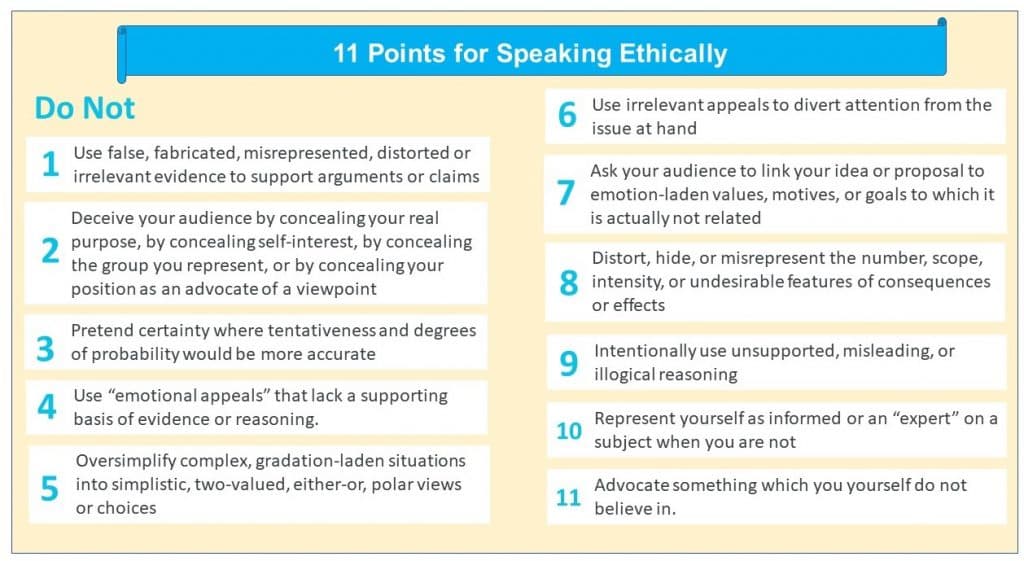
Unit 33: Informative and Persuasive Presentations – Communication Skills View original
Is this image relevant?
Logos, Ethos, Pathos | Introduction to College Composition View original
Is this image relevant?
Communicating Ethically | Communication for Professionals View original
Is this image relevant?
Unit 33: Informative and Persuasive Presentations – Communication Skills View original
Is this image relevant?
Foundations of Ethical Persuasion
Ethical persuasion means influencing people through honest, transparent, and respectful communication. Rather than tricking or pressuring your audience, you're giving them good reasons to agree with you while respecting their right to make up their own minds.
- Prioritizes the audience's autonomy (their ability to make informed decisions freely)
- Avoids manipulation, coercion, or deliberately misleading information
- Builds long-term trust and credibility with your audience
- Aligns with professional codes of conduct and broader societal values
The key distinction here is between persuasion and propaganda. Persuasion presents evidence and reasoning to help people reach a conclusion. Propaganda aims to manipulate or mislead, often by bypassing critical thinking altogether.
Understanding Fallacious Arguments
A fallacy is an error in reasoning that makes an argument logically invalid, even if it sounds convincing on the surface. Using fallacies undermines your credibility, and audiences who catch them will trust you less.
You need to watch for fallacies in two places: your own speeches and the arguments you're responding to. Here are the most common ones:
- Ad hominem: Attacking the person making the argument instead of addressing the argument itself
- Straw man: Misrepresenting someone's argument to make it easier to attack
- False dichotomy: Presenting only two options when more actually exist
- Slippery slope: Claiming one event will inevitably trigger a chain of negative consequences, without evidence for that chain
- Appeal to ignorance: Assuming something is true because it hasn't been proven false (or vice versa)
- Post hoc ergo propter hoc: Assuming that because event B followed event A, A must have caused B
These are covered in more detail with examples in the Logical Fallacies section below.
Principles of Persuasion
These principles, drawn from social psychology, describe patterns in how people are influenced. When used ethically, they can make your persuasive speeches significantly more effective.
Reciprocity in Persuasive Communication
Reciprocity is the social norm that compels people to return favors or gestures. When someone does something for you, you feel a pull to do something back.
In a speech, this means offering your audience something valuable before making your request. If you give them useful information, a new perspective, or a practical resource, they're more inclined to consider your position.
- Providing free, genuinely helpful advice before asking for support on an issue
- Sharing valuable data or insights that benefit the audience before presenting your call to action

Leveraging Social Proof
Social proof is the psychological tendency to look at what other people are doing when deciding how to act. If many people support something, others are more likely to follow.
You can use social proof ethically by citing real evidence of widespread support or adoption:
- Testimonials from satisfied customers or respected individuals
- Statistics showing broad approval or participation (e.g., "9 out of 10 dentists recommend this toothpaste")
- Case studies demonstrating successful outcomes
The ethical line here: the evidence you cite needs to be real and representative. Cherry-picking misleading statistics crosses into manipulation.
Authority Principle in Persuasion
People are more likely to be persuaded by someone they view as a credible expert. The authority principle means that perceived expertise increases your persuasive power.
You can apply this by:
- Establishing your own qualifications and experience on the topic
- Citing endorsements or findings from respected figures in the field
- Referencing credible research and data sources
For example, a doctor recommending a treatment carries more weight than a random endorsement. But be careful: citing authority figures outside their area of expertise (like a celebrity endorsing a medical product) weakens this principle and can feel manipulative.
Balancing Persuasion Principles
No single principle works in isolation. The most persuasive speeches combine reciprocity, social proof, and authority strategically. But you always need to consider your specific audience's demographics, cultural norms, and the ethical boundaries of the situation. Using these principles to inform and empower your audience is ethical. Using them to exploit or deceive is not.
Emotional Appeals in Communication

Understanding Pathos in Persuasion
Pathos is one of Aristotle's three modes of persuasion (alongside logos and ethos). It involves engaging your audience's feelings and values to influence their attitudes or behaviors.
Effective emotional appeals rely on:
- Storytelling that creates personal connections between the audience and the issue
- Vivid imagery that helps the audience feel the reality of a situation
- Relatable examples that connect to experiences your audience has actually had
Pathos works because people don't make decisions based on logic alone. Emotions drive action. A statistic about homelessness informs; a story about one person's experience with homelessness motivates.
Responsible Use of Emotional Appeals
Emotional appeals become unethical when they manipulate rather than illuminate. The goal is to help your audience connect emotionally with a real issue, not to exploit their fears or vulnerabilities.
Guidelines for responsible use:
- Keep emotional appeals authentic and directly relevant to your topic
- Respect your audience's emotional well-being; avoid fear-mongering or guilt-tripping
- Balance emotional content with logical evidence and credible sources
- Consider how different segments of your audience might react to emotionally charged content
For instance, using a personal anecdote to illustrate how a policy affects real people is ethical. Fabricating or exaggerating a story to provoke outrage is not.
Enhancing Persuasive Impact
The strongest persuasive speeches combine all three of Aristotle's appeals:
- Pathos (emotion) to make the audience care
- Logos (logic) to give them reasons to agree
- Ethos (credibility) to make them trust you
Pairing an emotional story with hard statistical data, or combining expert testimony with a relatable personal experience, creates arguments that are both compelling and well-supported. This balance is what separates truly persuasive speaking from empty rhetoric.
Logical Fallacies in Arguments
Common Logical Fallacies
These are the fallacies you'll encounter most often in persuasive contexts. Learn to spot them in others' arguments and in your own drafts.
- Ad hominem: Attacks the person rather than their argument
- Example: "You can't trust his economic policy because he's never run a business." (His business experience is irrelevant to whether the policy itself is sound.)
- Straw man: Misrepresents or oversimplifies an opponent's position to make it easier to refute
- Example: "Those who support gun control want to abolish the Second Amendment entirely." (Most gun control advocates aren't calling for total abolition.)
- False dichotomy: Frames a situation as having only two options when more exist
- Example: "Either we cut all social programs or we'll go bankrupt as a nation." (There are many options between those two extremes.)
- Slippery slope: Claims one action will inevitably lead to a chain of extreme consequences, without evidence for each link in the chain
- Example: "If we legalize marijuana, soon all drugs will be legal, and society will collapse."
Additional Fallacies to Avoid
- Appeal to ignorance: Treats the absence of disproof as proof
- Example: "No one has proven ghosts don't exist, so they must be real." (Lack of disproof doesn't equal evidence.)
- Post hoc ergo propter hoc ("after this, therefore because of this"): Assumes that because one event followed another, the first caused the second
- Example: "I wore my lucky socks and we won the game, so my socks caused our victory."
- Bandwagon fallacy: Argues something is true or right simply because it's popular
- Example: "Everyone is buying this product, so it must be the best." (Popularity doesn't guarantee quality.)
- Appeal to nature: Assumes that something is good or correct just because it's natural
- Example: "Herbal supplements are better than pharmaceuticals because they're natural." (Plenty of natural substances are harmful, and plenty of synthetic ones are safe.)
See Fiveable more often in Google
Mark Fiveable as a preferred source and Google is more likely to show you our guides in Top Stories, with a "preferred" badge in AI Mode and AI Overviews.