3.4 Cultural Considerations in Public Speaking

📞Intro to Public Speaking Unit 3 Review
3.4 Cultural Considerations in Public Speaking
📞 Intro to Public Speaking
Cultural differences in audience perception
Culture shapes how people interpret messages. Two speakers can say the exact same words, but audiences from different cultural backgrounds may walk away with very different understandings. Recognizing these differences helps you craft a presentation that actually lands with your specific audience.

Top images from around the web for High-context vs. low-context communication
Finding the Purpose and Central Idea of Your Speech | Public Speaking View original
Is this image relevant?
Culture ad alto e basso contesto - High-context and low-context cultures - abcdef.wiki View original
Is this image relevant?
Elements of Speech Communication | Boundless Communications View original
Is this image relevant?
Finding the Purpose and Central Idea of Your Speech | Public Speaking View original
Is this image relevant?
Culture ad alto e basso contesto - High-context and low-context cultures - abcdef.wiki View original
Is this image relevant?
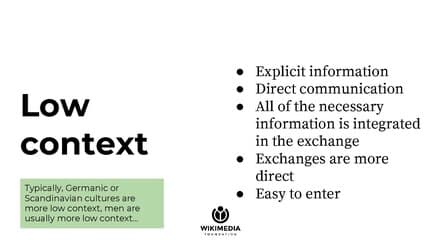
High-context vs. low-context communication
This distinction, developed by anthropologist Edward T. Hall, describes how much of a message's meaning comes from the words themselves versus the surrounding context.
- High-context cultures rely heavily on implicit communication. The audience expects meaning to come through tone, body language, shared history, and what's not said as much as what is. Examples include Japan, China, and many Arab countries.
- Low-context cultures emphasize explicit, direct verbal messages. The audience wants you to say exactly what you mean. Examples include the United States, Germany, and Scandinavian countries.
How to adapt:
- For high-context audiences, use more subtle, indirect phrasing and pay close attention to non-verbal delivery.
- For low-context audiences, state your points clearly and don't rely on the audience to "read between the lines."
Individualism vs. collectivism
This cultural dimension affects what kind of appeals and examples resonate with your audience.
- Individualistic cultures (United States, Australia, United Kingdom) value personal achievement and self-expression. Audiences tend to respond well to speakers who share unique perspectives and personal stories.
- Collectivistic cultures (many Asian, African, and Latin American countries) prioritize group harmony and cooperation. Audiences respond better when speakers emphasize community, shared goals, and collective benefit.
A practical way to adapt: pay attention to your pronoun choices. "I" statements and personal anecdotes work well for individualistic audiences. "We" language and group-oriented framing work better for collectivistic ones.
Power distance and uncertainty avoidance
These are two more cultural dimensions (from Geert Hofstede's research) that affect audience expectations.
- Power distance describes how much a culture accepts unequal distributions of authority.
- High power distance cultures (e.g., Malaysia, Philippines) expect formal, hierarchical communication. The speaker is seen as an authority figure.
- Low power distance cultures (e.g., Denmark, Israel) prefer egalitarian, conversational speakers who engage the audience as equals.
- Uncertainty avoidance describes how comfortable a culture is with ambiguity.
- High uncertainty avoidance cultures (e.g., Greece, Portugal) prefer structured, detailed presentations with clear conclusions.
- Low uncertainty avoidance cultures (e.g., Singapore, Jamaica) are more comfortable with flexible, open-ended discussions.
Adjust your presentation style accordingly. A formal tone with clear structure suits high power distance, high uncertainty avoidance audiences. A casual, interactive approach works better for the opposite end of the spectrum.
Sensitivity to cultural norms

Researching audience background
Before you speak, do your homework on who's in the room. Here's a practical approach:
- Gather demographic information about your audience's cultural composition. If you're speaking at an event, ask the organizers.
- Research specific cultural norms that could affect your presentation. Consult academic sources, cultural guides, or people from that background.
- Identify key factors that shape audience expectations: religious beliefs, social hierarchies, traditional customs, and communication etiquette.
- Adapt your content and delivery based on what you find:
- Adjust formality level (formal greetings in Japan vs. a casual approach in Australia)
- Modify directness (indirect communication in Thailand vs. direct style in Germany)
- Tailor humor carefully (self-deprecating humor works in the United Kingdom; sarcasm can fall flat or offend in many Asian cultures)
Non-verbal communication and cultural sensitivity
Your body language communicates just as much as your words, and the meaning of non-verbal cues varies widely across cultures.
- Eye contact: Sustained eye contact signals confidence in many Western cultures, but can feel confrontational or disrespectful in some Middle Eastern and East Asian contexts.
- Gestures: The "OK" hand sign is offensive in Brazil. In Korea, giving or receiving something with both hands shows respect. Research gesture meanings before you speak.
- Personal space: North American audiences generally expect more distance between speaker and listener; Latin American audiences are often comfortable with closer proximity.
Beyond body language, be aware of cultural taboos. Discussing death casually can be offensive in Chinese culture. Showing the soles of your feet is disrespectful in many Arab countries. These are the kinds of things that can derail an otherwise strong presentation if you haven't done your research.
When choosing examples and references, make them culturally relevant. Use local historical events, well-known figures, or familiar cultural touchpoints. A baseball metaphor works for a U.S. audience; a cricket reference connects better with an Indian audience.
Language considerations
If your audience includes non-native speakers of your language, a few adjustments make a big difference:
- Simplify vocabulary. Avoid complex jargon, slang, and idiomatic expressions. "It's raining cats and dogs" means nothing to someone who hasn't heard that phrase before.
- Slow down slightly and enunciate clearly. You don't need to be dramatic about it, just deliberate.
- Use visual aids to reinforce key points. Seeing a concept alongside hearing it helps bridge language gaps.
- Keep sentence structures simple. This also helps interpreters if your speech is being translated live.
- Avoid puns and culture-specific idioms. These almost never translate well.
Finally, check your own cultural lens. Reflect on assumptions you might be making, and seek feedback from culturally diverse people before your presentation to catch blind spots you didn't know you had.
Avoiding stereotypes and ethnocentric language

Understanding stereotypes and ethnocentrism
Stereotypes are oversimplified generalizations about a group of people. Even "positive" stereotypes (like assuming all Asians are good at math) reduce individuals to a single trait and can alienate your audience.
Ethnocentrism means judging other cultures by the standards of your own, treating your cultural norms as the default or "correct" way. This can sneak into a speech through word choices, examples, or assumptions. Describing another culture's traditional food as "weird," for instance, is ethnocentric.
Both stereotypes and ethnocentrism damage your credibility and can make audience members feel excluded or disrespected.
Strategies for culturally sensitive communication
- Use specific, factual language instead of generalizations. Rather than "All Italians are passionate," try "Italian culture often values expressive communication."
- Acknowledge diversity within cultural groups. Avoid essentialist statements like "The Chinese always..." No culture is monolithic.
- Evaluate your sources. Make sure the cultural information you're drawing on comes from reputable, diverse sources. Cross-reference multiple perspectives.
- Get feedback. Before your speech, ask people from diverse backgrounds to review your content. They can spot unintended stereotypes or ethnocentric framing that you might miss.
Inclusive language for diverse audiences
Gender-inclusive language
Use gender-neutral terms to make all audience members feel included.
- Replace gendered defaults with neutral alternatives: "chairperson" instead of "chairman," "firefighter" instead of "fireman."
- Use singular "they" when referring to a non-specific individual. This is widely accepted in both spoken and written English.
- Avoid assumptions about gender roles. If you're using examples or scenarios, represent a range of gender identities and don't default to stereotypical roles.
Representing diverse experiences
Your examples and stories shape how inclusive your speech feels. A few guidelines:
- Draw examples from a wide range of cultural backgrounds. Include stories and achievements from underrepresented groups.
- Use diverse names and cultural contexts in hypothetical scenarios rather than defaulting to one cultural perspective.
- Consider socioeconomic diversity too. Don't assume everyone in your audience has had the same economic experiences. Vary the contexts in your examples.
- Recognize intersectionality: people hold multiple identities (race, gender, class, ability) that overlap and interact. Avoid reducing anyone to a single identity category.
Accessible and respectful language
- Disability: Use person-first language as a default ("person with a disability" rather than "disabled person"). That said, some communities prefer identity-first language ("Deaf person," "autistic person"), so know your audience when possible.
- Religion: Use secular language or balanced religious references. Don't assume your audience shares a single set of religious beliefs.
- Presentation design: Apply universal design principles to your visual aids. Include captions on videos, use alt text for images, and choose high-contrast color schemes. These choices make your presentation accessible to audience members with different sensory abilities and learning styles.
See Fiveable more often in Google
Mark Fiveable as a preferred source and Google is more likely to show you our guides in Top Stories, with a "preferred" badge in AI Mode and AI Overviews.