1.2 Communication Models and Processes

📞Intro to Public Speaking Unit 1 Review
1.2 Communication Models and Processes
📞 Intro to Public Speaking
Communication models give us a framework for understanding how messages travel between people. They break the process into parts like sender, receiver, and channel, and they've evolved over time from simple one-way diagrams to more realistic, interactive concepts.
For public speaking, these models matter because they help you think systematically about your audience, anticipate barriers, and adjust your message on the fly. A speaker who understands how communication actually works can build stronger connections and deliver more effective presentations.
Communication Models and Components
Linear and Interactive Models
The linear model is the simplest way to picture communication: a message moves in one direction, from sender to receiver, through a channel. Think of it like a radio broadcast. The speaker talks, the listener receives, and that's it. It's a useful starting point, but it's also an oversimplification because real communication rarely works in just one direction.
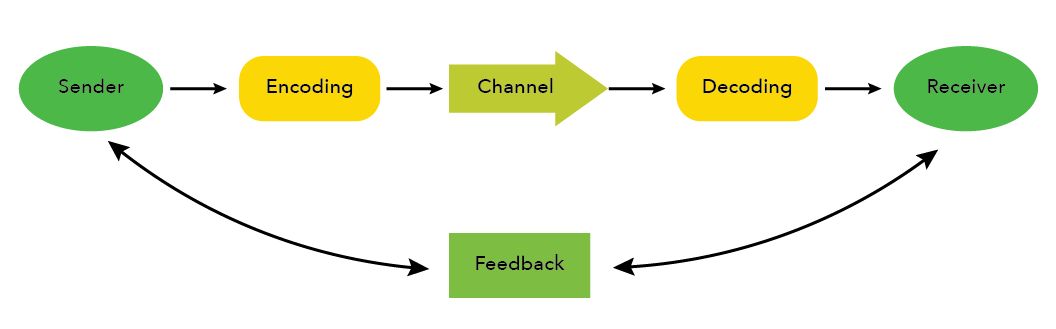
The interactive model builds on the linear model by adding two-way exchange. It introduces several important concepts:
- Encoding: the sender translates thoughts into symbols (words, gestures, images)
- Decoding: the receiver interprets those symbols back into meaning
- Noise: any interference that distorts the message (more on this below)
- Feedback: the receiver's response, which flows back to the sender
The interactive model is more realistic because it acknowledges that communication is a back-and-forth process, not a one-way street.
Advanced Communication Models
The transactional model takes things further. Instead of treating sending and receiving as separate steps, it recognizes that both happen simultaneously. While you're speaking, you're also reading your audience's body language. While they're listening, they're sending you nonverbal feedback. Communication is dynamic and ongoing, with roles constantly shifting.
Shannon and Weaver's mathematical model was originally designed for telephone engineering, but it introduced components that are still useful today:
- Information source: where the message originates
- Transmitter: encodes the message for sending
- Channel: the medium the message travels through
- Receiver: decodes the message
- Destination: the final recipient
This model is especially helpful for identifying where breakdowns happen in the communication chain.
Schramm's model emphasizes the role of shared experience. Two people can only communicate effectively to the extent that their backgrounds, knowledge, and experiences overlap. The greater the overlap, the better the understanding. This is why a speaker who knows their audience's frame of reference communicates more effectively than one who doesn't.
The constitutive model shifts the focus entirely. Rather than treating communication as transmitting information from one person to another, it views communication as a process where meaning is co-created by everyone involved. The message isn't just "sent" and "received"; it's built together through interaction.
Key Components of Communication Models
Across all these models, the same core components keep appearing:
- Sender: initiates the communication
- Receiver: interprets and responds to the message
- Message: the information being communicated
- Channel: the medium used to transmit the message (verbal, nonverbal, written, digital)
- Feedback: the receiver's response or reaction
- Context: the surrounding environment and circumstances
- Noise: any interference that disrupts the process
Context in Communication
Context is everything that surrounds and shapes a communication event. The same words can land completely differently depending on when, where, and between whom they're spoken.
Types of Communication Context
Situational context refers to the immediate environmental factors:
- Time of day (a morning keynote vs. an after-lunch session when energy is low)
- Physical location (a formal auditorium vs. a casual classroom)
- Nature of the event (a job interview vs. a team brainstorm)
Cultural context shapes communication norms and expectations:
- Shared beliefs and values, such as individualism vs. collectivism
- Cultural practices like greeting customs and personal space norms
- Communication styles, particularly direct vs. indirect approaches
Social context involves the relationships and roles between communicators:
- Power dynamics (boss-employee, teacher-student)
- Familiarity level (close friends vs. strangers)
- Group size (one-on-one conversation vs. a large audience)
Influence of Context on Communication
Historical context considers past events and shared experiences. Two colleagues who went through a company crisis together will communicate differently than two people meeting for the first time. Broader societal events, like an economic downturn or a political shift, also shape how people interpret messages.
Psychological context includes the mental and emotional states of the communicators:
- Mood and emotions (stress, excitement, anxiety)
- Personal biases and preconceptions
- Cognitive factors like attention span and information processing ability
These different types of context don't exist in isolation. They interact with each other in ways that make communication complex. Cultural norms might clash with situational expectations. A person's psychological state might be shaped by historical events. Social roles can shift depending on the physical setting. Effective speakers pay attention to all of these layers.
Barriers to Effective Communication
Barriers are anything that prevents a message from being received as intended. Recognizing them is the first step toward overcoming them.
Physical and Physiological Barriers
Physical barriers impede the transmission of the message itself:
- Environmental noise, such as construction sounds or background chatter
- Distance between communicators (face-to-face vs. remote communication)
- Technical issues like a poor internet connection or a faulty microphone
Physiological barriers relate to the physical condition of the communicators:
- Hearing impairments that make it difficult to perceive auditory cues
- Visual impairments that create challenges with written or visual materials
- Fatigue or illness that reduce concentration and comprehension

Language and Semantic Barriers
Language barriers arise from linguistic differences between communicators:
- Vocabulary gaps, such as when a speaker uses technical jargon that the audience doesn't know
- Dialectal variations, including regional accents or local expressions
- Non-native language use, where limited fluency can lead to misinterpretation of idioms or phrasing
Semantic barriers involve differences in how words are interpreted. Even when two people speak the same language, ambiguous phrasing can cause confusion. A word's connotation might vary across cultures or individuals. And specialized terminology that's second nature to the speaker may be completely unfamiliar to the audience.
Psychological and Cultural Barriers
Psychological barriers stem from mental and emotional factors:
- Preconceptions and stereotypes that color how a message is interpreted
- Emotional states that affect how receptive someone is (an anxious listener may miss key points)
- Cognitive biases like confirmation bias, where people only hear what supports their existing beliefs
Cultural barriers arise when communicators come from different cultural backgrounds:
- Differing communication styles, such as high-context cultures (where meaning is often implied) vs. low-context cultures (where meaning is stated explicitly)
- Nonverbal differences in gestures, eye contact, and personal space
- Conflicting values or beliefs that affect how a message is received
Communication Models for Public Speaking
Applying Transactional and Schramm's Models
The transactional model is particularly relevant to public speaking because it captures what actually happens in a live speech. You're not just broadcasting a message; you're simultaneously sending verbal content and reading your audience's nonverbal feedback. If you notice confused faces, you slow down. If you see nodding, you know you're connecting. This model reminds you that the audience is an active participant, not a passive receiver.
Schramm's model guides you to think about shared experience. Before you speak, consider: what does your audience already know? What references will resonate with them? Selecting relatable examples and analogies, and building common ground early in your speech, directly applies Schramm's insight that meaning depends on overlapping experience.
Utilizing Constitutive and Shannon-Weaver Models
The constitutive model encourages you to view your speech as a collaborative process rather than a one-way delivery. Practical applications include building in interactive elements like Q&A sessions, audience polls, or moments of reflection. When you treat the audience as co-creators of meaning, engagement goes up.
Shannon and Weaver's model is most useful for troubleshooting. It helps you identify potential sources of noise before they become problems. Will the room have echo? Is the projector reliable? Is the microphone working? By thinking through each link in the communication chain, you can develop strategies to minimize interference.
Practical Applications in Public Speaking
The interactive model's emphasis on feedback translates directly to delivery skills. Effective speakers monitor audience reactions, including facial expressions, body language, and energy level, and adjust their content and pacing accordingly. Building in moments for audience questions also creates a feedback loop that strengthens communication.
More broadly, communication models guide your entire approach to public speaking:
- Audience analysis: Tailor your content to your audience's background, knowledge, and experiences
- Channel selection: Choose appropriate supporting tools (visual aids, handouts, demonstrations) based on what will transmit your message most effectively
- Barrier anticipation: During speech preparation, identify potential barriers and plan how to address them
- Speech structure: Organize content so that it builds shared understanding progressively, moving from familiar concepts to new ideas
No single model captures everything about communication, but together they give you a toolkit for thinking about every stage of the speaking process, from preparation through delivery.
See Fiveable more often in Google
Mark Fiveable as a preferred source and Google is more likely to show you our guides in Top Stories, with a "preferred" badge in AI Mode and AI Overviews.