8.5 The Internal Environment

👔Principles of Management Unit 8 Review
8.5 The Internal Environment
👔 Principles of Management
8.1
Gaining Advantages by Understanding the Competitive Environment
8.2
Using SWOT for Strategic Analysis
8.3
A Firm's External Macro Environment: PESTEL
8.4
A Firm's Micro Environment: Porter's Five Forces
8.5
The Internal Environment
8.6
Competition, Strategy, and Competitive Advantage
8.7
Strategic Positioning
Internal Analysis
Internal analysis helps managers figure out what their company does well and where it falls short. By evaluating key resources, capabilities, and value chain activities, leaders can pinpoint competitive advantages and spot areas that need improvement. This drives smarter strategic decisions and better resource allocation.
Key Resources and Capabilities
Managers start by assessing the firm's strengths and weaknesses. Strengths give the firm a competitive edge, like a strong brand reputation or proprietary technology. Weaknesses are deficiencies that hold the firm back, such as outdated equipment or high employee turnover.
The assets a firm uses to develop, produce, and deliver its offerings are its key resources, and they come in three types:
- Tangible resources are physical assets like manufacturing plants, equipment, and distribution centers.
- Intangible resources are non-physical assets like patents, trademarks, and customer loyalty. These are often harder for competitors to copy, which makes them especially valuable.
- Human resources encompass employees' knowledge, skills, and experience. A team of skilled engineers or a talented salesforce can be a major source of advantage.
Having resources isn't enough on its own. Capabilities refer to the firm's ability to deploy those resources effectively. When a capability is distinctive enough to set the firm apart from rivals, it becomes a core competency. Toyota's lean manufacturing expertise is a classic example: many competitors have similar factory equipment, but Toyota's ability to use those resources with exceptional efficiency is what differentiates it.
Managers rely on several tools to analyze resources and capabilities:
- Financial analysis examines metrics and ratios like profitability and liquidity to gauge financial health.
- Benchmarking compares the firm's performance against industry standards or specific competitors on measures like market share or customer satisfaction scores.
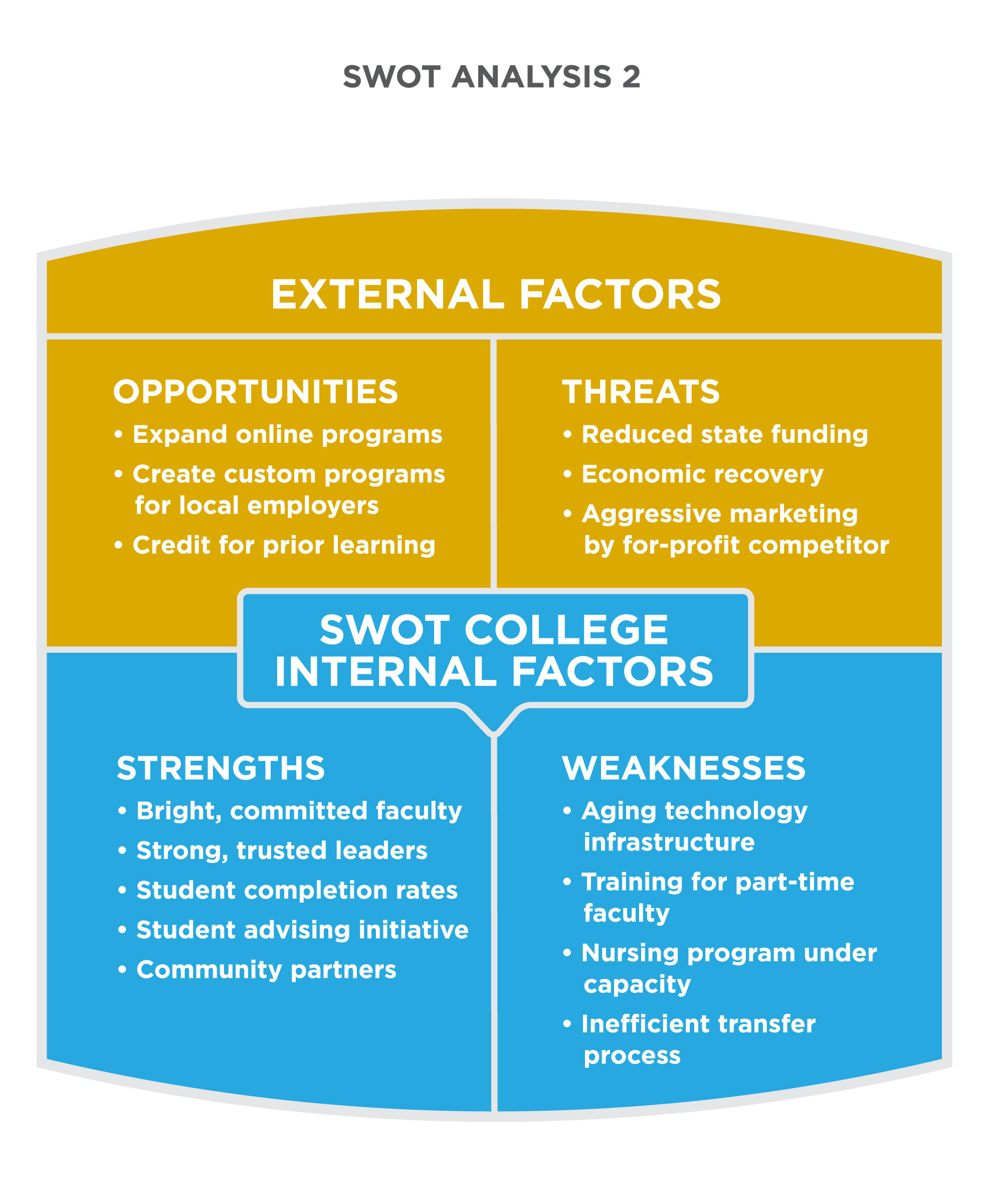
- SWOT analysis maps internal strengths and weaknesses against external opportunities and threats (such as shifting consumer preferences or new regulations).
The resource-based view (RBV) ties all of this together. It's a perspective in strategic management arguing that unique, valuable resources are the primary source of sustained competitive advantage.

Components of the Firm's Value Chain
The value chain breaks down everything a firm does into discrete activities and examines how each one contributes to competitive advantage. Michael Porter developed this framework, dividing activities into two categories.
Primary activities directly create value for the customer:
- Inbound logistics covers receiving, storing, and distributing inputs like raw materials and components.
- Operations transforms those inputs into finished products or services through manufacturing, assembly, or similar processes.
- Outbound logistics handles storing and distributing the finished offerings, including warehousing and shipping.
- Marketing and sales promotes and sells offerings through advertising, pricing strategies, and sales channels.
- Service provides post-sale support such as installation, repair, and customer assistance.
Support activities enable and enhance the primary activities:
- Firm infrastructure includes general management functions like accounting, legal, and strategic planning.
- Human resource management handles recruiting, training, compensation, and retention.
- Technology development improves products and processes through R&D, automation, and IT systems.
- Procurement manages purchasing inputs and supplier relationships, including contract negotiation and quality control.
These activities contribute to competitive advantage in three main ways:
- Reducing costs through efficiency and economies of scale. Walmart's tightly integrated supply chain management is a textbook example of wringing cost out of logistics and operations.
- Differentiating offerings with unique features or superior quality. Apple's investment in design and user experience across its value chain lets it charge premium prices.
- Targeting specific segments by tailoring activities to a niche. Whole Foods built its entire value chain around sourcing and selling organic and natural products.
VRIO Framework for Competitive Advantage
The VRIO framework evaluates whether a specific resource or capability can provide sustained competitive advantage. It tests four criteria, and a resource needs to pass all four:
- Valuable: Does it help the firm exploit opportunities or neutralize threats? Strong brand equity, for example, increases customers' willingness to pay a premium.
- Rare: Do few or no competitors possess it? Coca-Cola's proprietary formula is a resource almost no one else has.
- Inimitable: Is it difficult for others to copy or substitute? Resources can be hard to imitate for several reasons:
- Unique historical conditions shaped the resource over time (Walmart's early adoption of information technology gave it a head start rivals couldn't easily replicate).
- Causal ambiguity means outsiders can't clearly identify the link between the resource and the firm's performance.
- Social complexity involves things like a deeply embedded organizational culture or trust-based relationships that can't simply be purchased or built overnight.
- Organized: Is the firm structured to fully exploit the resource? Even a valuable, rare, inimitable resource won't help if the organization's processes, culture, or hierarchy prevent it from being used effectively. A flat organizational structure, for instance, can facilitate the rapid innovation needed to leverage a technology advantage.
Resources meeting all four VRIO criteria provide sustained competitive advantage. Those meeting only some criteria may offer a temporary advantage or simply competitive parity (keeping up with rivals, but not pulling ahead).
VRIO helps managers prioritize where to invest, identify which advantages need protecting, and evaluate how durable the firm's competitive position really is.
Strategic Management and Governance
Strategic management is the process of aligning organizational resources with long-term goals and objectives. It connects internal analysis to actual decision-making about where the firm is headed.
Stakeholder theory broadens the lens beyond just shareholders. It holds that managers should consider the interests of all groups affected by the firm's actions, including employees, customers, suppliers, and the surrounding community. These relationships can themselves become sources of competitive advantage.
Corporate governance refers to the systems and structures that ensure proper oversight and accountability in decision-making. Boards of directors, audit committees, and executive compensation policies are all governance mechanisms designed to keep leadership aligned with the firm's strategic interests.
Organizational structure supports strategy implementation by defining how authority, communication, and resources flow through the firm. The right structure helps a firm execute its strategy; the wrong one creates bottlenecks and misalignment.
See Fiveable more often in Google
Mark Fiveable as a preferred source and Google is more likely to show you our guides in Top Stories, with a "preferred" badge in AI Mode and AI Overviews.