10.2 Organizational Change

👔Principles of Management Unit 10 Review
10.2 Organizational Change
👔 Principles of Management
Types and Dimensions of Organizational Change
Organizational change comes in various forms and dimensions. From structural shifts to cultural transformations, change can be incremental or revolutionary. Understanding these types and dimensions helps managers navigate the complex process of organizational evolution.
The organizational life cycle also plays a key role in shaping structure and change. As companies grow from entrepreneurial startups to mature corporations, they face unique challenges at each stage. Recognizing these phases helps leaders adapt their approach to management and organizational design.
Types and Dimensions of Organizational Change
Types of organizational change
Structural change involves altering the organization's hierarchy, authority relationships, and coordination mechanisms. This could mean reorganizing departments, adding or removing management layers, or changing the span of control. For example, a company might flatten its hierarchy by eliminating middle management positions to speed up decision-making.
Technological change involves introducing new equipment, tools, or methods to improve operational efficiency. Think of a manufacturer automating its assembly line, a retailer adopting a new inventory management system, or a hospital implementing electronic health records. The goal is doing work faster, cheaper, or better.
Cultural change involves modifying the organization's values, beliefs, norms, and expectations. This is often the hardest type to pull off because it requires shifting how people think and behave, not just what systems they use. Examples include promoting a customer-centric mindset, encouraging innovation and risk-taking, or fostering a more diverse and inclusive workplace. Cultural change requires addressing organizational culture, the shared values, beliefs, and behaviors that shape the organization's identity and guide employee actions.

Dimensions of change
Scope of change refers to the extent and depth of the change initiative:
- Incremental change involves small, gradual adjustments to existing processes or structures. It aims to improve efficiency and effectiveness without major disruptions. Resistance tends to be lower because the changes feel manageable.
- Transformational change involves significant, fundamental shifts in the organization's strategy, structure, or culture. It aims to redefine the organization's purpose, values, or competitive advantage. A company pivoting its entire business model (like Netflix moving from DVD rentals to streaming) is transformational change.
Level of change refers to where in the organizational hierarchy the change occurs:
- Individual level involves changes in employees' roles, responsibilities, or behaviors (training, coaching, performance management)
- Group level involves changes in team dynamics, processes, or structures (team building, cross-functional collaboration, restructuring project teams)
- Organizational level involves changes that affect the entire organization (mergers, acquisitions, strategic shifts)
These levels often interact. An organizational-level merger, for instance, triggers group-level restructuring and individual-level role changes.
Intentionality of change refers to whether the change is planned or unplanned:
- Planned change involves deliberate, proactive efforts to improve organizational performance. It follows a systematic process: diagnosis, design, implementation, and evaluation. An example is a company deciding to restructure its sales division after analyzing declining performance.
- Unplanned change involves reactive responses to unexpected events or crises. It requires rapid adaptation and flexibility to minimize disruptions. A sudden supply chain disruption or a global pandemic forcing remote work are examples of unplanned change.
Change Management and Resistance
Change management is the systematic approach to dealing with organizational transitions, with a particular focus on the people side of change. Even a well-designed change initiative will fail if the people affected by it don't buy in.
Resistance to change is one of the most common challenges managers face during change efforts. Employees may resist because of fear of the unknown, uncertainty about their job security, loss of control over their work, or simply comfort with the status quo. Effective managers anticipate resistance and address it through communication, participation, and support rather than ignoring it or forcing compliance.
Change agents are the individuals who facilitate and implement change initiatives. They can be internal (managers, team leaders) or external (consultants, specialists). Their role is to champion the change, build support, and guide the organization through the transition.
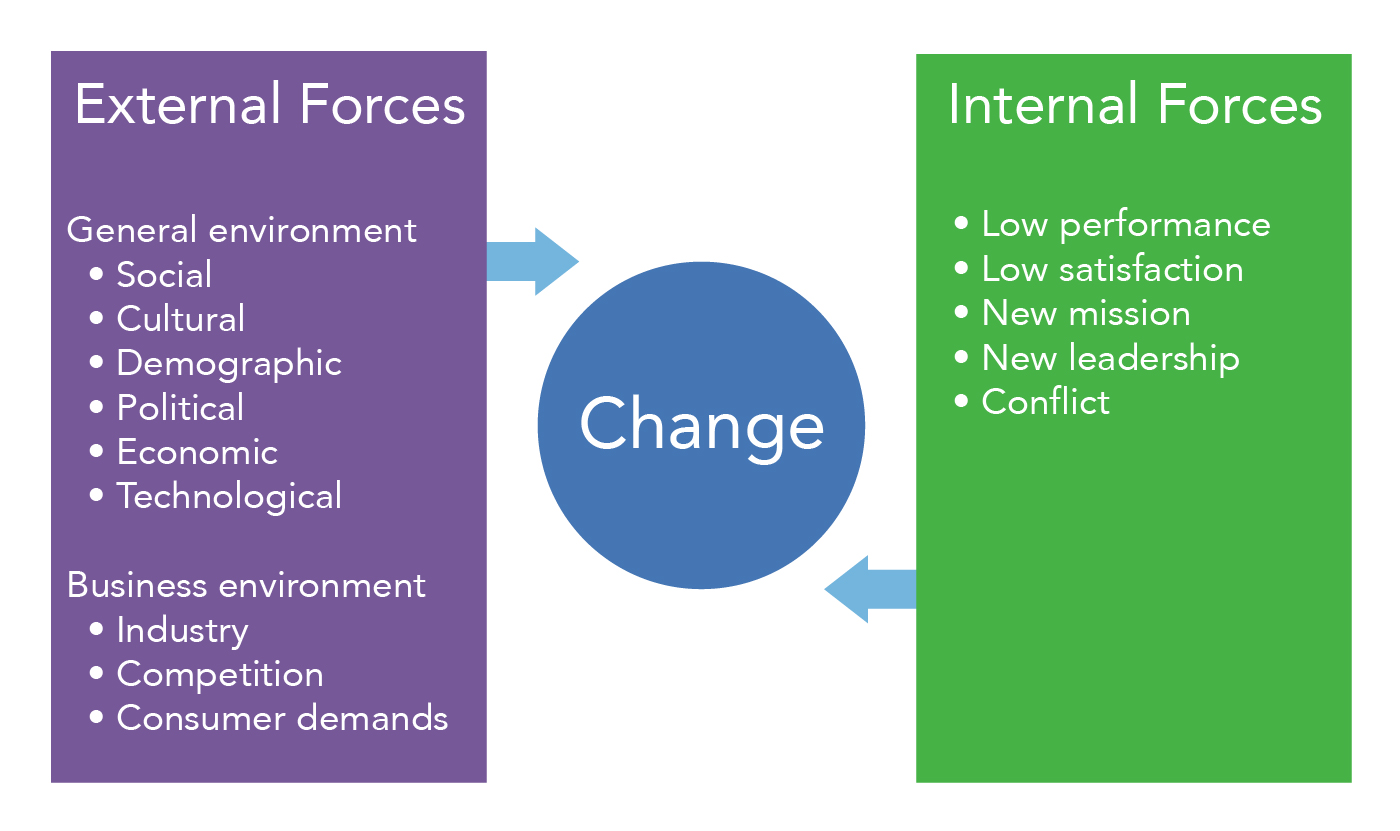
Kurt Lewin's force field analysis is a practical tool for understanding change situations. The idea is straightforward: any situation has driving forces pushing toward change and restraining forces pushing against it. Change happens when driving forces outweigh restraining forces. Managers can use this framework to identify which restraining forces to reduce and which driving forces to strengthen.
Organizational development (OD) is a planned, systematic approach to improving organizational effectiveness through interventions in the organization's processes, structure, and culture. OD takes a long-term view and typically involves data collection, diagnosis, and collaborative problem-solving.
Organizational Life Cycle and Structure
Organizations tend to pass through predictable phases as they grow, and each phase brings a different kind of structure and a different set of management challenges.
Phases of the organizational life cycle
Entrepreneurial phase: The organization is new, small, and focused on survival. Structure is simple and flat with centralized decision-making (usually the founder calls the shots). Communication is informal, and the emphasis is on innovation, flexibility, and rapid growth. The main challenge is generating enough revenue to stay alive.
Collectivity phase: The organization has survived its early days and is growing. Functional departments begin to form, and the structure becomes more hierarchical. Policies, procedures, and performance standards start to take shape. Roles become more specialized and formalized. The challenge here is maintaining the entrepreneurial energy while building the systems needed to manage growth.
Formalization phase: The organization is now large and established. Structure becomes complex and bureaucratic with multiple layers of management. The emphasis shifts to efficiency, stability, and control. Standardized processes, rules, and regulations ensure consistency and compliance. The risk at this stage is becoming too rigid and slow to respond to market changes.
Elaboration phase: The organization recognizes the need to balance its bureaucratic tendencies with flexibility. Structure may shift toward a matrix or network design that balances centralization and decentralization. Cross-functional teams, project-based work, and lateral communication channels become common. The emphasis is on collaboration, innovation, and adaptability to changing market conditions. The challenge is managing the complexity of these more fluid structures.
See Fiveable more often in Google
Mark Fiveable as a preferred source and Google is more likely to show you our guides in Top Stories, with a "preferred" badge in AI Mode and AI Overviews.