16.2 Types of Communications in Organizations

👔Principles of Management Unit 16 Review
16.2 Types of Communications in Organizations
👔 Principles of Management
Types of Communications in Organizations
Communication is what makes coordination and decision-making possible inside any organization. From spoken conversations to written memos to nonverbal cues, the type of communication a manager chooses shapes how messages are received and acted on. Understanding these forms, along with the social factors and structural forces that influence them, helps managers navigate workplace communication more effectively.

Top images from around the web for Types of organizational communication
Types of Communication | Organizational Behavior and Human Relations View original
Is this image relevant?
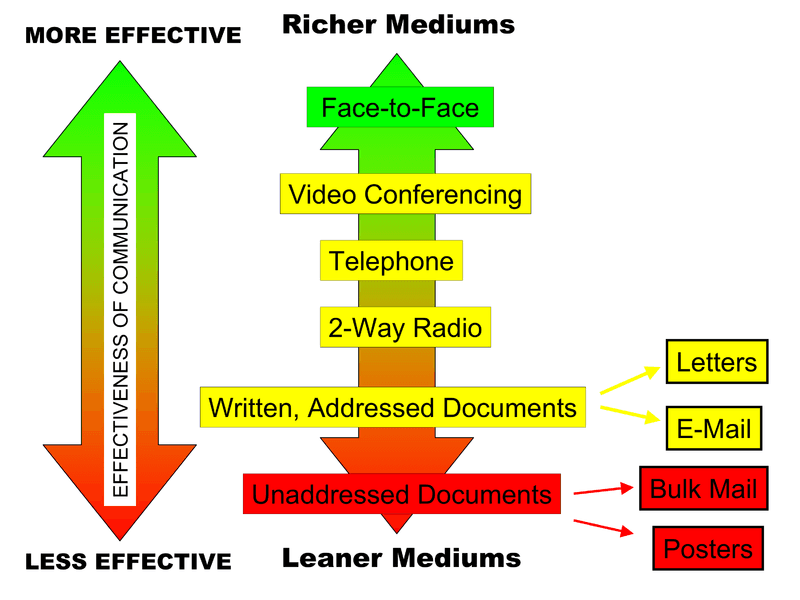
Channels of Business Communication | Principles of Management View original
Is this image relevant?
Communication and Management | Principles of Management View original
Is this image relevant?
Types of Communication | Organizational Behavior and Human Relations View original
Is this image relevant?
Channels of Business Communication | Principles of Management View original
Is this image relevant?
Types of Communication in Organizations

Types of organizational communication
Organizations rely on three broad categories of communication: oral, written, and nonverbal. Each has distinct strengths and limitations, and skilled managers know when to use which.
Oral communication uses spoken language to convey messages. It's the most common form of workplace communication and includes:
- Face-to-face conversations, which allow for immediate feedback and clarification
- Telephone calls, which enable communication across distances
- Video conferencing (Zoom, Teams, etc.), which approximates face-to-face interaction for remote teams
- Meetings and presentations, which allow for group discussion and information sharing
A key advantage of oral communication is that tone of voice and inflection carry meaning beyond the words themselves. A manager saying "That's fine" can mean very different things depending on how it's said.
Written communication relies on text to transmit information. Common forms include:
- Emails, the most widely used digital communication tool in organizations
- Memos, brief formal documents used for internal communication
- Reports, which provide detailed information on specific topics or projects
- Policies and procedures, which document organizational rules and guidelines
Written communication creates a permanent record that can be referenced later, and it allows the sender to compose and revise carefully before sending. The tradeoff is that it lacks immediate feedback. A reader can't ask a clarifying question in real time, which means poorly worded messages can easily cause misunderstandings.
Nonverbal communication includes everything beyond words: body language, facial expressions, and other physical cues. Key elements include:
- Facial expressions that convey emotions (smiling, frowning, raised eyebrows)
- Gestures like hand and arm movements that emphasize or illustrate points
- Posture, which can signal confidence, attentiveness, or disinterest
- Eye contact, which can indicate engagement, honesty, or discomfort
- Personal space, the physical distance people maintain during interactions
- Appearance and dress, which can convey professionalism, status, or cultural identity
Nonverbal cues can reinforce or contradict verbal messages. If a manager says "I'm open to your ideas" while crossing their arms and avoiding eye contact, the nonverbal signals undermine the spoken words. These cues are also heavily influenced by cultural background, so what signals respect in one culture may signal discomfort in another.

Social factors in workplace communication
Communication doesn't happen in a vacuum. Several social forces shape how messages are sent, received, and interpreted.
Power dynamics affect openness and honesty. In hierarchical relationships, employees may filter or withhold information from superiors, telling them what they want to hear rather than what they need to hear. This is sometimes called upward communication distortion.
Group dynamics influence individual behavior. Conformity pressure can lead to groupthink, where team members suppress dissenting opinions to maintain harmony. This is dangerous because it shuts down the critical feedback that good decisions require.
Cultural differences affect communication styles and expectations. Some cultures favor direct communication while others rely on context and implication. This distinction is often described as low-context (explicit, direct) versus high-context (implicit, indirect) communication. Norms around personal space, eye contact, and formality also vary widely across cultures, creating potential for misunderstanding in diverse workplaces.
Organizational culture shapes communication norms more broadly. Shared values and beliefs within a company influence what gets communicated, how formally, and through which channels.
Perception acts as a filter on all communication. Several perceptual biases affect how people interpret messages:
- Selective attention leads people to focus on information that aligns with their existing beliefs. Confirmation bias is a specific form of this, where people seek out evidence that supports what they already think.
- Stereotyping involves applying preconceived notions about a group to an individual, which can lead to biased communication and unfair treatment.
- Halo effect occurs when an overall positive impression of someone causes you to overestimate their abilities or overlook their flaws.
- Horn effect is the opposite: an overall negative impression leads you to underestimate someone's strengths or overemphasize their weaknesses.
- Self-fulfilling prophecy happens when expectations actually shape outcomes. The Pygmalion effect is a well-known example: when managers expect high performance from employees, those employees tend to perform better, partly because the manager communicates confidence and provides more support.
Impact of structure on communication
Organizational structure determines the pathways through which information flows. Four structural elements are especially relevant.
Centralization refers to where decision-making authority sits in the organization.
- High centralization concentrates power at the top. Information flows primarily downward (directives, policies), and lower-level employees have less autonomy. Decision-making can be slower because everything must go through senior leadership.
- Low centralization (decentralization) distributes authority more broadly. Information flows both vertically and horizontally, enabling more collaboration and faster decision-making at lower levels.
Formalization is the extent to which written rules, policies, and procedures guide behavior.
- High formalization means heavy reliance on documented guidelines and standardized processes. Communication channels are consistent (templates, protocols), but there's less flexibility and room for creative problem-solving.
- Low formalization allows for more informal, ad-hoc communication. This enables adaptability but can lead to inconsistency across the organization.
Departmentalization is how employees are grouped into units. Each approach creates different communication patterns:
- Functional departmentalization groups employees by specialization (marketing, finance, HR). Communication within each department tends to be efficient, but silos can form, reducing coordination between departments.
- Product departmentalization groups employees by product line or service. Cross-functional teams improve coordination around each product, but resources may be duplicated across product lines.
- Geographic departmentalization groups employees by regional location. Local units can respond to market-specific needs more effectively, but maintaining global coordination and consistency becomes harder.
Span of control is the number of subordinates a single manager directly oversees.
- A wide span of control means fewer management layers, which enables faster communication and decision-making. However, managers have less time for direct supervision, so employees rely more on horizontal communication with peers.
- A narrow span of control means more management layers, allowing closer supervision. The tradeoff is slower communication and decision-making because messages must pass through additional levels of hierarchy.
Communication Processes and Challenges
Beyond the types and structural factors, several processes and challenges affect how well communication actually works in practice.
Communication channels are the mediums through which information travels. Formal channels follow the organizational structure (memos, reports, official meetings). Informal channels develop naturally among employees and include the grapevine (word-of-mouth networks) and social interactions. Informal channels are fast and influential, but the information they carry isn't always accurate.
Feedback loops enable two-way communication. They allow the receiver to ask for clarification, confirm understanding, and respond. Without feedback loops, communication is one-directional and much more prone to error.
Communication networks describe the patterns of information flow within a group. Centralized networks funnel information through one or a few key individuals, which works well for simple tasks. Decentralized networks allow more direct communication between members, which is better for complex problem-solving.
Information overload occurs when people receive more information than they can effectively process. It leads to decreased productivity, missed details, and decision paralysis. Managers can combat this by prioritizing what truly needs to be communicated and choosing the right channel for each message.
Communication barriers hinder effective information exchange and fall into three categories:
- Physical barriers like noise, distance, or poor technology that impede clear transmission
- Psychological barriers like emotions, stress, or cognitive biases that distort how messages are interpreted
- Organizational barriers like rigid hierarchies or departmental silos that restrict information flow
Active listening is one of the most effective techniques for improving communication. It involves fully concentrating on the speaker, providing verbal and nonverbal feedback, and withholding judgment until the speaker has finished. Active listening builds trust, improves comprehension, and reduces the misunderstandings that plague so many workplace interactions.
See Fiveable more often in Google
Mark Fiveable as a preferred source and Google is more likely to show you our guides in Top Stories, with a "preferred" badge in AI Mode and AI Overviews.