4.1 The Organization's External Environment

👔Principles of Management Unit 4 Review
4.1 The Organization's External Environment
👔 Principles of Management
External Environment Elements and Influences
The external business environment includes every outside force that affects how a company operates, competes, and makes decisions. Understanding these forces matters because managers can't control them, but they can anticipate and respond to them. Most management frameworks divide the external environment into two layers: the general environment (broad forces like the economy and technology) and the task environment (forces closer to daily operations, like competitors and suppliers).

Top images from around the web for Elements of external business environment
Common Frameworks for Evaluating the Business Environment | Principles of Management View original
Is this image relevant?
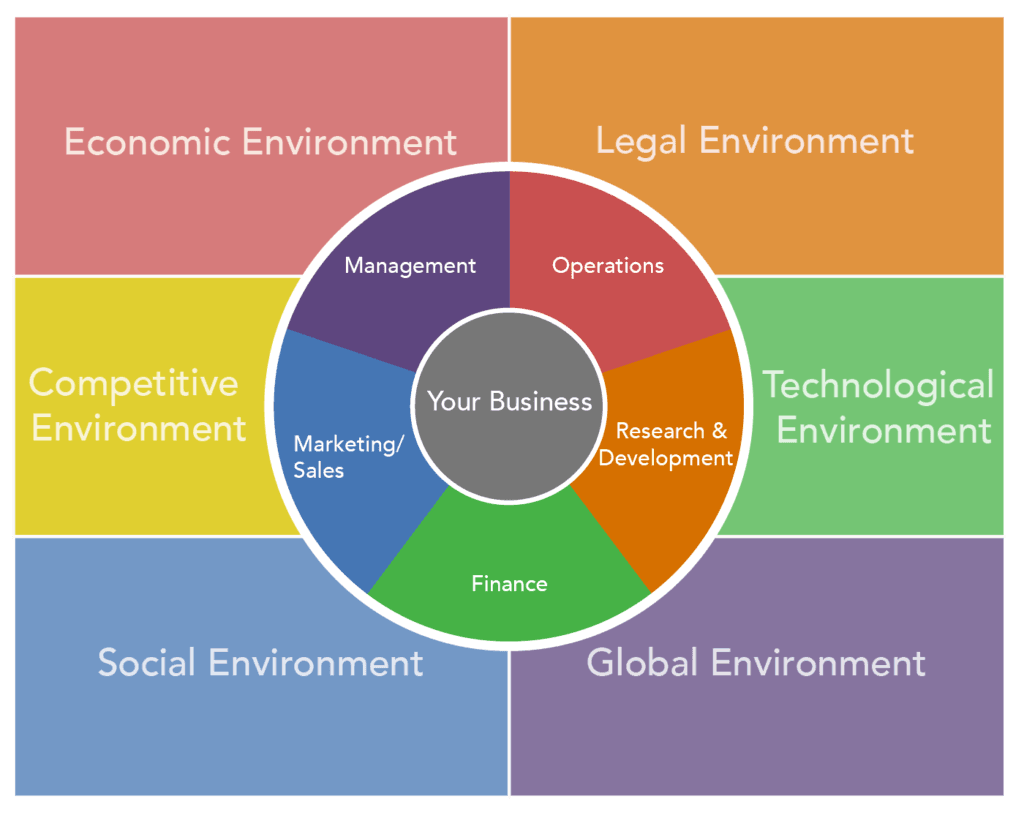
External Forces | Introduction to Business View original
Is this image relevant?
External Forces That Shape Business Activities | Introduction to Business View original
Is this image relevant?
Common Frameworks for Evaluating the Business Environment | Principles of Management View original
Is this image relevant?
External Forces | Introduction to Business View original
Is this image relevant?
Elements of the External Business Environment
Economic conditions directly shape what businesses can and can't do:
- Inflation rates affect both the purchasing power of consumers and the cost of inputs like raw materials and labor. When inflation rises, companies face pressure to raise prices or absorb thinner margins.
- Interest rates influence how expensive it is for businesses and consumers to borrow money. High rates discourage expansion and big consumer purchases (homes, cars); low rates encourage both.
- Economic growth (often measured by GDP) determines overall market demand. In a growing economy, more people are buying, and businesses see more opportunity.
- Unemployment rates work on two sides: high unemployment means consumers spend less, but it also means a larger pool of available workers. Low unemployment makes hiring harder and can push wages up.
- Consumer spending patterns shape demand for specific products. During tight economic times, spending shifts toward essential goods; during prosperity, discretionary spending (travel, electronics, dining out) rises.
Technological advancements create both opportunities and threats:
- New technologies can streamline processes, cut costs, and open entirely new markets. Think of how cloud computing reduced IT costs for small businesses, or how e-commerce let companies reach global customers without physical stores.
- Disruptive technologies can undermine established business models. Streaming services like Netflix didn't just compete with cable TV; they changed how consumers expect to access entertainment. Companies that fail to adapt risk becoming irrelevant.
Political and legal factors set the rules of the game:
- Government regulations establish standards for product safety, environmental protection, labor practices, and fair competition.
- Tax policies directly affect profitability and investment decisions. Corporate tax rates, R&D tax credits, and industry-specific incentives all influence where and how companies allocate resources.
- Trade agreements, tariffs, and quotas shape access to global markets. A new tariff on imported steel, for example, raises costs for domestic manufacturers who rely on foreign suppliers.
- Political stability matters for long-term planning. Businesses are less likely to invest heavily in regions where governments or policies change unpredictably.
Sociocultural trends shape what consumers want and how employees expect to work:
- Demographic shifts change both market demand and workforce composition. An aging population in Japan, for instance, has driven growth in healthcare and elder-care industries while shrinking the available labor pool.
- Changing consumer preferences push companies to adjust their offerings. The growing demand for eco-friendly and health-conscious products has reshaped industries from food (plant-based options) to fashion (sustainable sourcing).
- Social movements and activism pressure companies to take positions on societal issues like climate change, income inequality, and racial justice.
Competition determines market share and profitability:
- Existing competitors fight for customer loyalty and market dominance (Coca-Cola vs. Pepsi is the classic example).
- New entrants can disrupt established industries with innovative models. Airbnb didn't build hotels; it created a platform that challenged the entire hospitality industry.
- Substitute products threaten to replace existing offerings. Plant-based meat alternatives, for instance, compete directly with traditional meat producers.
- To survive, companies develop a competitive advantage through either unique value (differentiation) or lower costs (cost leadership).
Suppliers and partners are critical to daily operations:
- The availability and cost of raw materials directly affect production and pricing. The global semiconductor shortage that began in 2020 disrupted industries from automotive to consumer electronics, showing how dependent companies are on their supply chains.
- Relationships with key suppliers and distributors affect reliability and efficiency. Approaches like just-in-time inventory reduce storage costs but increase vulnerability to supply disruptions.
- Effective supply chain management balances cost optimization with resilience.

Economic and Technological Impacts on Strategy
Economic forces don't just create background conditions; they actively shape the strategies managers pursue.
- During economic downturns, companies prioritize cost-cutting and efficiency. This can mean layoffs, renegotiating supplier contracts, or streamlining processes. The goal is to maintain profitability when revenue is shrinking.
- During periods of growth, businesses shift toward expansion and innovation: entering new markets, developing new products, or acquiring competitors.
- Shifts in consumer spending patterns push companies to rethink pricing strategies. A recession might call for value-based pricing; a boom might support premium product lines.
Technological forces drive transformation at an even faster pace:
- Adopting technologies like robotics, AI, or cloud computing can dramatically improve productivity and reduce costs.
- Technology enables entirely new business models. Software-as-a-service (SaaS) companies like Salesforce generate recurring revenue from subscriptions rather than one-time product sales.
- Technological change can create whole new industries (smartphones) while destroying others (point-and-shoot cameras, GPS devices, MP3 players were all absorbed into one device).
- Companies invest in research and development (R&D) to stay ahead. Organizations like Apple and Google spend billions annually on R&D, treating innovation as a core competitive strategy rather than an afterthought.
- Innovation management refers to the systematic process organizations use to generate, evaluate, and implement new ideas, rather than leaving innovation to chance.

Sociocultural Influences on Organizations
Sociocultural Trends in Organizational Culture
Sociocultural forces affect organizations from two directions: they change what customers want and they change what employees expect.
Demographic shifts require real changes in how companies manage their workforce:
- An aging population means organizations need to rethink benefits, retirement plans, and how institutional knowledge gets transferred. Mentoring programs pair experienced workers with newer employees to preserve critical expertise.
- Increasing workforce diversity calls for inclusive policies and practices. Many companies now invest in unconscious bias training and employee resource groups to create environments where diverse teams can perform well.
- Generational differences in values and work preferences affect management approaches. Younger workers, for example, tend to prioritize work-life balance and purpose-driven work more than previous generations did, which influences how managers design roles and communicate organizational mission.
Changing consumer preferences reshape company practices and branding:
- The shift toward sustainability and social responsibility has influenced everything from product design to sourcing to marketing. Eco-friendly packaging and fair-trade sourcing are no longer niche selling points; for many consumers, they're expectations.
- Companies use market segmentation to tailor offerings to specific consumer groups rather than trying to appeal to everyone with a single product.
- The rise of personalization and on-demand services (think Netflix recommendations or same-day delivery) reflects broader cultural expectations around convenience and individual choice.
Social movements and activism create real pressure on companies to align with societal values:
- Organizations increasingly address issues like environmental impact, income inequality, and social justice to protect their reputations. Some adopt living wage policies or set carbon neutrality targets.
- Aligning stated values with actual practices helps attract both talent and customers. A company that promotes diversity but has no diverse leadership will face credibility problems.
Workforce expectations have shifted significantly:
- Employees increasingly expect flexibility, work-life balance, and investment in their career development. This has driven the expansion of remote work options, professional development programs, and mental health support.
- Benefits like parental leave and flexible scheduling, once considered perks, are now standard expectations in many industries. Companies that don't adapt struggle to attract and retain skilled workers.
Strategic Planning and Ethical Considerations
Strategic planning is how organizations translate their understanding of the external environment into action:
- Analyze market trends, competitive landscapes, and external forces (economic, technological, sociocultural, political).
- Set long-term goals based on that analysis, identifying where the organization wants to be and what opportunities or threats it faces.
- Develop action plans that outline specific steps, resource allocation, and timelines for achieving those goals.
- Review and adjust strategies regularly. The external environment changes constantly, so a strategy that made sense last year may need updating.
Business ethics and corporate social responsibility (CSR) have become central to how organizations operate, not just optional add-ons:
- Companies implement ethical guidelines and codes of conduct to ensure responsible decision-making across the organization.
- The stakeholder perspective holds that organizations should consider their impact on all stakeholders (employees, customers, communities, the environment), not just shareholders.
- Ethical behavior and genuine social responsibility contribute to long-term sustainability, stronger reputations, and greater trust from both customers and employees. Companies that cut ethical corners may see short-term gains but often face costly consequences later (lawsuits, boycotts, regulatory penalties).
See Fiveable more often in Google
Mark Fiveable as a preferred source and Google is more likely to show you our guides in Top Stories, with a "preferred" badge in AI Mode and AI Overviews.