17.8 The Control- and Involvement-Oriented Approaches to Planning and Controlling

👔Principles of Management Unit 17 Review
17.8 The Control- and Involvement-Oriented Approaches to Planning and Controlling
👔 Principles of Management
17.1
Is Planning Important
17.2
The Planning Process
17.3
Types of Plans
17.4
Goals or Outcome Statements
17.5
Formal Organizational Planning in Practice
17.6
Employees' Responses to Planning
17.7
Management by Objectives: A Planning and Control Technique
17.8
The Control- and Involvement-Oriented Approaches to Planning and Controlling
Approaches to Planning and Controlling
Planning and controlling sit at the heart of what managers actually do: setting goals, building strategies to reach them, and making sure execution stays on track. The key tension in this topic is how much control managers keep for themselves versus how much they share with employees. That choice depends heavily on the environment the organization operates in.
Control-Oriented vs. Involvement-Oriented Approaches
These two approaches represent opposite ends of a spectrum. Most real organizations fall somewhere in between, but understanding the extremes helps you see the trade-offs.
Control-oriented approach:
- Planning and decision-making flow top-down, with upper management (C-suite executives) setting goals and strategies
- Power is centralized at the top of the hierarchy
- Strict adherence to plans and procedures ensures consistency and predictability
- Works best in stable environments with routine tasks where efficiency matters most (e.g., assembly line production)
The logic here is straightforward: if the work is predictable and the environment doesn't change much, you gain efficiency by having a small group of leaders make the plans and everyone else follow them precisely.
Involvement-oriented approach:
- Planning and decision-making are participative, drawing input from employees at multiple levels
- Authority is decentralized and distributed throughout the organization
- Flexibility and adaptation take priority over rigid adherence to a fixed plan
- Encourages employee creativity, which fosters innovation and better problem-solving
- Works best in dynamic environments with complex tasks that require agility (e.g., software development)
The logic here is different: when the environment shifts quickly, the people closest to the work often have the best information. Giving them a voice in planning leads to faster, smarter responses. It also boosts engagement, since people are more committed to plans they helped create.
Employee Roles in Mechanistic vs. Organic Organizations
The control/involvement distinction maps closely onto two classic organizational structures. Think of these as the structural expression of each approach.
Mechanistic organizations align with the control-oriented approach:
- Hierarchical structure with a clear chain of command and vertical communication (information flows up and down)
- Specialized tasks with well-defined job descriptions, so each person knows exactly what they're responsible for
- Limited employee participation in planning; directives come from above
- Strict rules and procedures maintain order and consistency
- Best suited for stable environments and routine tasks (e.g., manufacturing)
Organic organizations align with the involvement-oriented approach:
- Flat structure with decentralized authority and horizontal communication (information flows across teams)
- Flexible roles that shift based on what the organization needs at a given time
- High employee involvement in planning and decision-making through collaboration
- Emphasis on teamwork to leverage diverse skills and perspectives
- Best suited for dynamic environments and complex tasks (e.g., research and development)
- The organizational culture tends to value adaptability and open communication
The key distinction: mechanistic organizations optimize for efficiency through standardization, while organic organizations optimize for adaptability through collaboration.

Management Responsibilities and Control Methods
How Managers Adapt to Environmental Uncertainty
The level of uncertainty in an organization's environment should shape how managers plan and control. This breaks down into three broad categories:
Stable environments:
- Management focuses on efficiency and optimization to maximize productivity and minimize costs
- Standardization and formal controls (rules, procedures, budgets) guide behavior and resource allocation
- Decision-making is centralized with top management to keep everything aligned with organizational goals
- Quality and performance stay consistent because the playbook rarely needs to change
Moderately uncertain environments:
- Management balances efficiency with adaptability as market conditions shift
- Coordination and problem-solving become more important than pure standardization
- Performance targets and benchmarks help monitor progress and support data-driven adjustments
- Employee involvement in decision-making increases, since frontline workers often spot emerging challenges and opportunities first
Highly uncertain environments:
- Management prioritizes innovation and rapid responsiveness over efficiency
- Flexibility is essential to capitalize on new opportunities and mitigate risks quickly
- Direct communication and informal controls replace rigid procedures, enabling faster course corrections
- Decision-making is decentralized, and employees are empowered to experiment and solve problems proactively
Notice the pattern: as uncertainty increases, organizations shift from control-oriented to involvement-oriented methods. Managers don't pick one approach permanently; they adapt based on what the environment demands.
Strategic Planning and Change Management
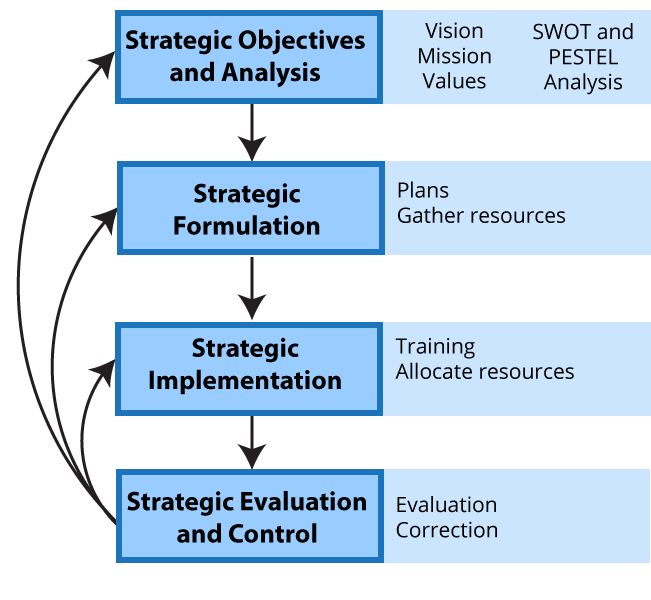
Strategic planning is the process of setting long-term goals and deciding how to allocate resources to achieve them. It provides the organization's overall direction.
Change management focuses on guiding the organization through transitions, whether that's adopting new technology, restructuring, or shifting strategy. It addresses the human and operational challenges that come with implementing something new.
Both processes share a commitment to continuous improvement, constantly evaluating performance and refining approaches to stay competitive. In practice, strategic planning often creates the need for change management, since new strategic goals usually require the organization to do things differently.
See Fiveable more often in Google
Mark Fiveable as a preferred source and Google is more likely to show you our guides in Top Stories, with a "preferred" badge in AI Mode and AI Overviews.