14.1 Motivation: Direction and Intensity

👔Principles of Management Unit 14 Review
14.1 Motivation: Direction and Intensity
👔 Principles of Management
Motivation: Direction and Intensity
Motivation explains why people choose certain actions at work and how hard they push to follow through. For managers, understanding motivation isn't just academic theory: it's the foundation for designing jobs, setting goals, and building reward systems that actually drive performance.
This section covers the core components of motivation, how role perceptions shape performance, and the major theories (content vs. process) that explain what motivates people and how that motivation works.
Components of Motivation
Motivation is the psychological force that drives behavior and performance. It has three distinct components:
- Direction refers to what you choose to pursue. Which tasks, goals, or activities do you focus on? Direction is shaped by personal interests, values, and perceived abilities. An employee who values creativity might direct effort toward brainstorming new product ideas rather than routine data entry.
- Intensity refers to how much effort you put toward your chosen direction. Two employees might both aim for a promotion (same direction), but one works evenings and weekends while the other does the minimum. Intensity is affected by factors like the perceived importance of the goal and the potential rewards (bonuses, promotions, recognition).
- Persistence refers to how long you sustain effort over time, especially when facing obstacles or setbacks.
All three matter. High intensity in the wrong direction wastes energy, and the right direction with low intensity produces mediocre results.
Role Perceptions and Performance
Role perceptions are an individual's understanding of their job duties, responsibilities, and expectations. Even a highly motivated employee can underperform if they don't have a clear picture of what they're supposed to be doing.
Accurate role perceptions allow employees to:
- Focus effort on the most important tasks
- Prioritize work effectively
- Meet the expectations of managers and the organization
Inaccurate role perceptions create real problems. When employees misunderstand their role, their efforts can become misaligned with organizational goals. They may spend time and resources on non-essential tasks, which leads to reduced performance and lower job satisfaction. This is why managers need to communicate expectations clearly and check for understanding, not just assume everyone knows what's expected.
Content vs. Process Motivation Theories
Motivation theories fall into two broad categories, and the distinction matters because each type answers a different question.
Content theories ask: What motivates people? They identify the specific needs, desires, and incentives that drive behavior.
Process theories ask: How does motivation work? They focus on the cognitive processes and decision-making behind motivated behavior.
Content Theories
Maslow's Hierarchy of Needs proposes that people are motivated by five levels of needs, arranged from most basic to highest:
- Physiological (food, water, shelter)
- Safety (job security, stable income)
- Social (belonging, friendships at work)
- Esteem (recognition, status)
- Self-actualization (reaching full potential, meaningful work)
The core idea is that lower-level needs must be reasonably satisfied before higher-level needs become strong motivators. An employee worried about paying rent (safety) won't be very motivated by a "creative freedom" initiative (self-actualization).
Herzberg's Two-Factor Theory distinguishes between two categories of workplace factors:
- Hygiene factors (salary, job security, working conditions, company policies) don't motivate on their own, but their absence causes dissatisfaction.
- Motivators (recognition, responsibility, achievement, growth opportunities) are what actually drive satisfaction and motivation.
The practical takeaway: fixing poor hygiene factors (like raising a below-market salary) removes dissatisfaction but won't create genuine motivation. To truly motivate, you need to build in motivators like meaningful work and recognition.

Process Theories
Vroom's Expectancy Theory proposes that motivation depends on three beliefs, and all three must be present:
- Expectancy: "If I put in effort, will it lead to good performance?" (effort → performance)
- Instrumentality: "If I perform well, will I actually receive a reward?" (performance → reward)
- Valence: "Do I value the reward being offered?" (perceived value of the reward)
Motivation is strongest when all three are high. If an employee doubts that hard work will improve their performance (low expectancy), or doesn't believe good performance will be rewarded (low instrumentality), or doesn't care about the reward (low valence), motivation drops.
Adams' Equity Theory suggests people are motivated by fairness. Employees compare their own ratio of inputs (effort, skills, time) to outcomes (pay, recognition, promotions) against the ratios of their coworkers. When they perceive an imbalance, they feel tension and are motivated to restore equity. This might mean reducing effort, asking for a raise, or even leaving the organization.
Additional Motivation Theories
Several other theories add important dimensions to understanding workplace motivation:
- Goal-Setting Theory holds that specific, challenging goals lead to higher performance than vague goals like "do your best." Goals work best when employees receive feedback on their progress and are committed to the goal.
- Self-Determination Theory focuses on intrinsic motivation and identifies three core psychological needs: autonomy (control over your work), competence (feeling effective), and relatedness (connection with others). When these needs are met, intrinsic motivation flourishes.
- Cognitive Evaluation Theory examines how external rewards can sometimes undermine intrinsic motivation. For example, paying someone for a task they already enjoyed can shift their focus from the activity itself to the reward.
- Reinforcement Theory takes a behavioral approach: behavior is shaped by its consequences. Positive reinforcement (rewards for desired behavior) and negative reinforcement (removing an unpleasant condition when desired behavior occurs) both increase the likelihood of that behavior repeating.
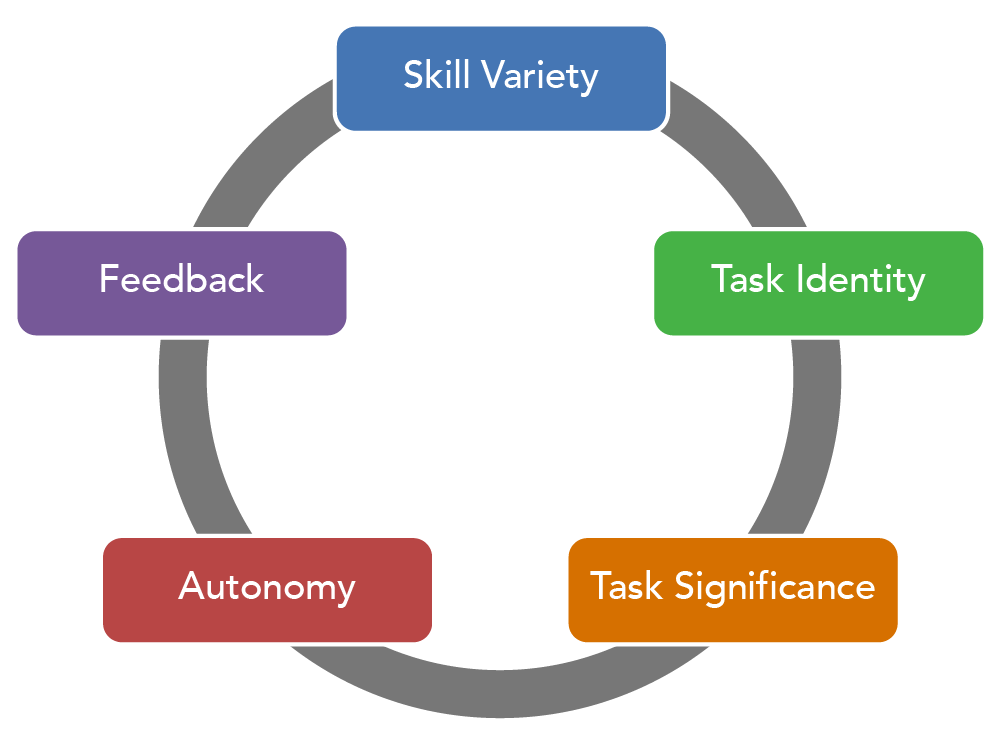
- Job Characteristics Model proposes that job design itself influences motivation through five core dimensions: skill variety, task identity (completing a whole piece of work), task significance (impact on others), autonomy, and feedback. Jobs high in these dimensions tend to produce greater internal motivation.
Applying Motivation Theories in the Workplace
Managers can draw on these theories to develop strategies tailored to their teams, but no single theory works in every situation.
- Content theories help identify what employees need. If a team member seems disengaged, a manager might assess whether basic needs (fair pay, job security) are met before trying to inspire them with stretch goals. Providing growth opportunities and recognition addresses higher-level needs like esteem and self-actualization.
- Process theories help managers design systems that sustain motivation. Using Expectancy Theory, a manager might ensure that performance goals are achievable (boosting expectancy), that rewards are clearly tied to results (boosting instrumentality), and that the rewards offered are ones employees actually want (boosting valence).
- Context matters. Effective motivation techniques depend on individual differences and the specific situation. A new employee might be most motivated by clear role expectations and job security, while a seasoned employee might respond more to autonomy and challenging goals. The best managers tailor their approach rather than applying a one-size-fits-all strategy.
See Fiveable more often in Google
Mark Fiveable as a preferred source and Google is more likely to show you our guides in Top Stories, with a "preferred" badge in AI Mode and AI Overviews.