8.4 Personal Selling and Sales Management

📣Intro to Marketing Unit 8 Review
8.4 Personal Selling and Sales Management
📣 Intro to Marketing
Personal selling in the promotion mix
Personal selling is direct, face-to-face communication between a salesperson and a potential customer. Unlike advertising or PR, which broadcast messages to large audiences, personal selling is a one-on-one interaction where the salesperson can tailor the conversation in real time. This makes it one of the most persuasive tools in the promotion mix, but also one of the most expensive on a per-contact basis.

Top images from around the web for Role of personal selling
Promotion: Integrated Marketing Communication (IMC) | Introduction to Business View original
Is this image relevant?
The Importance of Personal Selling | OpenStax Intro to Business View original
Is this image relevant?
Personal Selling | Principles of Marketing View original
Is this image relevant?
Promotion: Integrated Marketing Communication (IMC) | Introduction to Business View original
Is this image relevant?
The Importance of Personal Selling | OpenStax Intro to Business View original
Is this image relevant?
Role of personal selling
Personal selling works best when the product is complex, high-value, or requires customization. Think industrial equipment, enterprise software, or financial advisory services. In B2B settings especially, buying decisions involve multiple stakeholders and long evaluation periods, so having a salesperson who can build relationships and navigate that process is critical.
It also complements the rest of the promotion mix. Advertising might generate awareness, and a website might provide details, but a salesperson can answer specific questions, handle objections on the spot, and adapt the pitch based on what the customer actually cares about.
Advantages of personal selling
- Two-way communication: Salespeople get immediate feedback and can adjust their approach mid-conversation, something no ad or email can do
- Trust and rapport: Face-to-face interaction builds stronger relationships, which matters for repeat business and long-term accounts
- Real-time problem solving: Salespeople can demonstrate products, answer technical questions, and address concerns as they come up
- Cross-selling and upselling: Once a salesperson understands a customer's situation, they can recommend additional products or upgrades that genuinely fit
- Market intelligence: Salespeople gather firsthand insights about customer needs, competitor activity, and buying behavior that feed back into the company's strategy
Steps in the personal selling process
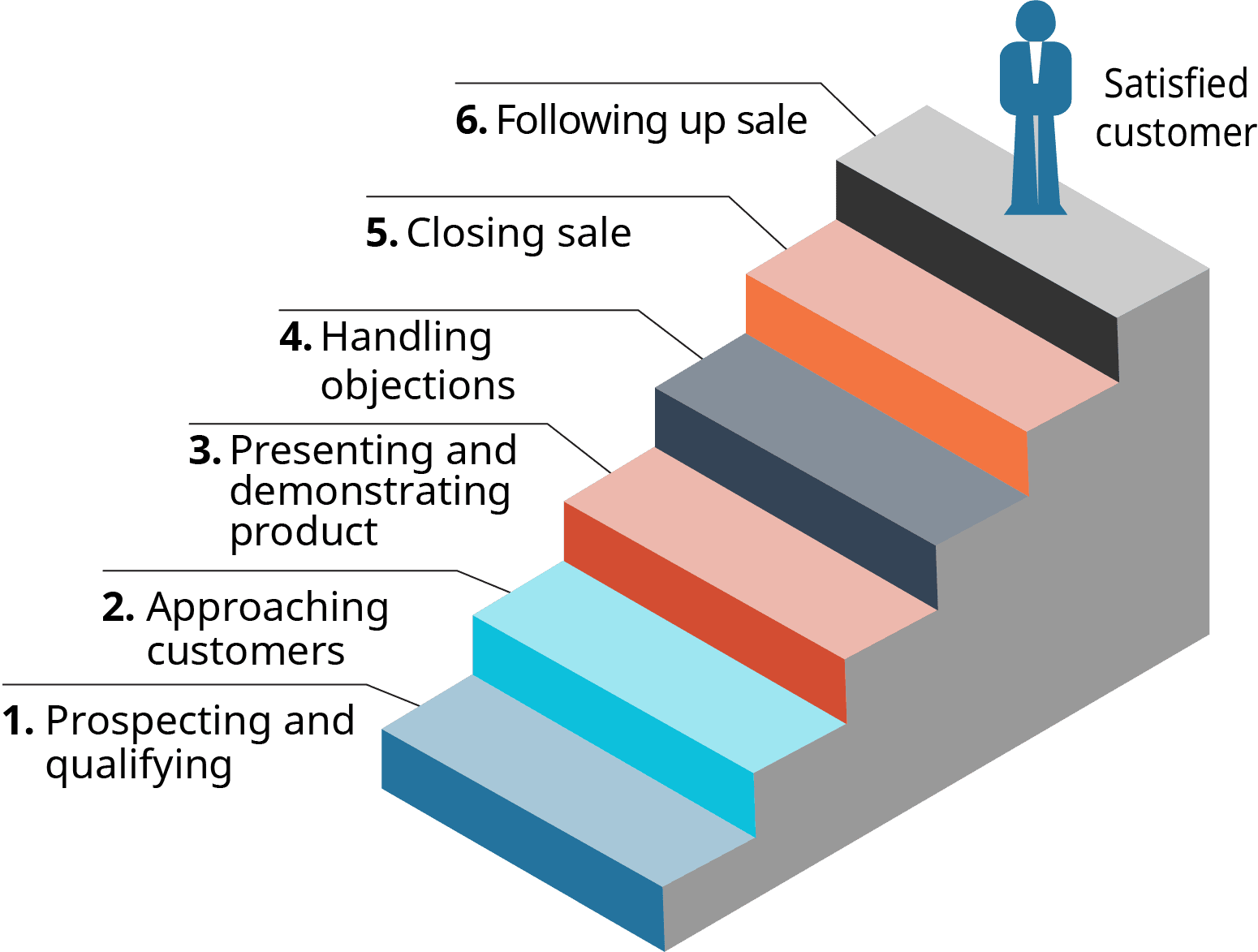
The personal selling process follows a sequence of stages, from finding potential customers all the way through maintaining the relationship after a sale. Each step builds on the one before it.
Pre-sale activities
1. Prospecting — Identifying potential customers who are likely to need your product or service. This is about generating leads through:
- Researching industry trends and analyzing customer data
- Attending trade shows and networking events
- Getting referrals from existing customers
2. Pre-approach — Gathering information about a specific prospect before making contact. The goal is to walk into the conversation prepared.
- Review the prospect's website, social media, annual reports, or press coverage
- Identify the key decision-makers and influencers in the buying process
- Anticipate likely needs, pain points, and potential objections

Sales presentation and closing
3. Approach — Making initial contact, usually through a phone call, email, or in-person introduction. The aim is to get a meeting, not to make the full pitch right away. A strong approach includes a compelling value proposition tailored to what you learned in the pre-approach.
4. Presentation — Delivering the actual sales pitch. This is where you show how your product or service solves the prospect's specific problems.
- Use storytelling, case studies, and live demonstrations to make the value concrete
- Focus on benefits (what it does for the customer), not just features (what the product has)
5. Handling objections — Addressing concerns the prospect raises. Common objections involve price, timing, or competing alternatives. Strong salespeople anticipate these and prepare responses in advance rather than getting caught off guard.
6. Closing — Asking for the sale. A few common closing techniques:
- Assumptive close: Act as if the decision is already made ("Should we schedule delivery for Tuesday or Thursday?")
- Alternative close: Offer two options, both of which result in a sale ("Would you prefer the standard or premium package?")
- Urgency close: Highlight a time-sensitive reason to act now ("This pricing is available through the end of the quarter")
Post-sale activities
7. Follow-up — Maintaining the relationship after the purchase. This step is often overlooked, but it's where long-term value gets built.
- Check in to make sure the customer is satisfied and the product is working as expected
- Provide ongoing support and resources
- Ask for feedback, testimonials, or referrals to generate new leads
A satisfied customer who feels taken care of is far more likely to buy again and recommend you to others.
Importance of effective sales management
Even the best individual salespeople need structure and support. Sales management is the process of planning, organizing, directing, and controlling the sales force to meet the company's revenue goals.
Planning and organizing sales activities
- Setting clear sales targets (quotas) for individuals and teams
- Developing sales strategies and allocating resources like budgets, territories, and personnel
- Aligning the sales team's day-to-day activities with the company's broader marketing and business objectives
- Designing an efficient sales process so reps spend more time selling and less time on administrative tasks

Developing and supporting the sales team
Sales managers aren't just supervisors; they're coaches. Their job is to make sure each salesperson has the skills, tools, and motivation to perform.
- Coaching and feedback: Regular one-on-one meetings, ride-alongs (joining a rep on sales calls), and performance reviews help identify strengths and areas for improvement
- Recognition and rewards: Acknowledging top performers through bonuses, awards, or public recognition keeps morale high and encourages healthy competition
- Ongoing support: Providing updated sales materials, CRM tools, and market data so the team can work effectively
Strategies for sales force management
Recruitment and training
Recruitment is about finding people with the right mix of skills, personality, and cultural fit.
- Write clear job descriptions with specific qualifications and performance expectations
- Source candidates through job postings, employee referrals, campus recruiting, and industry outreach
- Use structured interviews, skills assessments, and reference checks to evaluate fit
Training prepares new hires and keeps experienced reps sharp. Effective programs cover:
- Product knowledge (what you're selling and how it works)
- Sales techniques (prospecting, presenting, closing)
- Customer service skills and company policies
- A mix of formats works best: classroom sessions, online modules, role-playing exercises, and on-the-job mentoring
- Training shouldn't stop after onboarding. Ongoing development keeps the team current on industry changes and new tools.
Motivation and compensation
Salespeople are often highly driven by incentives, so how you structure motivation and pay matters a lot.
Motivation strategies:
- Commissions and bonuses tied to performance align the salesperson's goals with the company's revenue targets
- Career advancement opportunities and professional development help retain top talent
- Team-building activities and a positive culture keep people engaged beyond just the paycheck
Compensation design typically involves balancing three components:
| Component | Purpose |
|---|---|
| Base salary | Provides income stability and security |
| Commission | Rewards sales performance directly |
| Benefits/bonuses | Attracts talent and incentivizes specific goals |
The right balance depends on factors like the length of the sales cycle, industry norms, company budget, and how much influence individual reps have over closing deals. A company with a long, complex sales cycle (like enterprise software) might lean heavier on base salary, while a transactional sales environment might weight commissions more heavily.
Compensation plans should be reviewed regularly to stay competitive and keep driving the right behaviors.
See Fiveable more often in Google
Mark Fiveable as a preferred source and Google is more likely to show you our guides in Top Stories, with a "preferred" badge in AI Mode and AI Overviews.