4.4 Data Collection Methods

📣Intro to Marketing Unit 4 Review
4.4 Data Collection Methods
📣 Intro to Marketing
Marketing research depends on gathering the right information to support business decisions. Data collection methods are the specific techniques researchers use to get that information. Each method fits different situations, and picking the wrong one can lead to misleading results.
This section covers the four main data collection methods (surveys, interviews, focus groups, and observations), how to choose between them, the role of sampling, and the types of bias that can undermine your findings.
Data Collection Methods

Top images from around the web for Surveys
Reading: Primary Marketing Research Methods | Principles of Marketing View original
Is this image relevant?
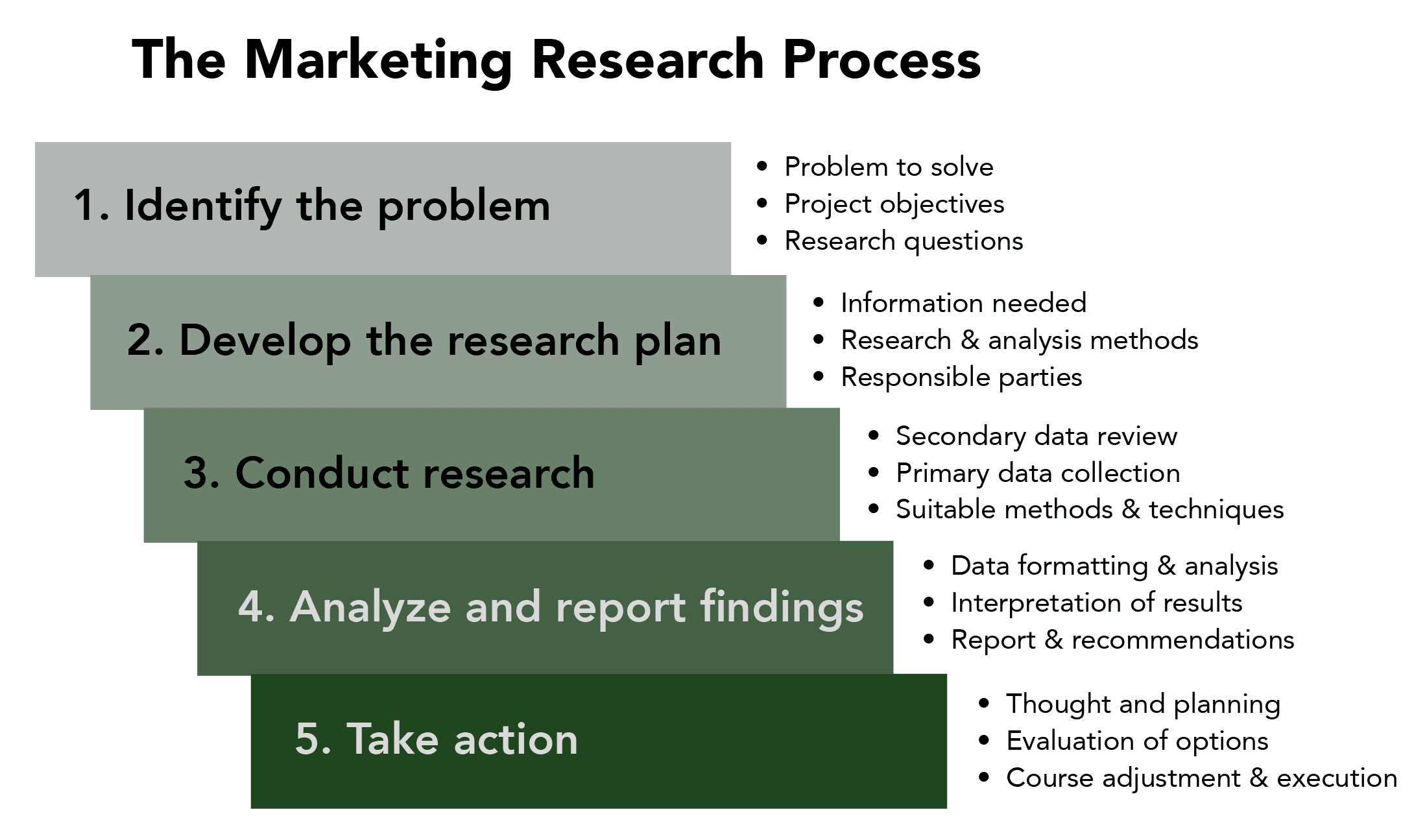
Reading: The Marketing Research Process | Principles of Marketing View original
Is this image relevant?
Reading: Primary Marketing Research Methods | Principles of Marketing View original
Is this image relevant?
Reading: The Marketing Research Process | Principles of Marketing View original
Is this image relevant?
Surveys
Surveys are a structured method where you ask a sample of respondents a set of standardized questions, usually through a questionnaire or online form. They can be self-administered (the respondent fills it out alone) or conducted by an interviewer, and questions can be closed-ended (multiple choice, rating scales) or open-ended (free-text responses).
Think of a customer satisfaction survey you get after an online purchase, or a market research survey asking which brands you recognize. Those are classic examples.
Why surveys are popular:
- Relatively inexpensive compared to other methods
- Can reach a large, geographically spread-out sample, making results more representative
- Produce quantitative data that's straightforward to analyze with statistics
- Can be deployed quickly, especially online
Where surveys fall short:
- Response rates can be low, particularly for longer surveys, which introduces nonresponse bias
- You can't probe deeper or ask follow-up questions the way you can in an interview
- Respondents may rush through or give socially desirable answers rather than honest ones
Interviews
Interviews are a qualitative method where a researcher asks open-ended questions in a one-on-one (or sometimes small group) setting. They come in three formats:
- Structured interviews follow a set script with no deviation
- Semi-structured interviews have predetermined questions but allow the interviewer to explore interesting responses
- Unstructured interviews are more conversational, guided by broad topics rather than specific questions
The big advantage is depth. Interviews let you probe, ask follow-up questions, and explore the why behind someone's behavior or opinion. A marketing team might use interviews to understand why customers switched to a competitor, uncovering motivations a survey would miss.
The trade-off is cost and scale. Interviews are time-consuming to conduct and analyze, so sample sizes tend to be small. That limits how confidently you can generalize the findings to a larger population. There's also the risk of interviewer bias, where the interviewer's tone, body language, or phrasing subtly steers the respondent's answers.
Focus Groups
A focus group brings together a small group (typically 6-10 people) to discuss a specific topic, guided by a moderator who keeps the conversation on track. Participants are usually selected because they share relevant characteristics, such as being users of a particular product or members of a target demographic. Sessions are recorded and transcribed for analysis.
Focus groups are especially useful for:
- Observing how people discuss, debate, and influence each other's opinions
- Generating new ideas or hypotheses early in the research process
- Getting qualitative insights into attitudes and perceptions at a lower cost than conducting the same number of individual interviews
The downsides are real, though. Groupthink can take over, where participants conform to the majority opinion. Dominant personalities can overshadow quieter members. And because the sample is small and hand-picked, results don't generalize well to the broader population. The moderator's own biases can also shape the direction of the discussion.
Observations
Observation involves systematically watching and recording behavior as it happens, rather than asking people to report on it. This can take place in a natural setting (a researcher watching how shoppers navigate a store) or a controlled environment (a usability lab where participants test a website).
Observers can be participants (embedded in the setting) or non-participants (watching from the outside without interacting). Observations can also be structured (using a checklist of specific behaviors to record) or unstructured (open-ended exploration).
The strength of observation is that you capture what people actually do, not what they say they do. You can also pick up on nonverbal cues and environmental context that other methods miss entirely.
The challenges:
- It's time-consuming and expensive, especially for long-term studies
- You're limited to what's observable; you can't see motivations or attitudes
- Observer bias can creep in when the researcher's expectations color their interpretation
- The Hawthorne effect is a real concern: people tend to change their behavior when they know they're being watched, which threatens the validity of your data
Advantages and Disadvantages of Methods
Surveys: Pros and Cons
- Advantages:
- Cost-effective and fast to administer, especially online
- Can reach a large, geographically dispersed sample
- Produce quantitative data suited for statistical analysis
- Disadvantages:
- Low response rates can introduce nonresponse bias
- No ability to probe for deeper insights or clarify confusing answers
- Respondents may give socially desirable or careless responses
- Poorly designed questions create measurement error
Interviews: Strengths and Limitations
- Strengths:
- Provide in-depth, detailed information
- Allow probing and follow-up questions
- Build rapport, making them suitable for complex or sensitive topics
- Limitations:
- Time-consuming and costly to conduct and transcribe
- Small sample sizes limit generalizability
- Interviewer bias can influence responses
- Respondents may still give socially desirable answers
Focus Groups: Benefits and Drawbacks
- Benefits:
- Reveal group dynamics and how people influence each other's decisions
- Encourage spontaneous, interactive discussion that sparks new ideas
- More cost-effective than conducting the same number of individual interviews
- Drawbacks:
- Small, non-representative samples
- Groupthink and conformity can distort responses
- Dominant participants can overshadow others
- Moderator bias can steer the conversation
Observations: Advantages and Challenges
- Advantages:
- Capture actual behavior rather than self-reported behavior
- Pick up nonverbal communication and contextual details
- Useful for studying behaviors people can't easily describe or recall
- Challenges:
- Time-consuming and expensive
- Limited to what's directly observable
- Observer bias can affect data collection and interpretation
- The Hawthorne effect can alter how participants behave
Choosing the Right Method

Aligning with Research Objectives
Your research question should drive your method choice. Quantitative methods like surveys work best when you need to test a hypothesis, measure variables, or generalize findings to a large population. Qualitative methods like interviews, focus groups, and observations work best when you need to explore attitudes, motivations, or behaviors in depth.
Sometimes a mixed-methods approach, combining both quantitative and qualitative techniques, gives you the most complete picture. For example, you might run a survey to identify broad trends, then conduct interviews to understand the reasons behind those trends.
The stage of your research matters too. Early exploratory research (trying to understand a new problem) often calls for qualitative methods. Later descriptive or explanatory research (measuring how widespread something is or testing cause-and-effect) typically calls for quantitative methods.
Considering the Target Audience
Different audiences respond better to different methods. A few things to assess:
- Accessibility: Can you reach this group online, or do you need in-person contact?
- Willingness to participate: Will they take the time for a 30-minute interview, or is a quick survey more realistic?
- Ability to provide the information you need: Can they articulate their thoughts, or would observing their behavior be more revealing?
For example, online surveys work well for younger, tech-savvy audiences, while in-person interviews may be more effective for older populations or communities with limited internet access. Also consider topic sensitivity: focus groups are generally not the best choice for highly personal or stigmatized topics, since participants may not speak openly in front of strangers.
Practical Considerations
Even the ideal method on paper has to be feasible in practice. Key constraints include:
- Budget: Surveys are generally the cheapest option. Interviews and observations cost more per respondent.
- Timeline: Surveys can be deployed and collected in days. Focus groups and observations require more scheduling and setup.
- Resources and expertise: Qualitative methods demand skilled interviewers or moderators. Observations may require specialized equipment or facilities.
- Control: If you need a controlled environment, laboratory observation gives you that. If you want natural behavior, field observation or surveys may be better fits.
Importance of Sampling
Representativeness
Sampling is the process of selecting a subset of individuals from a larger population to participate in your study. The goal is for your sample to be representative, meaning it shares the same key characteristics (demographics, attitudes, behaviors) as the population you care about. When a sample isn't representative, your findings can be biased or misleading.
Probability sampling methods give every member of the population a known chance of being selected, making representative samples more likely. The main types are:
- Simple random sampling: Every individual has an equal chance of selection
- Stratified sampling: The population is divided into subgroups (strata), and random samples are drawn from each
- Cluster sampling: The population is divided into clusters (like geographic regions), and entire clusters are randomly selected
Non-probability sampling methods (convenience, snowball, quota) are easier and cheaper but carry a higher risk of producing unrepresentative results.
Sample Size Considerations
Sample size is the number of individuals in your study. You want it large enough to produce reliable results, but not so large that you waste time and money.
Factors that determine the right sample size:
- Desired precision: A tighter margin of error (e.g., ±3% vs. ±5%) requires a larger sample
- Population variability: More diverse populations need larger samples to capture that diversity
- Statistical power: The ability to detect a real effect or relationship. Researchers commonly aim for 80% power.
- Type of analysis: If you plan to compare subgroups (e.g., men vs. women, age brackets), you need enough respondents in each subgroup
For exploratory or qualitative research, smaller samples (even 15-30 interviews) can be sufficient. For quantitative research aiming to generalize, you'll typically need hundreds or more.
Bias and Errors in Data Collection
Types of Bias
Selection bias happens when your sample doesn't accurately represent the target population. Certain groups end up overrepresented or underrepresented. Common sources include convenience sampling (surveying whoever is easiest to reach), volunteer bias (only highly motivated people participate), and nonresponse bias (covered below).
Response bias happens when participants give inaccurate or incomplete answers. Several forms exist:
- Social desirability bias: Answering in a way that makes you look good (e.g., overreporting exercise habits)
- Acquiescence bias: Tendency to agree with statements regardless of content
- Extremity bias: Consistently choosing extreme options on rating scales
- Recall bias: Inaccurately remembering past events or behaviors
Interviewer bias occurs when the interviewer's characteristics, behavior, or questioning style influences responses. Demographic differences between interviewer and respondent can affect rapport. Verbal and nonverbal cues can inadvertently signal which answers are "desired." Leading or loaded questions are a common culprit.
Measurement Error
Measurement error is the gap between what you're trying to measure and what your instrument actually captures. Sources include:
- Poorly worded or ambiguous questions
- Inadequate response options (e.g., a scale that doesn't include the respondent's true answer)
- Inconsistent coding of open-ended responses
- Faulty equipment in observational studies
Pilot testing your instrument on a small group before full deployment is one of the best ways to catch these problems early. Validating that your questions actually measure what you intend them to measure is equally important.
Nonresponse Bias
Nonresponse bias occurs when the people who don't participate in your study differ systematically from those who do. If non-respondents hold different opinions or have different behaviors than respondents, your results will be skewed, and higher nonresponse rates make this problem worse.
Strategies to reduce nonresponse bias:
- Offer incentives (gift cards, small payments, lottery entries)
- Send multiple reminders and contact attempts
- Provide alternative response modes (online, phone, and mail options)
- Weight or adjust the data after collection to account for known nonresponse patterns
See Fiveable more often in Google
Mark Fiveable as a preferred source and Google is more likely to show you our guides in Top Stories, with a "preferred" badge in AI Mode and AI Overviews.