4.2 Marketing Research Process

📣Intro to Marketing Unit 4 Review
4.2 Marketing Research Process
📣 Intro to Marketing
Marketing Research Process
Marketing research gives businesses a structured way to answer specific questions before making decisions. Instead of guessing what customers want or how a market is shifting, companies follow a repeatable process to collect and analyze data. This section walks through the six steps of that process and what makes each one effective.

Top images from around the web for Systematic Approach to Collecting, Analyzing, and Interpreting Data
Reading: The Role of the Marketing Plan | Principles of Marketing View original
Is this image relevant?
Reading: The Marketing Research Process | Principles of Marketing View original
Is this image relevant?
Reading: The Marketing Research Process | Introduction to Marketing View original
Is this image relevant?
Reading: The Role of the Marketing Plan | Principles of Marketing View original
Is this image relevant?
Reading: The Marketing Research Process | Principles of Marketing View original
Is this image relevant?
Systematic Approach to Collecting, Analyzing, and Interpreting Data
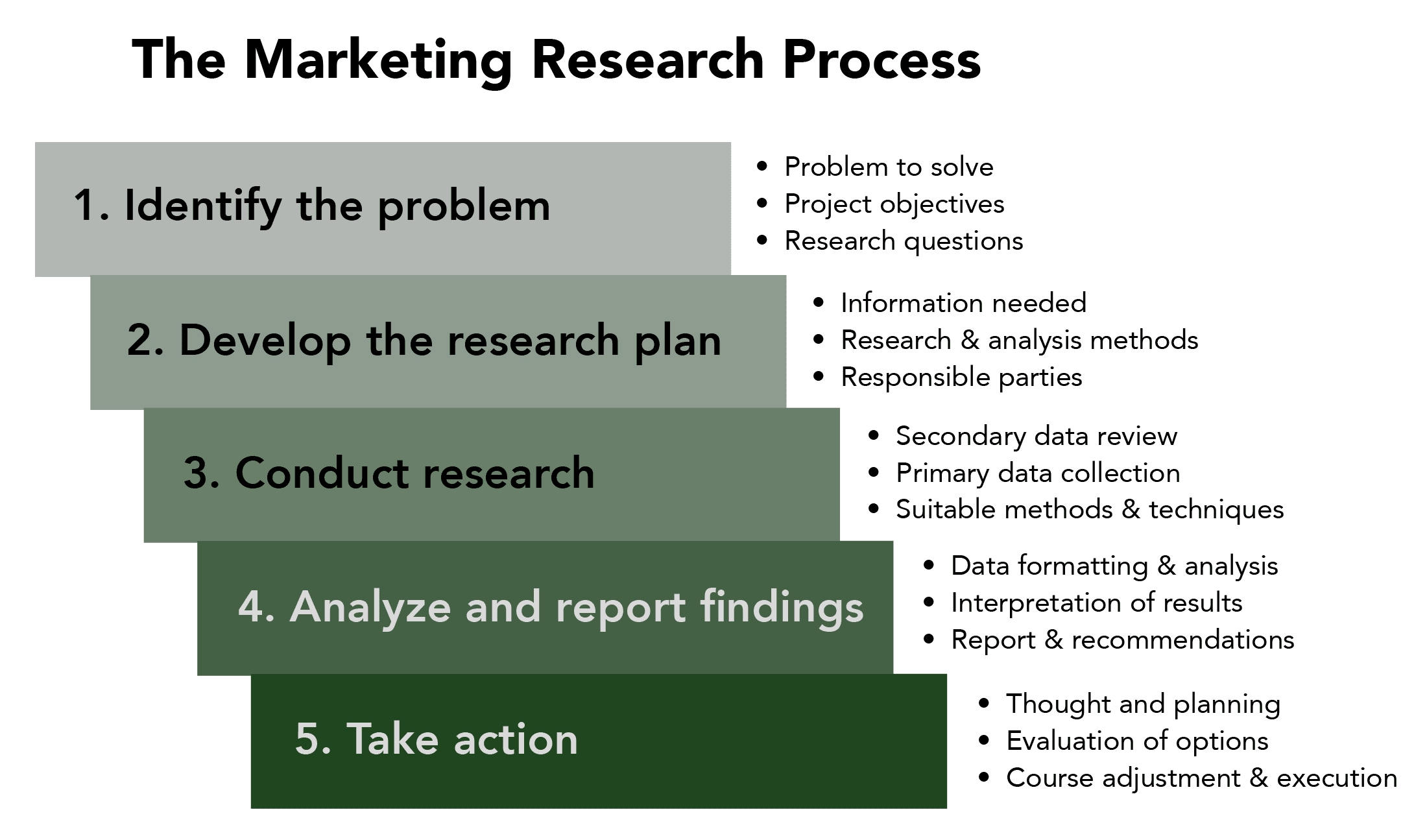
The marketing research process follows six steps that build on each other. Skipping or rushing any step weakens everything that comes after it.
- Problem definition — Identify the specific issue or opportunity the research needs to address.
- Research design — Choose the right methodology and data collection methods.
- Data collection — Gather relevant data from primary and/or secondary sources.
- Data analysis — Process the data to find patterns, trends, and relationships.
- Interpretation and reporting — Draw conclusions and present findings to stakeholders.
- Decision-making — Use the findings to guide actual marketing decisions.
The whole point of following these steps is to end up with findings you can act on, not just interesting data sitting in a spreadsheet.
Defining Research Problem and Objectives
Foundation of the Marketing Research Process
Everything in the research process flows from how well you define the problem. A vague problem leads to vague results.
A research problem is a clear statement of the specific issue or opportunity you're investigating. It should be concise, measurable, and directly relevant to the organization's goals. For example, "Why have sales of our flagship product declined 15% among 18–24 year olds over the past two quarters?" is far more useful than "Sales are down."
Research objectives are the specific, actionable goals your research aims to achieve. They serve as a roadmap for every decision you'll make later in the process.
- Objectives should align directly with the research problem
- They help determine which methodology to use, how to collect data, and how large your sample needs to be
- A single research problem might have three or four objectives beneath it
Without clear problem definition and objectives, you risk collecting irrelevant data and ending up with findings that don't actually help anyone make a decision.

Research Methodology Design
Systematic Plan for Conducting the Research
Research methodology is your plan for how you'll conduct the study. It spells out the methods and procedures you'll use to collect, analyze, and interpret data. The right methodology depends on your research problem, your objectives, and the resources (time, budget, personnel) available.
Three common research designs show up in marketing:
- Exploratory research is used when the problem isn't well-defined yet. The goal is to gain initial insights and understanding. Common methods include focus groups and in-depth interviews. For instance, a company entering a new market might run focus groups to understand what potential customers even care about before designing a survey.
- Descriptive research aims to describe characteristics of a market, consumer behavior, or other phenomena. It answers "what is happening" questions. Methods include surveys, observations, and panel data. A retailer tracking monthly purchase patterns across customer segments is doing descriptive research.
- Causal research tests cause-and-effect relationships between variables. It answers "does X cause Y" questions. Methods include experiments and quasi-experiments. For example, an A/B test measuring whether a new package design increases purchase intent is causal research.
Your methodology should be designed to produce data that is reliable (consistent results if repeated), valid (actually measures what you intend), and relevant to your objectives.
Data Collection, Analysis, and Interpretation

Gathering and Examining Relevant Information
Data collection is where you gather the information needed to address your research objectives. There are two main categories:
- Primary data is collected specifically for your current research problem. Methods include surveys, interviews, focus groups, and observations. Primary data is tailored to your exact needs, but it's typically more expensive and time-consuming to gather.
- Secondary data already exists because it was collected for some other purpose. Sources include government statistics (like Census data), industry reports, trade publications, and academic studies. Secondary data is cheaper and faster to access, but it may not perfectly fit your research question.
Most research projects use a combination of both.
Data analysis is where you process the collected data to identify patterns, trends, and relationships. The techniques you use depend on the type of data:
- Quantitative analysis might involve descriptive statistics (means, percentages), hypothesis testing, or regression analysis
- Qualitative analysis might involve content analysis, thematic analysis, or grounded theory approaches
Data interpretation is the step where you connect the dots. You take the patterns from your analysis and draw meaningful conclusions that link back to your original research objectives. Raw numbers don't speak for themselves. Interpretation requires understanding the research context and being honest about what the data does and does not support.
Reporting and Presenting Findings
Communicating Key Insights and Recommendations
Reporting is where the research process pays off. Even the best analysis is useless if stakeholders can't understand it or act on it.
A strong research report is well-structured and tailored to its audience. It typically includes:
- A clear executive summary (the most-read section, so it needs to be sharp)
- A description of the methodology
- Key findings supported by data
- Conclusions drawn from those findings
- Specific, actionable recommendations
Visual aids like charts, graphs, and infographics make findings easier to grasp quickly. A well-designed chart can communicate a trend faster than a paragraph of text.
When presenting findings in person, focus on the insights that matter most for the decisions at hand. Stakeholders want to know what should we do differently based on this research, not every detail of how you ran the analysis. Strong communication and the ability to tell a clear story with data are what separate a report that gets filed away from one that actually drives marketing strategy.
See Fiveable more often in Google
Mark Fiveable as a preferred source and Google is more likely to show you our guides in Top Stories, with a "preferred" badge in AI Mode and AI Overviews.