3.2 Factors Influencing Consumer Behavior

📣Intro to Marketing Unit 3 Review
3.2 Factors Influencing Consumer Behavior
📣 Intro to Marketing
Consumer behavior is shaped by a mix of internal and external factors that work together to guide purchasing decisions. Marketers who understand these factors can better predict what consumers will do and craft strategies that actually reach them. This section covers the major categories: cultural, social, personal, psychological, and situational influences.
Factors Influencing Consumer Behavior

Top images from around the web for Internal and External Factors
The “Black Box” of Consumer Behavior | Principles of Marketing View original
Is this image relevant?
Reading: Influences on Consumer Decisions | Introduction to Business View original
Is this image relevant?
Consumer Decision Making – Introduction to Consumer Behaviour View original
Is this image relevant?
The “Black Box” of Consumer Behavior | Principles of Marketing View original
Is this image relevant?
Reading: Influences on Consumer Decisions | Introduction to Business View original
Is this image relevant?
Internal and External Factors
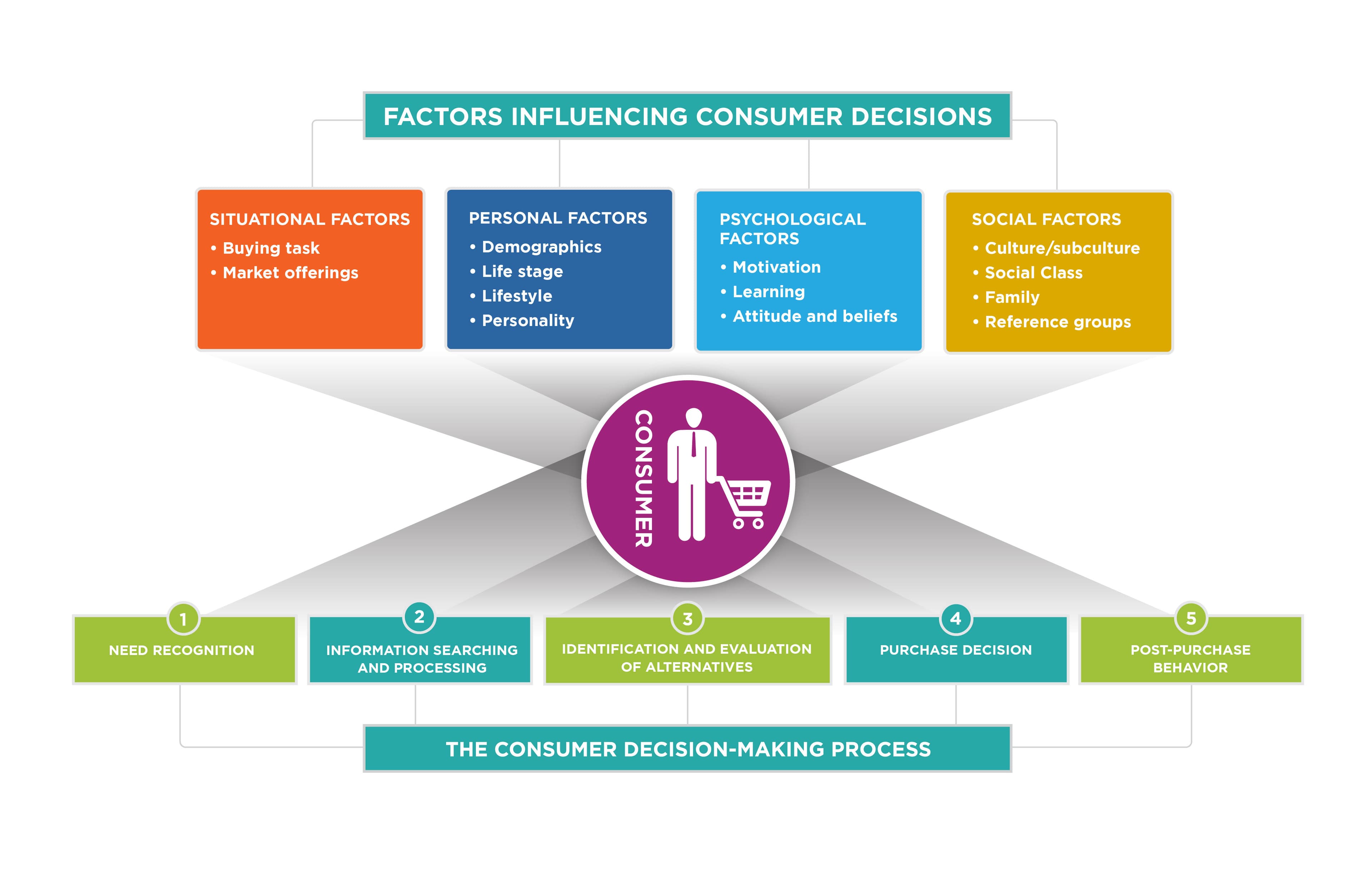
These factors fall into two broad camps. Internal factors are things happening inside the consumer's head: their personality, motivations, perceptions, and attitudes. External factors come from outside: culture, social groups, and the specific situation surrounding a purchase.
The relative importance of each factor shifts depending on:
- The individual consumer and their background
- The product or service being considered
- The specific buying situation (holiday shopping vs. a quick impulse buy)
All of these factors feed into the consumer decision-making process, which follows five stages:
- Problem recognition — You realize you have a need or want
- Information search — You look for options (online reviews, asking friends, browsing stores)
- Evaluation of alternatives — You compare your options on price, quality, features, etc.
- Purchase decision — You choose and buy
- Post-purchase behavior — You evaluate whether you're satisfied or regretful
Cultural, Social, and Personal Influences on Consumer Decisions
Cultural Factors
Cultural factors have the broadest influence on consumer behavior because they shape the lens through which people see the world.
- Culture is the set of shared values, beliefs, customs, and behaviors in a society. It shapes what people consider normal, desirable, or unacceptable. For example, gift-giving customs differ widely between cultures, which directly affects what products sell and when.
- Subcultures are smaller groups within a culture that share distinct values, interests, or experiences. These include ethnic groups (Hispanic Americans), religious communities (Southern Baptists), and geographic groups (urban residents). Each subculture can have unique consumption patterns that marketers target with tailored messaging.
- Social class refers to relatively permanent divisions in society based on socioeconomic status (income, education, occupation). Social class influences brand preferences and consumption patterns. Higher social classes may gravitate toward luxury goods, while lower social classes tend to prioritize value and practicality.
Social Factors
Social factors influence behavior through the direct and indirect pressure that other people exert on our choices.
- Reference groups are groups that serve as points of comparison when forming attitudes or making decisions. These can be membership groups you actually belong to (a professional association, a sports team) or aspirational groups you admire and want to emulate (celebrities, influencers). Aspirational groups are why celebrity endorsements work.
- Family is one of the strongest social influences on buying behavior. Within a household, different members play different roles in a purchase: the initiator identifies the need, the influencer shapes the decision, the decider makes the final call, the buyer completes the transaction, and the user actually consumes the product. These roles shift depending on the product and the family's life stage.
- Social roles and status also shape consumption. People buy products that reflect their position in various groups. A manager might prefer high-end business attire to signal authority, while a college student might choose affordable, trendy brands that fit their peer group.

Personal Factors
Personal factors are unique to each individual and change over time.
- Age and life cycle stage shift what you need and want. New parents buy baby products and minivans; retirees invest in travel and healthcare. Marketers segment audiences by life stage for this reason.
- Occupation and economic situation determine spending power. A high-income executive may prefer luxury cars, while a blue-collar worker may prioritize fuel efficiency and reliability. Economic downturns can shift entire markets toward budget-friendly options.
- Lifestyle is your pattern of living expressed through activities, interests, and opinions. An eco-conscious consumer gravitates toward sustainable and organic products, while an adventure-oriented consumer might spend heavily on outdoor gear and travel.
- Personality and self-concept shape how consumers respond to brands. People tend to choose brands whose image matches how they see themselves (or how they want to see themselves). A confident, outgoing person might be drawn to bold fashion brands, while someone who values simplicity might prefer minimalist designs.
Psychological Factors in Consumer Behavior
Motivation and Perception
Psychological factors operate beneath the surface, driving how consumers process information and make choices.
Motivation is the internal drive that pushes a person to satisfy a need. Maslow's hierarchy of needs is the classic framework here, organizing human needs into five levels:
- Physiological — food, water, shelter
- Safety — security, stability
- Love/belonging — friendships, family, community
- Esteem — recognition, status, confidence
- Self-actualization — personal growth, fulfillment
The idea is that people generally address lower-level needs before higher-level ones. A marketer selling home security systems appeals to safety needs, while a luxury brand appeals to esteem.
Perception is how people select, organize, and interpret information from the world around them. Two consumers can see the same ad and walk away with completely different impressions. Three perceptual processes explain why:
- Selective attention — You can't notice everything, so your brain filters stimuli. You're more likely to notice ads for products you're already interested in.
- Selective distortion — You tend to interpret information in ways that fit your existing beliefs. A loyal Apple user might dismiss a negative review as biased.
- Selective retention — You remember information that supports your attitudes and forget what contradicts them. That catchy jingle from your favorite brand sticks; the competitor's ad fades.
Learning, Beliefs, and Attitudes
Learning refers to changes in behavior that come from experience. It happens through three main mechanisms:
- Classical conditioning — associating a stimulus with a response (hearing a jingle and immediately thinking of a brand)
- Operant conditioning — learning from consequences (you buy a product, love it, and buy it again; or you have a bad experience and avoid the brand)
- Observational learning — watching others and modeling their behavior (seeing a friend rave about a product and deciding to try it)
Beliefs are descriptive thoughts a person holds about something, like "This brand uses high-quality materials." Attitudes are more stable evaluations, feelings, and tendencies toward an object or idea. If you have a favorable attitude toward Nike, you're more likely to buy Nike repeatedly, even without comparing alternatives each time.
Both beliefs and attitudes shape preferences and are notoriously hard to change once formed, which is why brands invest so heavily in building positive first impressions.

Situational Factors Affecting Consumer Choices
Situational factors are temporary conditions that influence behavior at the time of purchase. They can override even strong personal preferences.
Physical and Social Surroundings
Physical surroundings include everything about the environment where a purchase happens. Store layout, product placement, lighting, music, and scent all affect consumer emotions and purchase likelihood. Grocery stores place high-margin items at eye level for a reason. Bakeries vent the smell of fresh bread toward the entrance to draw people in.
Social surroundings involve the people around you during a purchase. An attentive salesperson can nudge you toward a more expensive option. Shopping with friends might make you more willing to splurge, while shopping with a budget-conscious partner might rein you in.
Temporal Factors and Purchase Task
Temporal factors relate to time. When you're in a rush, you're more likely to grab a familiar brand or make an impulse purchase rather than carefully comparing options. Seasonal timing also matters: holiday shopping, back-to-school season, and summer travel all create predictable shifts in what consumers buy and when.
Purchase task is the reason behind the purchase, and it affects how much effort you put into the decision. Buying a birthday gift for someone you care about involves more deliberation than grabbing a bag of chips. This connects to the concept of involvement level: high-involvement purchases (cars, laptops, homes) require extensive research, while low-involvement purchases (snacks, toiletries) are often made on autopilot.
Antecedent States
Antecedent states are momentary moods or temporary conditions that color your decision-making. A good mood can lead to more impulse purchases or willingness to try something new. A bad mood might cause you to avoid shopping altogether or stick rigidly to a list. Even temporary conditions like having extra cash in your pocket or feeling under the weather (reaching for cold medicine or comfort food) can shift what and how you buy.
See Fiveable more often in Google
Mark Fiveable as a preferred source and Google is more likely to show you our guides in Top Stories, with a "preferred" badge in AI Mode and AI Overviews.