3.1 Consumer Decision-Making Process

📣Intro to Marketing Unit 3 Review
3.1 Consumer Decision-Making Process
📣 Intro to Marketing
Consumer Decision-Making Process
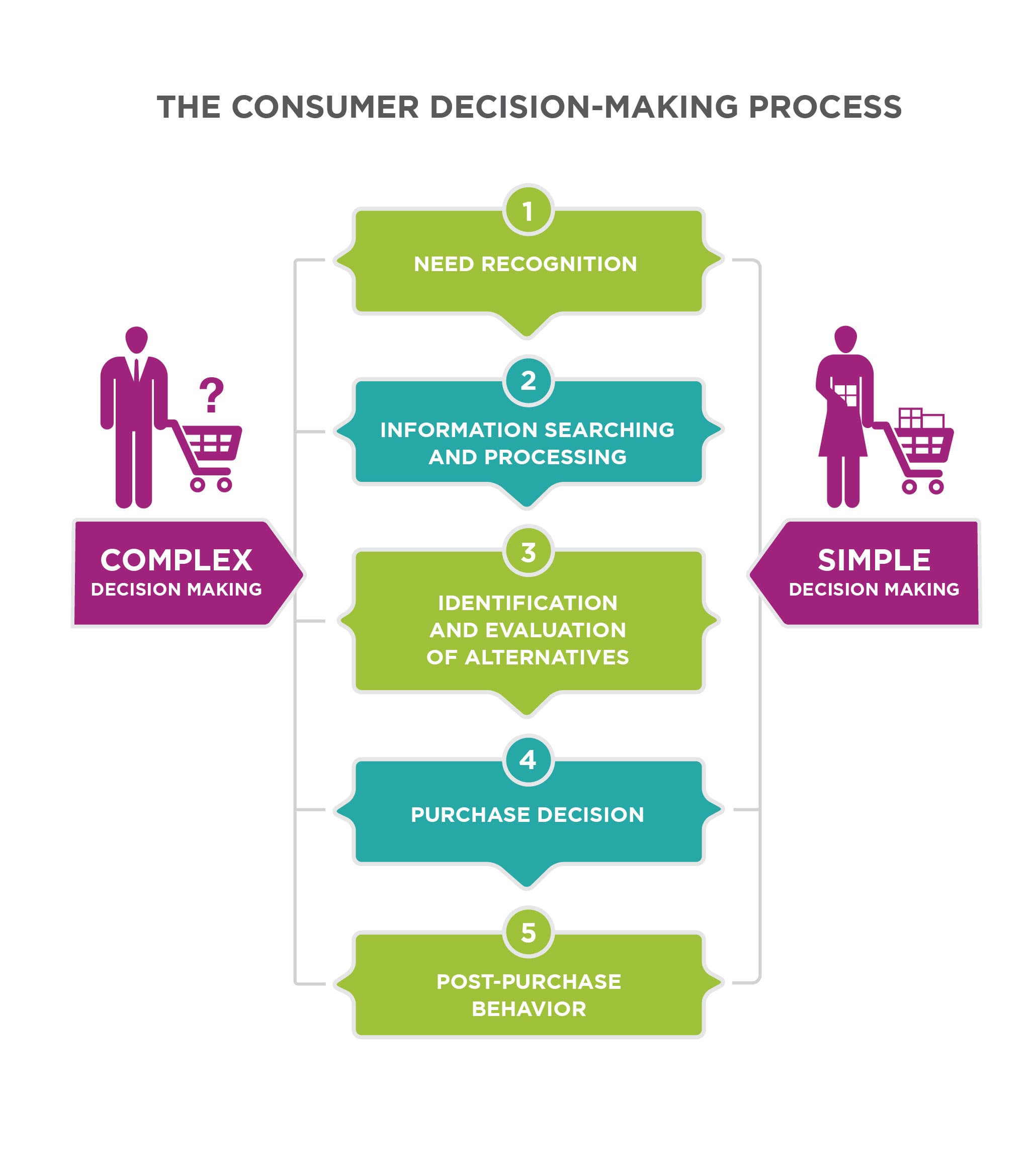
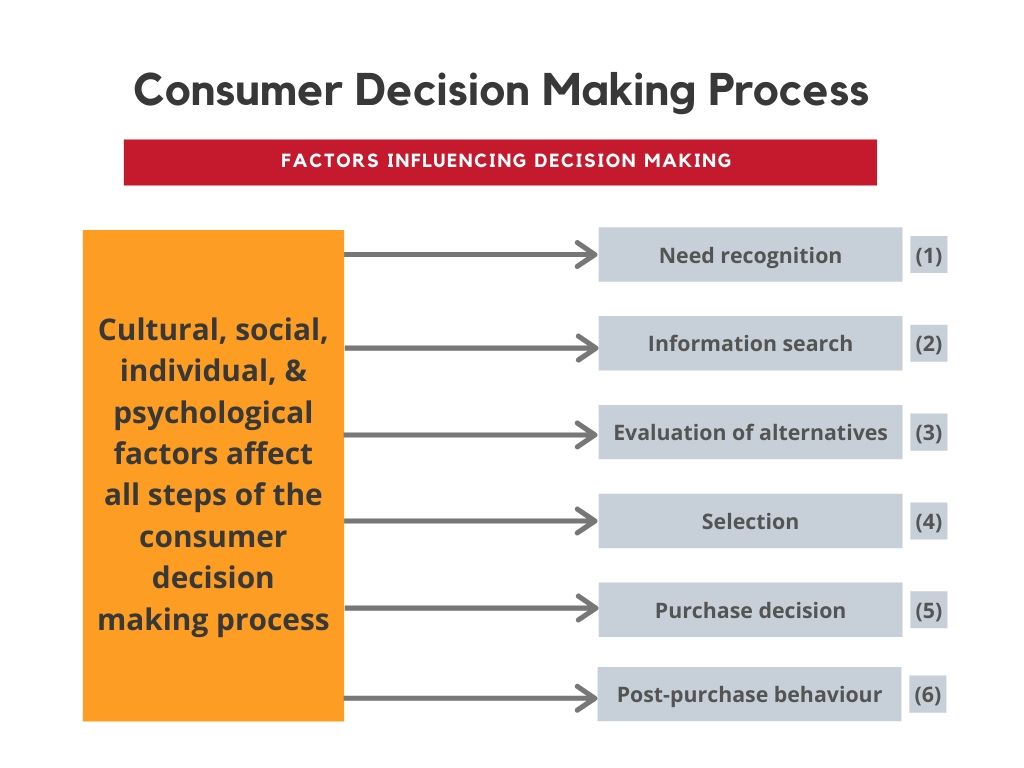
Every purchase you make follows a pattern, whether you realize it or not. The consumer decision-making process is a five-stage model that explains how people move from realizing they need something to reflecting on whether they made the right choice. Understanding this process matters because it's the foundation of consumer behavior: if you can map how people make choices, you can predict and influence those choices.
The five stages are: problem recognition, information search, evaluation of alternatives, purchase decision, and post-purchase behavior. These stages don't always happen in a neat sequence. For routine purchases like grabbing your usual cereal, you might skip straight from recognition to purchase. For big decisions like buying a car, you could spend weeks moving back and forth between stages.

Top images from around the web for Five-Stage Model
Consumer Decision Making – Introduction to Consumer Behaviour View original
Is this image relevant?
Putting It Together: Consumer Behavior | Principles of Marketing View original
Is this image relevant?
Consumer Decision Making Process – Introduction to Consumer Behaviour View original
Is this image relevant?
Consumer Decision Making – Introduction to Consumer Behaviour View original
Is this image relevant?
Putting It Together: Consumer Behavior | Principles of Marketing View original
Is this image relevant?
Level of Involvement
The amount of effort a consumer puts into this process depends on their level of involvement, which is shaped by:
- Perceived risk (financial, social, or psychological consequences of a bad choice)
- Cost (higher price usually means more deliberation)
- Personal relevance (products tied to your identity or lifestyle get more attention)
High-involvement purchases like a car or laptop require extensive research and careful comparison. Low-involvement purchases like a pack of gum involve little thought. This distinction affects how long and complex the decision process becomes.
External Influences
External factors can shape the decision-making process at every stage:
- Marketing activities (ads, promotions, packaging) can trigger need recognition, supply information during the search stage, and frame how you evaluate options.
- Social influences (recommendations from friends, family opinions, online influencers) shape preferences, spread information through word-of-mouth, and can tip the final purchase decision.
- Situational factors (time pressure, store layout, your mood) can create urgency, limit which alternatives you consider, and even change how you feel about a purchase afterward.
Recognizing Needs and Gathering Information
Problem Recognition
Problem recognition is the moment a consumer notices a gap between where they are now and where they want to be. This gap can be triggered by:
- Internal stimuli like hunger, boredom, or a phone with a cracked screen
- External stimuli like seeing an ad, noticing a friend's new sneakers, or walking past a bakery
Maslow's hierarchy of needs helps explain which needs consumers prioritize. The theory says people address lower-level needs before higher-level ones:
- Physiological needs (food, water, shelter)
- Safety needs (security, stability)
- Social needs (belonging, relationships)
- Esteem needs (prestige, status)
- Self-actualization (personal growth, fulfillment)
A consumer will prioritize buying groceries (physiological) over a luxury watch (esteem). Marketers can stimulate problem recognition by highlighting how their product fills a gap, demonstrating benefits, or creating a sense of urgency.

Information Search
Once a need is recognized, consumers gather information about potential solutions. This search takes two forms:
- Internal search: Drawing on your own memory and past experiences. You might recall that a certain brand of headphones worked well last time.
- External search: Looking beyond your own knowledge. This includes asking friends for recommendations, reading online reviews, visiting stores, or comparing products on websites.
How much searching a consumer does depends on their level of involvement, the perceived risk of making a wrong choice, and how much time they have. Someone buying a laptop will read dozens of reviews; someone buying toothpaste probably won't.
The search can also be active (deliberately researching car models before a purchase) or passive (noticing a car commercial while watching TV without intending to look for one). Both types feed into the next stage.
Evaluating Alternatives and Purchase Decisions
Evaluation of Alternatives
At this stage, consumers compare the options they've found against a set of evaluation criteria, which are the standards they use to judge each alternative. Common criteria include price, quality, brand reputation, and specific features.
For example, someone shopping for a smartphone might weigh battery life, camera quality, storage capacity, and operating system. The weight each criterion carries varies from person to person based on their values, beliefs, and past experiences. A consumer who cares about sustainability might prioritize eco-friendly materials, while a brand-loyal consumer might default to the same company every time.
Decision Rules and Heuristics
Because comparing every feature of every option is exhausting, consumers often use mental shortcuts called heuristics or decision rules to simplify the process:
- Lexicographic rule: Rank your criteria by importance, then pick whichever option scores best on the top criterion. If camera quality matters most to you, you choose the phone with the best camera regardless of other features.
- Satisficing rule: Set a minimum acceptable level for each criterion, then pick the first option that clears every bar. The first phone that meets your thresholds for battery life, storage, and price wins.
- Elimination-by-aspects rule: Go through criteria one at a time, eliminating any option that doesn't meet the minimum for each. This narrows the field step by step.
- Compensatory rule: Allow strengths in one area to offset weaknesses in another. A phone with an amazing camera but average battery life might still win if its overall score is highest.
Purchase Decision
The purchase decision is the moment you select your preferred option and complete the transaction. Even at this late stage, factors like a sudden discount, stock availability, or last-minute doubt about risk can change the outcome.
After a high-involvement purchase, consumers often experience post-decision dissonance: a nagging feeling of doubt about whether they made the right call. This is especially common with expensive or personally significant items. To ease that dissonance, people tend to seek out information that confirms their choice (like reading positive reviews after buying) or, if the doubt is strong enough, consider returning the product.
Post-Purchase Behavior and Its Impact
Consumer Satisfaction and Loyalty
Post-purchase behavior covers everything that happens after the transaction: using the product, evaluating how well it performs, and eventually disposing of it (discarding, recycling, or reselling).
Consumer satisfaction comes down to how the product's actual performance compares to what you expected:
- Confirmation: Performance matches expectations. You're satisfied.
- Positive disconfirmation: Performance exceeds expectations. You expected 12 hours of battery life but got 15. You're very satisfied.
- Negative disconfirmation: Performance falls short. Disappointment follows.
Satisfied customers are far more likely to repurchase, recommend the product to others through positive word-of-mouth, and develop brand loyalty (consistently choosing the same brand over competitors). For companies, brand loyalty translates to reduced price sensitivity, better customer retention, and higher customer lifetime value.
Dissatisfaction and Negative Behaviors
When customers are dissatisfied, the consequences for companies can be serious:
- Negative word-of-mouth: Unhappy customers tell others, damaging the brand's reputation and discouraging potential buyers.
- Seeking redress: Customers may demand refunds, exchanges, or compensation.
- Brand switching: Customers move to a competitor, costing the company revenue and market share.
To manage dissatisfaction, companies can offer responsive customer support (helplines, live chat), maintain generous return policies, and proactively collect feedback to catch problems early.
Impact on Future Decisions
Post-purchase experiences feed directly back into the decision-making process for future purchases. They update your internal knowledge about products and brands, and they reshape the criteria you'll use next time.
- Positive experiences build brand trust and loyalty, making you more likely to repurchase or recommend.
- Negative experiences can lead to brand avoidance, more extensive information searching, and stricter evaluation of alternatives the next time around.
Companies try to reinforce positive experiences through personalized recommendations, loyalty programs with rewards or exclusive perks, and ongoing communication like newsletters or social media engagement. The goal is to keep the cycle spinning in their favor: a good post-purchase experience today makes you an easier customer to win tomorrow.
See Fiveable more often in Google
Mark Fiveable as a preferred source and Google is more likely to show you our guides in Top Stories, with a "preferred" badge in AI Mode and AI Overviews.