1.1 Definition and Scope of Marketing

📣Intro to Marketing Unit 1 Review
1.1 Definition and Scope of Marketing
📣 Intro to Marketing
Marketing: Definition and Concepts
Marketing is the process of understanding what people need and want, then creating and delivering products or services that meet those desires. It sits at the center of how businesses create value for customers while also generating profit. This section covers the core concepts behind marketing, the tools marketers use (especially the 4 Ps), and how strategy and tactics work together.

Top images from around the web for Core Marketing Concepts
Marketing Defined | Principles of Marketing View original
Is this image relevant?
Putting It Together: Marketing Function | Principles of Marketing View original
Is this image relevant?
Implementing Positioning Strategy | Principles of Marketing View original
Is this image relevant?
Marketing Defined | Principles of Marketing View original
Is this image relevant?
Putting It Together: Marketing Function | Principles of Marketing View original
Is this image relevant?
Core Marketing Concepts
The American Marketing Association defines marketing as the activity, set of institutions, and processes for creating, communicating, delivering, and exchanging offerings that have value for customers, clients, partners, and society at large. That's a mouthful, but the key idea is straightforward: marketing is about creating and delivering value.
A few foundational terms you need to know:
- Needs are basic states of felt deprivation. Think food, shelter, safety, belonging. These exist whether or not marketers do anything.
- Wants are what needs look like once they're shaped by culture and personality. You need food; you want a specific brand of ramen or a steak dinner.
- Demand is what happens when wants are backed by purchasing power. Lots of people want a sports car, but demand only exists among those who can actually buy one.
Beyond these, marketers work with concepts like target markets (the specific group of customers you're trying to reach), segmentation (dividing a broad market into smaller groups), positioning (how your product is perceived relative to competitors), and exchange (the act of obtaining something of value by offering something in return).
Marketing's Role in Meeting Needs
Marketing has two core jobs: attract new customers by promising superior value, and keep current customers by delivering satisfaction. That means marketers need to identify unmet needs and develop offerings that address them better than the competition does.
This goes beyond just selling a product. Strong marketing builds relationships with customers that lead to loyalty and long-term retention. A few companies that do this well:
- Apple designs technology that's intuitive and tightly integrated, so customers stay within its ecosystem.
- Amazon built its business around convenience, from one-click ordering to fast delivery through Prime.
- Nike connects high-performance athletic gear with aspirational branding that resonates emotionally with consumers.
Marketing Mix Components

The 4 Ps of Marketing
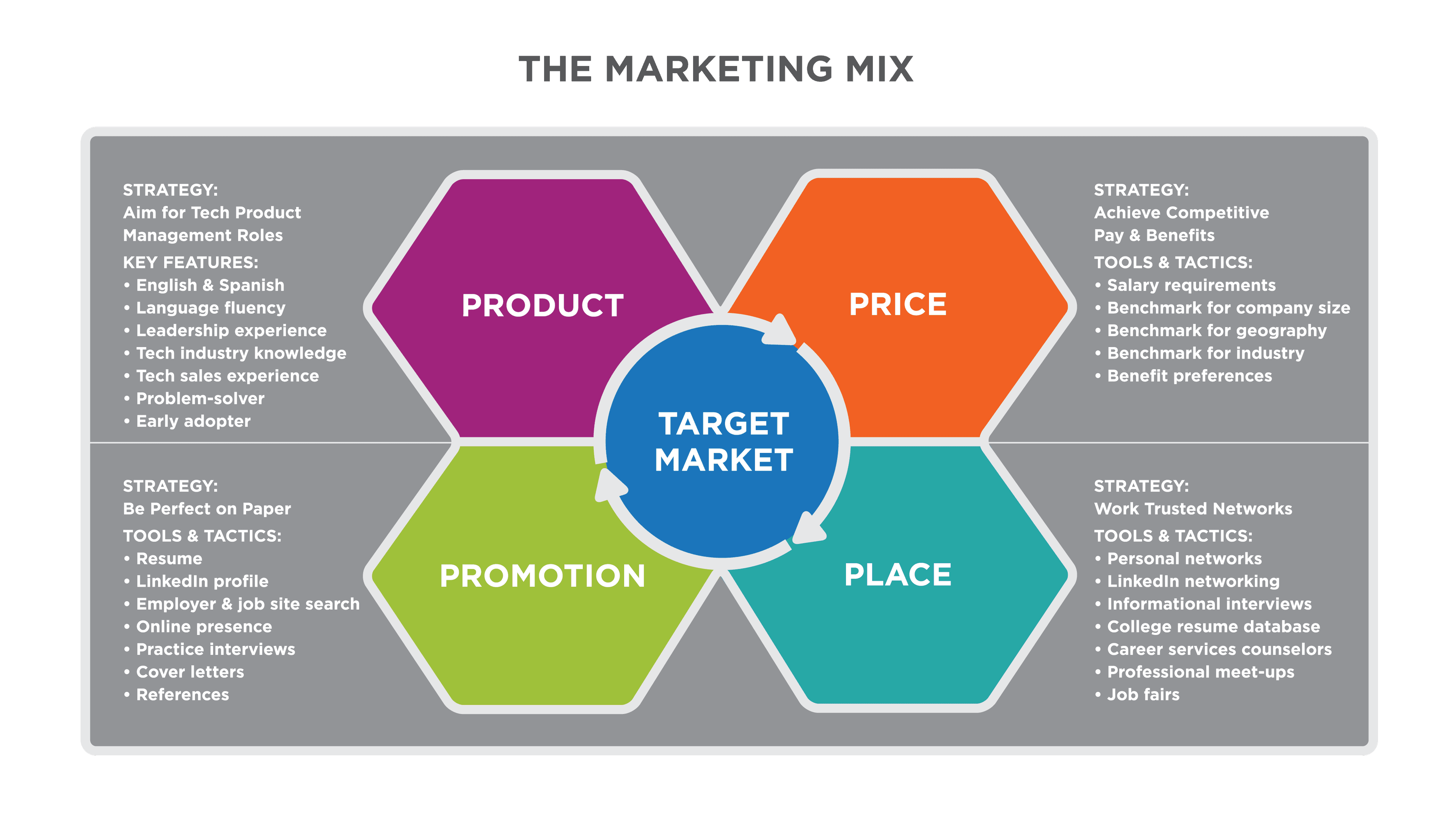
The marketing mix (also called the 4 Ps) is the set of tools a company uses to pursue its marketing objectives. Every marketing decision falls into one of these four categories:
- Product: The goods or services offered to the target market. This includes quality, design, features, brand name, packaging, and any associated services (like warranties).
- Price: What customers pay to obtain the product. Pricing decisions involve list price, discounts, payment terms, and credit options. Price signals value, so it has to match the positioning.
- Place (Distribution): How the product gets to the customer. This covers distribution channels, retail locations, online availability, inventory management, and logistics.
- Promotion: How you communicate the product's value and persuade customers to buy. This includes advertising, personal selling, sales promotions, and public relations.
Balancing the Marketing Mix
An effective marketing strategy requires all four Ps to work together as a cohesive whole. Each element should reinforce the others. If you position a product as premium, a rock-bottom price will confuse customers. If you sell a convenience product, it needs to be easy to find (wide distribution).
Overemphasizing one element at the expense of others creates problems. Slashing prices to drive sales, for example, can erode perceived quality and hurt the brand long-term.
Two examples of well-balanced mixes:
- Coca-Cola pairs a consistent, recognizable product with global distribution and iconic advertising. Every element reinforces the brand.
- Apple combines innovative products with premium pricing, sleek retail stores, and carefully targeted promotions. The high price supports the perception of quality rather than working against it.
Marketing for Customer Value

Creating Value for Customers
Value in marketing isn't just about low prices. It's the balance between what a customer gets (benefits) and what they give up (costs).
Benefits come in three forms:
- Functional benefits: The product's actual performance and utility. A car's fuel efficiency, a phone's battery life.
- Emotional benefits: The positive feelings tied to the product. The prestige of a luxury watch, the comfort of a trusted brand.
- Social benefits: How the product affects your relationships or status. Driving an electric vehicle might signal environmental values to others.
Costs also go beyond money. Customers spend time researching, energy learning how to use a product, and sometimes deal with psychological costs like buyer's anxiety. Marketers who reduce these costs while increasing benefits create stronger value propositions.
Building Customer Relationships
The goal of modern marketing isn't a single transaction. It's building ongoing relationships that increase customer lifetime value, which is the total revenue a business can expect from a single customer over the course of their relationship.
Companies build these relationships through:
- Personalized marketing: Tailoring messages and offers to individual preferences (Amazon's recommendation engine is a classic example)
- Excellent customer service: Zappos built its entire brand reputation around going above and beyond for customers
- Loyalty programs: Starbucks Rewards creates repeat visits by offering free drinks and personalized perks
The common thread is that these companies listen to feedback and continuously improve their offerings to meet evolving customer expectations.
Marketing: Strategy vs. Tactics
Strategic Marketing
Strategic marketing is the big-picture planning. It focuses on long-term direction: who are we trying to reach, how do we want to be perceived, and where should we allocate resources?
The core framework here is STP:
- Segmentation: Divide the broader market into distinct groups based on different needs, demographics, behaviors, or characteristics. A shoe company might segment by athletic activity (running, basketball, hiking).
- Targeting: Evaluate each segment's size, growth potential, and fit with your capabilities, then select one or more segments to focus on.
- Positioning: Define how your product should be perceived in the minds of your target customers relative to competitors. Volvo positions on safety. Red Bull positions on energy and extreme lifestyle.
Strategic decisions are typically made by senior management and align with the company's overall mission and vision.
Tactical Marketing
Tactical marketing is the day-to-day execution that brings the strategy to life. While strategy asks "what should we do?", tactics ask "how exactly do we do it?"
Examples of tactical decisions:
- Designing product packaging for a new launch
- Running a 20%-off holiday promotion
- Choosing whether to sell through retail stores, online, or both
- Creating a social media advertising campaign
Tactical decisions are usually made by middle and lower-level managers. They're shorter-term and more adaptable to changing conditions. If a promotion isn't working, you can adjust it quickly without rethinking the entire strategy.
Both levels are essential. Strategy without tactics is just a plan on paper. Tactics without strategy are random actions with no clear direction. The strategy provides the roadmap; tactics are how you drive it.
See Fiveable more often in Google
Mark Fiveable as a preferred source and Google is more likely to show you our guides in Top Stories, with a "preferred" badge in AI Mode and AI Overviews.