11.2 Corporate Social Responsibility

📣Intro to Marketing Unit 11 Review
11.2 Corporate Social Responsibility
📣 Intro to Marketing
Corporate Social Responsibility Defined
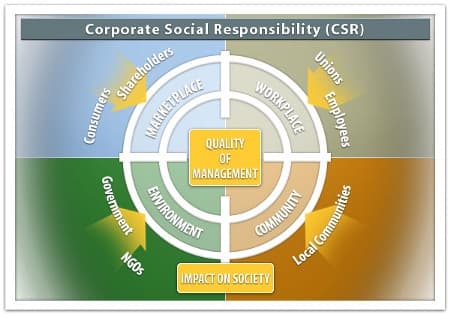
Corporate social responsibility (CSR) is a business model where companies voluntarily integrate social and environmental concerns into their operations and stakeholder interactions. It goes beyond just turning a profit. CSR matters because consumers, investors, and employees increasingly expect businesses to take responsibility for their broader impact on society and the environment.

Top images from around the web for Key Aspects and Importance
Corporate social responsibility - Wikipedia View original
Is this image relevant?
Corporate Social Responsibility | Boundless Management View original
Is this image relevant?
18.10: What is Corporate Social Responsibility? - Business LibreTexts View original
Is this image relevant?
Corporate social responsibility - Wikipedia View original
Is this image relevant?
Corporate Social Responsibility | Boundless Management View original
Is this image relevant?
Key Aspects and Importance
CSR covers several overlapping areas: ethical behavior, sustainable practices, community engagement, and transparency. A company practicing CSR doesn't just follow the law. It actively considers how its decisions affect people and the planet.
Implementing CSR helps companies build trust and enhance their reputation over time. It also plays a role in attracting and retaining talented employees who want to work for organizations that share their values. For an intro marketing course, the key takeaway is that CSR shapes how a brand is perceived, and perception drives consumer behavior.
Benefits of CSR Implementation
- Improved brand image and reputation — consumers view the company more favorably
- Increased customer loyalty — people tend to stick with brands whose values align with their own
- Enhanced employee engagement and retention — workers are more motivated when they feel their company does good
- Long-term cost savings through sustainable practices like energy efficiency and waste reduction
- Competitive differentiation — CSR can set a brand apart in crowded markets
- Attraction of socially conscious investors who screen for environmental and social performance
- Innovation — CSR goals push companies to develop things like eco-friendly packaging or more sustainable supply chains
Dimensions of CSR
A helpful way to understand CSR is through four dimensions, often visualized as a pyramid (sometimes called Carroll's CSR Pyramid). Each level builds on the one below it.

Economic and Legal Responsibilities
Economic responsibilities form the base. A company must generate profits and create value for shareholders. Without financial viability, none of the other dimensions are possible. But CSR asks companies to consider how they make money, not just how much.
Legal responsibilities require companies to comply with all applicable laws and regulations, including labor laws, environmental regulations, and consumer protection statutes. These aren't optional. They're the minimum standard society expects.
Balancing these two dimensions often involves trade-offs. For example, complying with stricter environmental regulations may raise costs in the short term but protect the company from fines and reputational damage later.
Ethical and Philanthropic Responsibilities
Ethical responsibilities go beyond what the law requires. They involve adhering to moral principles like fairness, integrity, and respect for human rights. Examples include ensuring fair labor practices throughout a supply chain, protecting customer privacy beyond what's legally mandated, and avoiding misleading advertising.
Philanthropic responsibilities sit at the top of the pyramid. These are voluntary contributions to society: charitable donations, community development programs, employee volunteering initiatives, sponsoring local events, providing scholarships, or supporting disaster relief. Philanthropy isn't expected the way legal and ethical behavior is, but it significantly boosts a company's reputation and community relationships.
Benefits and Challenges of CSR

Challenges of CSR Implementation
CSR isn't without friction. Here are the most common obstacles companies face:
- High initial costs — investing in sustainable materials, fair-trade sourcing, or community programs requires upfront spending
- Measurement difficulty — quantifying the social or environmental impact of CSR initiatives is genuinely hard, which makes it tough to justify spending to shareholders
- Short-term vs. long-term tension — CSR goals can conflict with quarterly financial targets, creating pressure from investors focused on immediate returns
- Leadership and integration — embedding CSR into core strategy (rather than treating it as a side project) requires strong commitment from top management and clear internal communication
- Stakeholder balancing — shareholders, employees, customers, and local communities may have competing expectations about what a company should prioritize
Overcoming Challenges and Maximizing Benefits
Companies that succeed with CSR tend to follow a few common practices:
- Align CSR with core values and competencies. A tech company donating computers to schools makes more strategic sense than sponsoring an unrelated cause.
- Engage stakeholders early. Understand what customers, employees, and communities actually care about before launching initiatives.
- Establish clear metrics and reporting. Track outcomes (e.g., tons of waste diverted, volunteer hours logged) and communicate results transparently.
- Build CSR into company culture. Include social responsibility in employee training and performance evaluations so it becomes part of daily operations.
- Collaborate with partners. Working with NGOs, industry groups, and local organizations amplifies impact and brings in outside expertise.
CSR in Action
Patagonia and Unilever
Patagonia, the outdoor clothing company, is one of the most frequently cited CSR examples. Its commitment to environmental sustainability includes using recycled materials in its products, donating 1% of sales to grassroots environmental organizations, and promoting fair labor practices across its supply chain. Patagonia has even run ads telling customers not to buy its products unless they truly need them, reinforcing its environmental mission over short-term sales.
Unilever, a multinational consumer goods company, built CSR into its business strategy through its Sustainable Living Plan. That plan set specific targets: sourcing 100% of agricultural raw materials sustainably, reducing greenhouse gas emissions across its value chain, and improving access to hygiene and sanitation in developing countries. Unilever's approach shows how a large corporation can tie CSR directly to measurable business goals.
Starbucks and TOMS Shoes
Starbucks focuses its CSR efforts on ethical sourcing through its C.A.F.E. (Coffee and Farmer Equity) Practices program. This program sets standards for ethical sourcing, fair wages for farmers, and environmental stewardship throughout its coffee supply chain. Starbucks also invests in farmer support centers and has pursued sustainable packaging initiatives.
TOMS Shoes became well known for its "one for one" model: for every pair of shoes purchased, TOMS donated a pair to a child in need. The company later expanded this model to include eyewear, clean water access, and safe birth initiatives. It's worth noting that TOMS has faced criticism over whether this donation model creates dependency or undercuts local shoe markets, which is a useful reminder that even well-intentioned CSR can have unintended consequences. (TOMS has since shifted toward donating a portion of profits to grassroots organizations rather than product-for-product giving.)
See Fiveable more often in Google
Mark Fiveable as a preferred source and Google is more likely to show you our guides in Top Stories, with a "preferred" badge in AI Mode and AI Overviews.