4.3 Types of Marketing Research

📣Intro to Marketing Unit 4 Review
4.3 Types of Marketing Research
📣 Intro to Marketing
Primary vs. Secondary Research
Every marketing research project starts with a fundamental choice: do you collect new data yourself, or do you work with data that already exists? This distinction between primary and secondary research shapes your timeline, budget, and the kind of insights you'll get.

Top images from around the web for Primary Research: Collecting New Data
Reading: The Marketing Research Process | Introduction to Marketing View original
Is this image relevant?
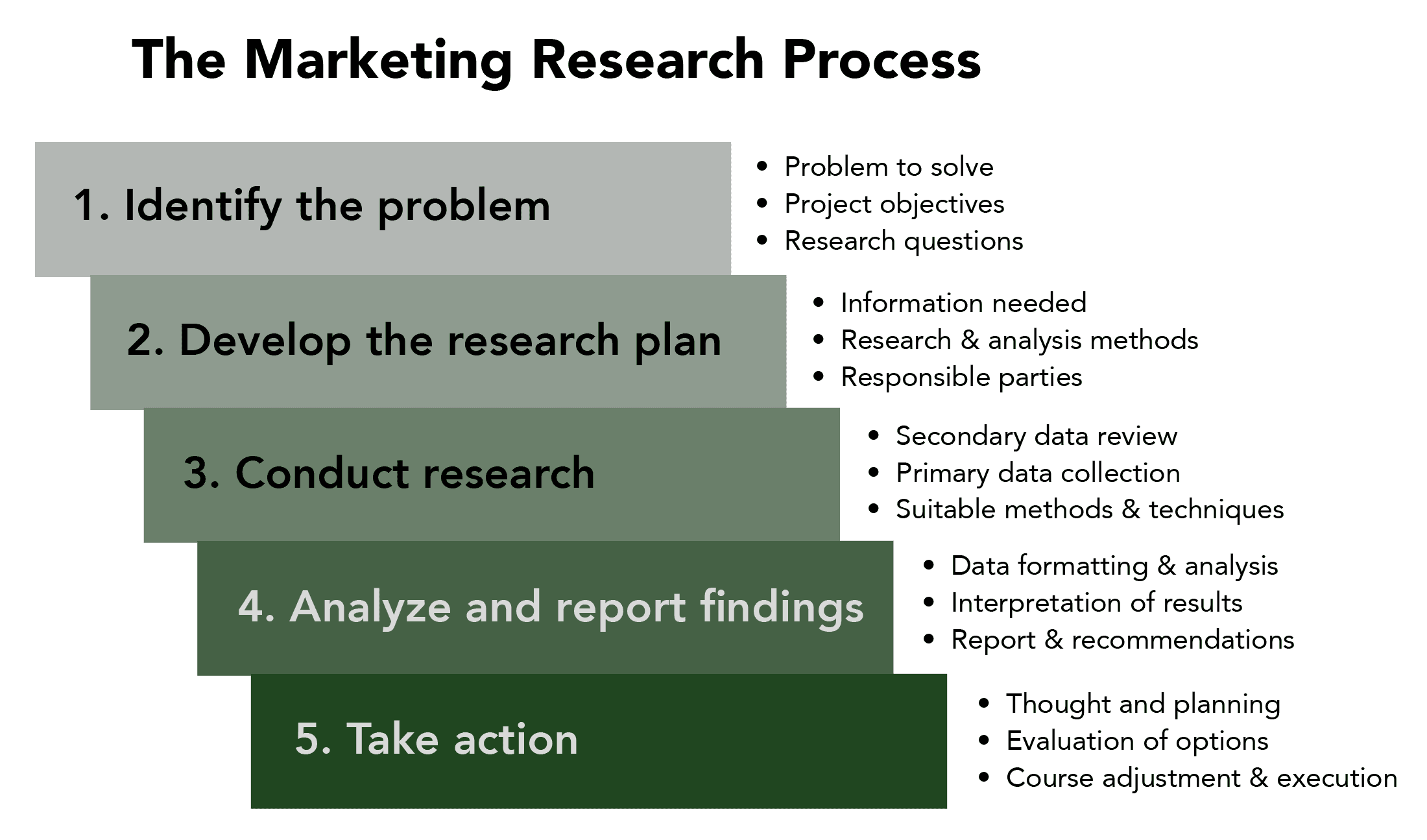
The Marketing Research Process | Introduction to Business View original
Is this image relevant?
Reading: Primary Marketing Research Methods | Introduction to Marketing View original
Is this image relevant?
Reading: The Marketing Research Process | Introduction to Marketing View original
Is this image relevant?
The Marketing Research Process | Introduction to Business View original
Is this image relevant?
Primary Research: Collecting New Data
Primary research means going directly to the source to gather fresh data tailored to your specific question. Methods include surveys, interviews, focus groups, and observations.
- Tailored and current. Because you design the study, the data directly addresses your research objectives.
- Greater control. You decide the questions, the sample, and the methodology, so you can ensure data quality and relevance.
- More expensive and time-consuming. Designing a survey, recruiting participants, and analyzing results takes real resources. A national consumer survey, for example, can cost tens of thousands of dollars and take weeks to complete.
Secondary Research: Analyzing Existing Data
Secondary research uses data someone else has already collected. Sources include company sales records, government census data, industry reports (like those from IBISWorld or Statista), and published academic studies.
- Faster and cheaper. You skip the data collection phase entirely, which saves significant time and money.
- Good starting point. Secondary data helps you understand the landscape before investing in primary research.
- Potential drawbacks. The data may be outdated, collected for a different purpose, or not specific enough for your question. You also can't control how it was gathered, so quality varies.
A common approach is to start with secondary research to understand what's already known, then use primary research to fill in the gaps.
Qualitative vs. Quantitative Research
Beyond where data comes from, you also need to decide what kind of data you need. Qualitative and quantitative research answer fundamentally different types of questions.
Qualitative Research: Non-Numerical Data
Qualitative research explores the "why" and "how" behind people's behavior. It collects non-numerical data like opinions, attitudes, and experiences through open-ended interviews, focus groups, or observation.
- Rich and detailed. A focus group discussing why they switched brands can reveal motivations that a survey would never capture.
- Exploratory and flexible. Researchers can follow up on unexpected responses and dig deeper in real time.
- Harder to generalize. Sample sizes are typically small (8–12 people in a focus group, for instance), and participants aren't randomly selected, so findings may not represent the broader population.
- Best for: understanding complex issues, exploring new topics, and generating hypotheses for further testing.

Quantitative Research: Numerical Data
Quantitative research measures things with numbers. It uses structured surveys, experiments, or statistical analysis of existing datasets to test hypotheses and identify patterns.
- Objective and measurable. Results can be expressed as percentages, averages, or statistical relationships (e.g., "72% of respondents preferred Package A").
- Generalizable. With large, randomly selected samples, findings can be applied to the broader population with confidence.
- Less depth. A survey can tell you that 60% of customers are dissatisfied, but not necessarily why.
- Best for: measuring behaviors, testing theories, tracking trends, and establishing cause-and-effect relationships.
Mixed Methods: Combining Approaches
Mixed methods research uses both qualitative and quantitative techniques in the same study. For example, a company might run focus groups (qualitative) to identify key themes about customer dissatisfaction, then design a large-scale survey (quantitative) to measure how widespread those issues are.
This approach strengthens findings through triangulation, where different data sources confirm the same conclusion, boosting the validity and reliability of results.
Research Designs: Exploratory, Descriptive, and Causal
Research design refers to the overall plan for how you'll answer your research question. The three main designs differ in their purpose and the level of certainty they provide.
Exploratory Research: Gaining Initial Insights
Exploratory research is used when you don't know much about a problem yet. The goal is to clarify the issue, identify key variables, and develop hypotheses for future study.
- Typically uses qualitative methods: in-depth interviews, focus groups, or review of secondary data.
- Flexible and open-ended. There's no rigid structure because you're still figuring out what questions to ask.
- Example: A coffee chain noticing declining foot traffic might conduct exploratory interviews with customers to understand possible reasons before committing to a larger study.

Descriptive Research: Describing Characteristics and Trends
Descriptive research paints a detailed picture of what's happening right now. It answers "who," "what," "where," and "when" questions.
- Typically uses quantitative methods: structured surveys, observational counts, or analysis of existing databases.
- More structured than exploratory research because you already know what you're measuring.
- Example: A clothing retailer surveying 2,000 customers to profile its core demographic (age, income, shopping frequency) is conducting descriptive research. This data is useful for market segmentation and benchmarking.
Causal Research: Establishing Cause-and-Effect
Causal research goes a step further by testing whether one variable actually causes a change in another. This is the most rigorous design.
- Typically uses experiments with control and treatment groups. For instance, showing one group of shoppers a new ad and another group the old ad, then comparing purchase rates.
- Requires careful control of outside variables so you can isolate the effect you're testing.
- Example: An e-commerce company running an A/B test to determine whether free shipping (the independent variable) increases average order value (the dependent variable).
Choosing the Right Research Type
Selecting the right approach means matching your research design to both your objectives and your constraints.
Match the Design to Your Objective
- Little is known about the problem? Start with exploratory research to define the issue and generate hypotheses.
- Need to describe a market or population? Use descriptive research to measure characteristics, behaviors, or trends.
- Need to prove that X causes Y? Use causal research with controlled experiments.
Many projects move through these stages sequentially: exploratory first to define the problem, then descriptive or causal research to measure and test.
Factor in Your Constraints
Even the ideal research design has to work within practical limits:
- Budget and time. Causal experiments are rigorous but expensive. Secondary research is fast but may lack specificity.
- Access to participants. Can you reach your target population? Are they willing to participate?
- Team expertise. Running a controlled experiment requires different skills than moderating a focus group.
The key trade-off is between depth, breadth, and generalizability on one side and feasibility and cost on the other. A well-chosen research type balances what you need to know with what you can realistically accomplish.
See Fiveable more often in Google
Mark Fiveable as a preferred source and Google is more likely to show you our guides in Top Stories, with a "preferred" badge in AI Mode and AI Overviews.