5.5 Service Marketing Strategies

📣Intro to Marketing Unit 5 Review
5.5 Service Marketing Strategies
📣 Intro to Marketing
Services vs Goods: Marketing Implications
Services require different marketing strategies than physical goods because of four key characteristics that make them harder to sell, deliver, and evaluate. Understanding these differences is the foundation of everything else in this section.

Top images from around the web for Characteristics of Services and Physical Goods
Putting It Together: Marketing Function | Introduction to Marketing View original
Is this image relevant?
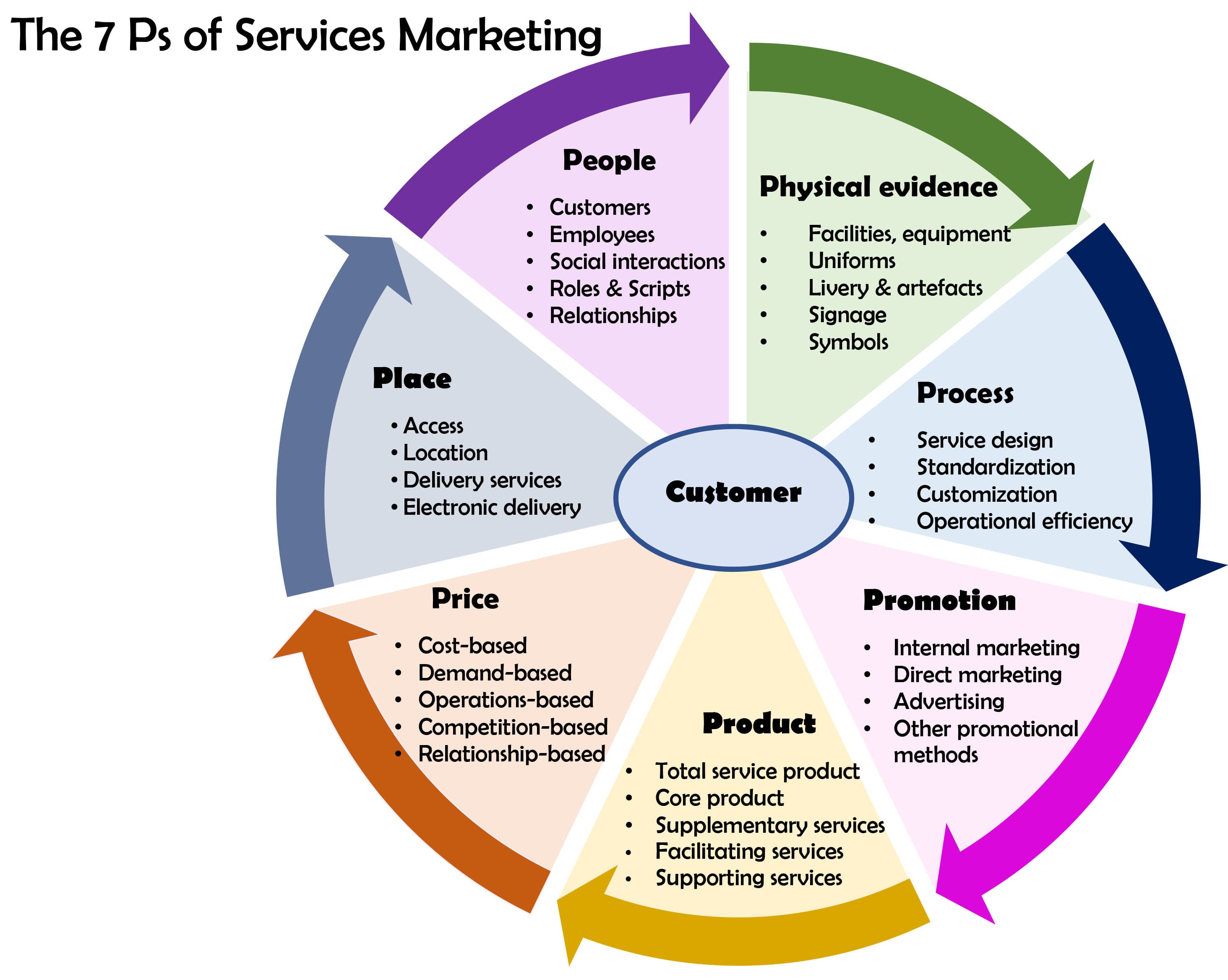
File:7 ps of services marketing.jpg - Wikimedia Commons View original
Is this image relevant?
Products and Marketing Mix | Principles of Marketing View original
Is this image relevant?
Putting It Together: Marketing Function | Introduction to Marketing View original
Is this image relevant?
File:7 ps of services marketing.jpg - Wikimedia Commons View original
Is this image relevant?
Characteristics of Services and Physical Goods
Services have four defining traits, each with direct marketing consequences:
- Intangibility means services can't be seen, touched, or tried before purchase. A customer buying a consulting engagement can't inspect it the way they'd inspect a laptop. This makes it harder for customers to evaluate quality and value upfront, so marketers rely on tangible cues like employee uniforms, facility cleanliness, and professional certifications.
- Variability means service quality depends on who delivers it, when, and where. A haircut from one stylist at a salon may be great while another's is mediocre. This human dependence requires training, standardization, and quality control. McDonald's franchise model is a classic example of minimizing variability through strict procedures.
- Perishability means services can't be stored or inventoried. An empty airline seat on a Tuesday flight is lost revenue forever. This forces careful management of demand and capacity through strategies like dynamic pricing.
- Inseparability means production and consumption happen at the same time. A dentist can't produce a cleaning in advance and ship it to you. The customer is present during delivery, which makes every interaction part of the product itself.
Physical goods, by contrast, are tangible, standardized, storable, and separable from their production and consumption.
Implications for Marketing Strategies
Each characteristic calls for a specific strategic response:
- For intangibility: Emphasize tangible evidence of quality. Customer testimonials, before-and-after photos, professional certifications, and clean, well-designed facilities all help customers feel confident about what they're buying.
- For variability: Build standardization into delivery. Call center scripts, hotel room cleaning checklists, and detailed training programs reduce inconsistency across locations and employees.
- For perishability: Use demand management strategies. Reservation systems, dynamic pricing, and off-peak discounts help optimize capacity. Uber's surge pricing is a well-known example of adjusting price to match real-time demand.
- For inseparability: Focus on the delivery experience itself. Friendly, knowledgeable staff and efficient processes (like streamlined check-in) directly shape how customers perceive the service.
Challenges of Marketing Services

Overcoming Intangibility and Variability
Since customers can't evaluate a service before buying it, perceived risk is high. Marketers address this in several ways:
- Tangible cues and branding communicate quality before purchase. Hotel websites show room photos, airlines publish safety records, and law firms display credentials prominently.
- Guarantees and service level agreements reduce perceived risk. Money-back guarantees, on-time delivery promises, and satisfaction pledges give customers a safety net.
- Strong brand identity builds trust over time. Marriott's reputation for consistent quality and FedEx's association with reliability both help customers feel confident choosing those providers over unknowns.
Variability is tackled through ongoing quality control:
- Mystery shopper programs and customer feedback surveys catch inconsistencies before they become patterns.
- Standardized training ensures every employee delivers the service to the same standard, regardless of location.
Managing Perishability and Simultaneous Production and Consumption
Perishability creates a constant balancing act between supply and demand. Empty hotel rooms during off-season and unsold concert tickets represent revenue that's gone forever.
Yield management techniques help optimize revenue:
- Track demand patterns to forecast busy and slow periods
- Adjust pricing dynamically (raise prices during high demand, discount during low demand)
- Use overbooking strategically to account for no-shows (airlines routinely do this)
- Offer incentives to shift demand to off-peak times (happy hour pricing, weekday hotel discounts)
Because production and consumption happen simultaneously, the customer is always "in the factory." This means:
- Customer expectations need to be managed proactively. A dentist explaining a procedure before starting it reduces anxiety and improves the experience.
- Technology can streamline delivery and reduce friction. Online check-in for flights, self-service kiosks at hotels, and mobile ordering at restaurants all improve efficiency while keeping customers satisfied.
Elements of the Services Marketing Mix
The traditional marketing mix (4 Ps) applies to services, but it's not enough. Services add three more elements to account for the human and experiential dimensions of service delivery.

Core Elements: Product, Price, Place, and Promotion
- Product includes both the core service and any supplementary features that enhance the experience. For an airline, the core service is transportation, but in-flight entertainment, lounge access, and priority boarding are supplementary services that add value.
- Price must account for intangibility. Customers can't physically compare services the way they compare goods on a shelf, so perceived value matters more. Consulting firms often use value-based pricing (charging based on the outcome delivered) rather than cost-plus pricing.
- Place refers to where and how the service is delivered. This could be physical locations (bank branches, dental offices), digital platforms (mobile banking apps, telehealth), or a hybrid of both. The trend toward omnichannel delivery means many services now need to work seamlessly across multiple touchpoints.
- Promotion focuses on building trust and encouraging trial. Since customers can't test a service beforehand, strategies like social media campaigns, referral programs, free consultations, and online reviews help reduce uncertainty and drive first-time purchases.
Extended Elements: People, Process, and Physical Evidence
These three additions are what distinguish the services marketing mix (sometimes called the 7 Ps) from the traditional 4 Ps:
- People are the employees who deliver the service. In many cases, the employee is the service from the customer's perspective. The Ritz-Carlton empowers every employee to spend up to $2,000 to resolve a guest issue without manager approval. Recruitment, training, and motivation directly affect service quality.
- Process is the design of the service delivery system. Every step a customer goes through, from booking to payment, is part of the process. A streamlined grocery store checkout or a well-organized airport security line can make or break the experience. Good process design reduces wait times, eliminates confusion, and creates consistency.
- Physical evidence includes all the tangible elements that surround the service. Comfortable waiting areas, modern medical equipment, clean restaurants, and professional employee attire all shape customer perceptions of quality. Since the service itself is intangible, these physical cues become proxies for quality in the customer's mind.
All seven elements need to work together. A theme park, for example, carefully coordinates its layout (physical evidence), ride operations (process), and cast member training (people) to create a cohesive experience.
Customer Service and Service Quality
Building Customer Satisfaction and Loyalty
Customer service covers every interaction between the provider and the customer: pre-sale (product information, quotes), during-sale (the actual service delivery), and post-sale (order tracking, returns, follow-up support).
Service quality is the gap between what customers expect and what they actually experience. The SERVQUAL model measures this across five dimensions:
- Reliability: Can the provider deliver the promised service consistently? (flights departing on time)
- Assurance: Do employees inspire confidence through knowledge and courtesy? (a financial advisor who clearly explains investment options)
- Tangibles: Are the physical facilities, equipment, and appearance professional? (a clean, modern clinic)
- Empathy: Does the provider show genuine care and individual attention? (a hotel remembering a returning guest's preferences)
- Responsiveness: Is the provider willing and quick to help? (a tech support team that resolves issues on the first call)
A helpful mnemonic: RATER (Reliability, Assurance, Tangibles, Empathy, Responsiveness).
When service quality is high, customer satisfaction increases, which drives loyalty. Loyal customers continue purchasing and recommend the provider to others. Frequent flyer programs and referral incentives are common tools for reinforcing this loyalty loop.
Measuring and Improving Service Quality
Even the best service providers experience failures. Service recovery is how a company responds when things go wrong, and it follows a general pattern:
- Acknowledge the problem and apologize sincerely
- Resolve the issue as quickly as possible
- Offer appropriate compensation (discount, refund, free service)
- Follow up to confirm the customer is satisfied
Strong service recovery can actually increase loyalty. Customers who have a problem resolved well sometimes rate the company higher than customers who never had a problem at all. This is known as the service recovery paradox.
To improve service quality over time, companies use several tools:
- Net Promoter Score (NPS) asks customers how likely they are to recommend the service on a 0-10 scale. It's a quick, widely used measure of loyalty.
- Customer satisfaction surveys capture more detailed feedback on specific aspects of the experience.
- Mystery shopping and competitive benchmarking reveal how the company's service compares to competitors and industry standards.
- Continuous improvement programs like Six Sigma and regular employee training help providers adapt to changing customer expectations and maintain consistency.
See Fiveable more often in Google
Mark Fiveable as a preferred source and Google is more likely to show you our guides in Top Stories, with a "preferred" badge in AI Mode and AI Overviews.