5.3 Product Life Cycle Strategies

📣Intro to Marketing Unit 5 Review
5.3 Product Life Cycle Strategies
📣 Intro to Marketing
Products don't last forever. They go through predictable stages, and the strategies that work at launch won't work when the market is saturated. The product life cycle (PLC) model maps out these stages so companies can adjust their marketing, pricing, and development decisions at the right time.
Product Life Cycle Stages

Top images from around the web for Introduction, Growth, Maturity, and Decline
Free Product Lifecycle PowerPoint Template - Free PowerPoint Templates - SlideHunter.com View original
Is this image relevant?
Free Product Life Cycle Curve PowerPoint Template - Free PowerPoint Templates - SlideHunter.com View original
Is this image relevant?
Free Product Lifecycle PowerPoint Template - Free PowerPoint Templates - SlideHunter.com View original
Is this image relevant?
Free Product Life Cycle Curve PowerPoint Template - Free PowerPoint Templates - SlideHunter.com View original
Is this image relevant?
Introduction, Growth, Maturity, and Decline
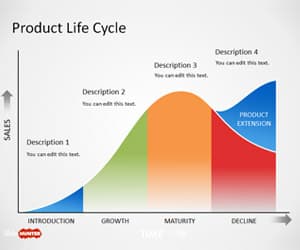
The PLC describes four stages a product passes through from its market launch to its eventual exit. Each stage has distinct patterns in sales volume, profit margins, competitive intensity, and the marketing strategies that make sense.
Think of it as a curve: sales start slow, ramp up, plateau, then fall. Not every product follows this exact shape, but the general pattern holds across most industries.
Characteristics of Each Stage
Introduction is defined by low sales, high marketing costs, limited competition, and negative or very low profits. The company is spending heavily just to get the product noticed and into stores.
- Example: A new smartphone with innovative features launches with heavy advertising and promotional campaigns. The company is burning cash to generate awareness, and very few competitors have entered yet.
Growth brings rapid sales increases, rising competition, improving profits, and expanding market share. The product has caught on and demand is climbing.
- Example: That smartphone gains popularity, attracting more buyers and drawing competitors into the space. Production and distribution scale up to meet growing demand.
Maturity is where sales peak but growth flattens. Competition is intense, profits stabilize or start slipping, and the focus shifts to differentiation and cost control.
- Example: The smartphone market becomes saturated with multiple brands offering similar features. Companies compete on price, brand loyalty, and incremental upgrades rather than breakthrough innovation.
Decline means falling sales, shrinking profits (or outright losses), and fewer competitors sticking around. The company has to decide: revitalize, harvest, or discontinue.
- Example: That smartphone model becomes outdated as newer technologies emerge. Sales drop, and the company must decide whether to upgrade the line or phase it out.
Marketing Strategies for Each Stage
Aligning Strategies with PLC Objectives
The core idea here is that your marketing playbook should change as the product moves through stages. What you're trying to accomplish is different at each point.
Introduction stage strategies focus on building awareness, encouraging trial, and getting distribution set up. Promotion spending is high, and pricing often uses either a skimming or penetration approach.
- Example: A company launches a new food processor by offering free in-store demonstrations, introductory discounts, and samples to get consumers to try it and build initial market share.
Growth stage strategies shift toward expanding market share, improving product quality, entering new segments, and building brand preference. Prices may adjust as demand increases and competitors arrive.
- Example: A successful fitness app expands to new geographic regions and introduces premium features to attract a wider user base and grow revenue.
Maturity stage strategies emphasize defending market position through differentiation, cost reduction, sharper segmentation, and targeted promotions.
- Example: A mature shampoo brand introduces new formulations for specific hair types, offers larger value packs, and runs targeted ads to hold its position against competitors.
Decline stage strategies center on tough decisions: continue as-is, modify the product, or discontinue it. The goal is usually to reduce costs and extract whatever value remains.
- Example: A declining DVD player line gets streamlined to only the most profitable models, with reduced marketing spend and lower inventory levels to maximize remaining cash flow.
Market Dynamics and Product Life Cycle

Impact of Market Factors on PLC Duration and Shape
Not all PLCs look the same. The duration and shape of the curve depend on factors like the pace of technological change, consumer preferences, and competitive intensity.
- Fast-changing markets produce shorter life cycles. Smartphones and laptops cycle through much faster than household appliances because technology advances quickly and consumer expectations shift constantly.
- Intense competition can compress the PLC by speeding up transitions between stages. In the fashion industry, brands continuously release new collections, which shortens the time any single product line stays relevant.
- Consumer adoption speed shapes the curve itself. Social media platforms like Facebook and Instagram saw steep growth stages because adoption was rapid. Electric vehicles, by contrast, have followed a more gradual curve due to slower consumer uptake.
Disruptive Innovations and PLC Patterns
Disruptive innovations can break the normal PLC pattern entirely by making existing products obsolete or creating brand-new categories.
- Streaming services like Netflix disrupted the video rental industry, sending DVD rental businesses into rapid decline while creating an entirely new on-demand content market.
- Smartphones combined the functions of traditional mobile phones, digital cameras, and portable music players into one device, effectively ending the life cycles of those standalone products.
The takeaway: companies can't assume their PLC will play out gradually. A disruptive competitor can collapse the timeline overnight.
Product Portfolio Management
Balancing Product Mix Across PLC Stages
Smart companies don't rely on a single product. Product portfolio management means maintaining a collection of products spread across different PLC stages so that revenue stays stable even as individual products rise and fall.
- Example: A consumer electronics company might have smartwatches (introduction), wireless earbuds (growth), laptops (maturity), and CD players (decline) in its portfolio simultaneously. Revenue from mature products funds development of new ones.
- Companies need to invest strategically in new product development so they have replacements ready as older products decline. An automotive manufacturer investing in electric and autonomous vehicles while still selling combustion engine cars is doing exactly this.
Portfolio Analysis and Decision-Making
Regular portfolio reviews help companies spot underperformers, prioritize investment, and decide what to modify, extend, or cut.
- Example: A cosmetics company runs an annual portfolio review, identifies low-performing lipstick shades for discontinuation, and redirects those resources toward developing on-trend color palettes.
Effective portfolio management ties product-level decisions back to broader corporate goals, market trends, and customer needs.
- Example: A food and beverage company notices consumer demand shifting toward healthier options. It introduces low-sugar and plant-based alternatives while phasing out or reformulating less healthy products. The portfolio evolves with the market rather than against it.
See Fiveable more often in Google
Mark Fiveable as a preferred source and Google is more likely to show you our guides in Top Stories, with a "preferred" badge in AI Mode and AI Overviews.