2.4 Ecological Tolerance

♻️AP Environmental Science Unit 2 Review
2.4 Ecological Tolerance
♻️ AP Environmental Science
Ecological tolerance is the range of conditions, like temperature, salinity, flow rate, and sunlight, that an organism can survive before it gets injured or dies. In AP Environmental Science, you should use tolerance ranges to explain why some species handle environmental change while others become stressed, leave, or die off.
Why This Matters for the AP Environmental Science Exam
Ecological tolerance connects directly to how you read data and explain why species thrive, struggle, or disappear when conditions change. On the AP Environmental Science exam, you may see tables or graphs showing how a population responds to a shifting factor like temperature or salinity, and you need to describe those patterns and explain what they mean. This topic also sets up later units on population changes, adaptations, and how disruptions push species past their limits.
Key Takeaways
- Ecological tolerance is the range of conditions an organism can handle before injury or death.
- Common factors include temperature, salinity, flow rate, and sunlight.
- Wide tolerance means a species can survive many conditions; narrow tolerance means it needs a specific range.
- Tolerance applies to both individual organisms and entire species.
- Near the edges of the tolerance range, organisms get stressed and put energy into survival instead of reproduction.
- Conditions far outside the tolerance range cause organisms to die off or leave the area.
The Tolerance Range
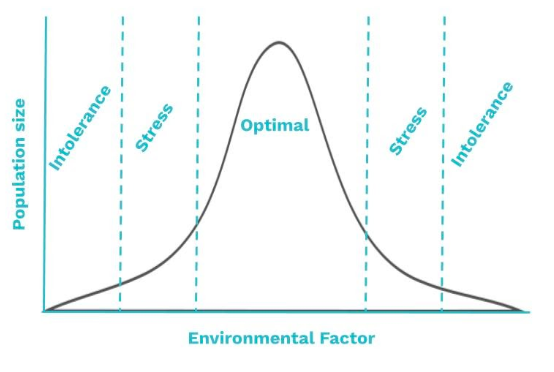
Think about the story of Goldilocks and the Three Bears. Ecological tolerance is about finding the conditions that are "just right" for an organism to survive and do well. Most species live where they do because those conditions support their survival better than anywhere else.
A species that can handle a wide range of environmental conditions has a high (wide) ecological tolerance. A species that can only survive in a narrow set of conditions has a low (narrow) ecological tolerance.
Inside the tolerance range, there is usually an optimal zone where organisms do best. Survival, growth, and reproduction are strongest there. As conditions move away from that ideal zone toward the upper or lower limits, organisms enter zones of stress.
What Counts as an Environmental Factor
Environmental factors are the measurable conditions an organism depends on. The main ones to know for this topic are:
- Temperature: conditions that are too hot or too cold can injure an organism or prevent survival.
- Salinity: the salt concentration in water, which matters a lot for aquatic species.
- Flow rate: how fast water moves, which affects stream and river organisms.
- Sunlight: the light available for photosynthesis and other processes.
Every population needs certain things to survive. No real ecosystem has zero food, zero water, or zero shelter, but the amounts and quality of these factors vary. A species can be pushed out of balance if its access to sunlight drops, if soil composition changes, or if predators and competitors increase.
Stress and Intolerance
When an environmental factor is slightly too high or too low, organisms become stressed. They spend time and energy on staying alive instead of reproducing or caring for offspring, so reproductive rates drop and population size tends to shrink.
If conditions move far enough outside the tolerance range, the ecosystem reaches intolerance: organisms either die off or leave the area to find more favorable conditions. This is why a single environmental change can shift which species are present in a community.
Individual vs Species Tolerance
Tolerance applies at two levels:
- Individual level: one organism has its own limits, and those limits can shift slightly based on its condition and history.
- Species level: a whole species has a general tolerance range built from the limits of its individuals.
Keeping these two levels straight helps when a question asks whether a specific organism or an entire species can survive a given change.
How to Use This on the AP Environmental Science Exam
MCQ
Watch for questions that describe a species as able or unable to survive in a changing environment. Words like wide or narrow tolerance signal whether a species can handle variation. If a factor moves outside the range, expect stress, reduced reproduction, migration, or death as the result.
Free Response
If you get a graph or table showing population size against a factor like temperature or salinity, describe the pattern first (where the population peaks and where it drops), then explain it using tolerance. Connect cause and effect: the factor moved outside the optimal zone, so stress increased and the population declined. Use precise terms like tolerance range, optimal zone, and stress.
Common Trap
Do not assume every species reacts the same way to a change. A condition that is lethal for a narrow-tolerance species may be fine for a wide-tolerance species in the same ecosystem.
Common Misconceptions
- Misconception: Tolerance is only about temperature.Actually: Tolerance is not just about temperature. Salinity, flow rate, and sunlight all count, and a species can have different tolerance ranges for each factor.
- Misconception: Stress means instant death.Actually: Stress does not mean instant death. Near the edges of the range, organisms survive but struggle, often with lower reproduction. Death or migration happens only when conditions go far enough out of range.
- Misconception: Wide tolerance means a species is everywhere.Actually: Wide tolerance does not mean a species is everywhere. Other factors like food, competition, and predators still limit where a species actually lives.
- Misconception: Tolerance is only a species trait.Actually: Tolerance is not only a species trait. It applies to individual organisms too, and individuals of the same species can vary slightly in their limits.
Related AP Environmental Science Guides
Practice Questions for 2.4
1 of 10
Red Spruce trees (Picea rubens) in a high-elevation forest are experiencing significant dieback. Researchers analyzed soil pH and root health across several plots, generating the figure shown. The Red Spruce has an optimum soil pH tolerance of 5.5 to 6.5. Below pH 5.0, aluminum ions in the soil become soluble and toxic to the roots. Due to decades of acid deposition from regional industrial emissions, the current average soil pH in the forest is 4.6.
A conservation group wants to immediately mitigate the physiological stress on the trees while long-term emissions policies are implemented. Which approach would be most effective?
A.
Adding nitrogen-based fertilizers to stimulate tree growth
B.
Installing scrubbers on regional coal-fired power plants
C.
Applying crushed limestone to the forest soil to raise the pH
D.
Planting genetically modified, acid-tolerant tree saplings
Vocabulary
The following words are mentioned explicitly in the AP® course framework for this topic.Term | Definition |
|---|---|
ecological tolerance | The range of environmental conditions, such as temperature, salinity, flow rate, and sunlight, that an organism can endure before injury or death occurs. |
flow rate | The speed at which water or other fluids move through an environment, affecting organism survival and habitat suitability. |
salinity | The concentration of dissolved salts in water, affecting the distribution of aquatic organisms. |
sunlight | Light energy from the sun that organisms require for various biological processes and survival. |
temperature | A measure of thermal energy that affects organism survival and is a key factor in ecological tolerance. |
Frequently Asked Questions
What is ecological tolerance in AP Environmental Science?
Ecological tolerance is the range of environmental conditions an organism can endure before injury or death results. It can apply to one individual or to an entire species.
What does an ecological tolerance diagram show?
An ecological tolerance diagram shows how well a species survives or reproduces across an environmental gradient, such as temperature or salinity. The middle is usually the optimal zone, while the edges show stress or intolerance.
What is an optimal zone in ecological tolerance?
The optimal zone is the range of conditions where organisms perform best, with high survival, growth, and reproduction. Conditions outside that zone can create stress.
What environmental factors affect ecological tolerance?
Common factors include temperature, salinity, flow rate, and sunlight. Each species can have a different tolerance range for each factor.
What is the difference between wide and narrow tolerance?
Wide tolerance means a species can handle a broad range of conditions. Narrow tolerance means a species needs conditions close to its ideal range and is more vulnerable to environmental change.
How is APES 2.4 tested?
APES 2.4 often asks you to describe tolerance ranges from a graph or explain why a species thrives, becomes stressed, moves, or declines when conditions change.
See Fiveable more often in Google
Mark Fiveable as a preferred source and Google is more likely to show you our guides in Top Stories, with a "preferred" badge in AI Mode and AI Overviews.