4.8 Earth's Geography and Climate

♻️AP Environmental Science Unit 4 Review
4.8 Earth's Geography and Climate
♻️ AP Environmental Science
Earth's geography shapes weather and climate along with sunlight. In AP Environmental Science, you should explain how mountains, ocean temperatures, and geologic features shape regional climate, especially through the rain shadow effect where one side of a mountain stays wet while the other turns dry.
Why This Matters for the AP Environmental Science Exam
This topic builds your ability to explain how physical features of the Earth, not just solar energy, control where rain falls and how warm or cool a region stays. On the AP Environmental Science exam, you may need to read a diagram or map and explain a process, so being able to walk through a rain shadow or connect ocean temperature to coastal climate is exactly the kind of cause-and-effect reasoning that shows up. It also connects to earlier topics like solar radiation and global wind patterns, so a solid grip here helps you answer questions that combine several ideas.
Key Takeaways
- Weather and climate depend on geologic and geographic factors like mountains and ocean temperature, not just the sun's energy.
- A rain shadow forms when a higher elevation area blocks precipitation, leaving the land behind it drier.
- The windward side of a mountain gets moist air that rises, cools, and drops precipitation.
- The leeward side stays dry because the air has already lost most of its moisture.
- Oceans store and release large amounts of heat, so ocean temperature strongly shapes nearby climates.
How Geography Shapes Weather and Climate
Sunlight is the starting energy source for climate, but the surface of the Earth decides how that energy plays out from place to place. Two geographic and geologic factors matter most for this topic: mountains and ocean temperature.
Mountains and the Rain Shadow Effect
Mountains act as barriers that block the movement of air masses. When a mountain range stands in the path of moving air, the two sides of that range can end up with very different temperature and precipitation. That difference is the rain shadow effect.
Here is the process step by step:
- On the windward side, warm, moist air is forced to rise up the slope.
- As that air rises, it cools and the moisture condenses, falling as precipitation. This keeps the windward side wet.
- By the time the air crosses over the peak and moves down the leeward side, it has lost most of its moisture.
- The dry, sinking air on the leeward side creates a drier region. This is why a rain shadow is defined as land that becomes drier because a higher elevation area blocks precipitation from reaching it.
The height of the mountain also affects conditions at the top, since temperature and precipitation change with altitude.
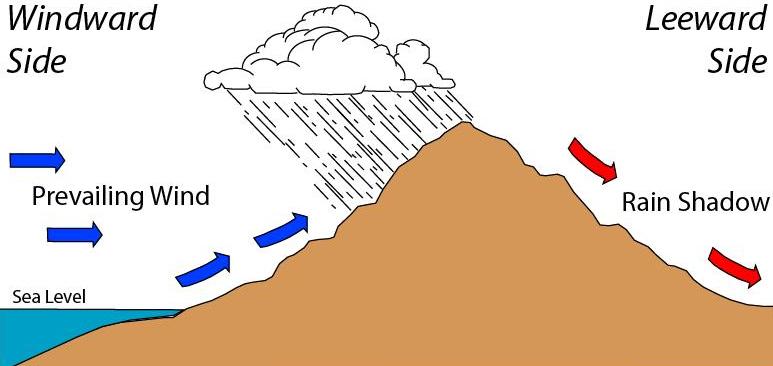
Rain shadow effect. Image courtesy of Wikimedia.
As an application of this idea, dry regions such as the area east of the Cascades or the Atacama Desert are often described as rain shadow zones. These are real-world examples of the concept, not separate required AP content.
Ocean Temperature and Coastal Climates
Water has a large heat capacity, which means it can absorb and store a lot of heat energy without changing temperature quickly. Because of this, ocean temperature has a strong effect on the climate of nearby land.
- Oceans warm up and cool down more slowly than land, so coastal areas often have milder, more stable temperatures.
- Ocean currents move heat from one region to another. A current carrying warmer water into a coastal region can warm that area's climate, while a current carrying cooler water can keep a coast cooler.
This is why two places at the same latitude can have very different climates depending on the ocean nearby.
How to Use This on the AP Environmental Science Exam
MCQ
Expect questions that show a labeled mountain diagram or ask which side is wet versus dry. Match windward with moist and rising air, and leeward with dry and sinking air. Watch for answer choices that flip the two.
Free Response
If a prompt asks you to describe or explain a rain shadow, name the steps in order: moist air rises on the windward side, cools and drops precipitation, then dry air descends on the leeward side. Use the term "rain shadow" and tie the result to drier land. If the question involves ocean temperature, explain it using water's high heat capacity and the role of currents in moving heat.
Common Trap
A diagram alone is not an explanation. Stating that one side is dry does not earn the point unless you explain why, using the air rising, cooling, losing moisture, and descending.
Common Misconceptions
- Misconception: Sunlight is the only thing that controls climate.Actually: Solar energy sets the stage, but geologic and geographic factors like mountains and ocean temperature shape the actual climate of a region.
- Misconception: The windward side is behind the mountain and the leeward side faces the incoming moist air.Actually: The windward side faces the incoming moist air and is wet. The leeward side is behind the mountain and is dry.
- Misconception: A rain shadow means it never rains.Actually: It means the leeward side is drier than the windward side because most moisture already fell, not that precipitation is impossible.
- Misconception: Oceans heat and cool as fast as land.Actually: Water has a high heat capacity, so it changes temperature slowly and tends to moderate the climate of nearby coasts.
- Misconception: Every dry desert is a rain shadow.Actually: Rain shadows are one cause of dry land, but not the only one. Match the term to the situation where a mountain blocks moisture.
Related AP Environmental Science Guides
Practice Questions for 4.8
1 of 10
A diagram illustrates the distribution of vegetation zones on a tropical mountain. Tropical rainforests grow at the base (0-1,000 m), cloud forests at mid-elevations (1,000-2,500 m), and alpine tundra near the peak (2,500-4,000 m). A corresponding line graph shows that mean annual temperature decreases by approximately 6.5°C for every 1,000 m increase in elevation.
The geographic influence on climate and biomes shown in the visual best explains which environmental consequence of global climate change?
A.
Tropical rainforests will rapidly expand into higher latitude ecosystems.
B.
Mountain peaks will accumulate more snowpack due to increased evaporation.
C.
High-altitude alpine species face extinction as they cannot migrate higher.
D.
Cloud forests will experience increased precipitation and soil waterlogging.
Vocabulary
The following words are mentioned explicitly in the AP® course framework for this topic.Term | Definition |
|---|---|
climate | Long-term patterns of atmospheric conditions, including average temperature and precipitation, over decades or centuries at a specific location. |
elevation | The height of a location above sea level, which affects temperature, precipitation, and climate patterns. |
geographic factors | Physical features of Earth's surface, such as mountains and ocean temperature, that affect weather and climate patterns. |
geography | The physical features and characteristics of Earth's surface, including landforms, water bodies, and their spatial distribution. |
geologic factors | Physical characteristics of Earth's crust and interior, such as rock composition and volcanic activity, that influence weather and climate. |
mountains | High elevation landforms that can block or redirect precipitation and affect local weather and climate patterns. |
ocean temperature | The thermal conditions of ocean water that influence atmospheric temperature, precipitation, and weather patterns. |
precipitation | Water falling from clouds to Earth's surface in the form of rain, snow, sleet, or hail. |
rain shadow | A region of land that receives less precipitation because a higher elevation area blocks moisture-bearing winds from reaching it. |
sun's energy | Solar radiation that drives weather and climate systems on Earth. |
weather | Short-term atmospheric conditions including temperature, precipitation, wind, and humidity at a specific location. |
Frequently Asked Questions
How does Earth's geography affect climate in APES?
Geography affects climate through factors such as mountains, elevation, ocean temperature, and ocean currents. These shape precipitation, temperature, and regional climate patterns.
What is a rain shadow?
A rain shadow is a dry region on the leeward side of a mountain range because the mountain blocks moist air and precipitation from reaching that land.
Which side of a mountain is wet in a rain shadow?
The windward side is usually wetter because moist air rises, cools, condenses, and drops precipitation there.
Why is the leeward side of a mountain dry?
By the time air descends on the leeward side, it has already lost much of its moisture. The sinking air warms and creates drier conditions.
How do oceans affect coastal climate?
Oceans have high heat capacity, so they heat and cool slowly. Ocean temperatures and currents can make nearby coastal climates milder, warmer, or cooler.
How is AP Environmental Science 4.8 tested?
APES 4.8 is often tested with diagrams, maps, or scenarios where you explain how mountains, rain shadows, ocean temperature, or currents affect weather and climate.
See Fiveable more often in Google
Mark Fiveable as a preferred source and Google is more likely to show you our guides in Top Stories, with a "preferred" badge in AI Mode and AI Overviews.