6.6 Nuclear Power

♻️AP Environmental Science Unit 6 Review
6.6 Nuclear Power
♻️ AP Environmental Science
Nuclear power splits Uranium-235 atoms in a process called fission, releasing heat that boils water into steam, spins a turbine, and generates electricity. It is a nonrenewable energy source that produces no air pollutants, but it creates thermal pollution and long-lasting radioactive waste, and accidents like Three Mile Island, Chernobyl, and Fukushima show its risks.
APES 6.6: Nuclear Power
In APES 6.6, nuclear power is electricity generated from nuclear fission. Uranium-235 atoms in fuel rods split after being struck by neutrons, releasing heat that turns water into steam. The steam spins a turbine connected to a generator, which produces electricity.
The exam focus is the trade-off. Nuclear energy does not release air pollutants during electricity generation, but it is nonrenewable, creates long-lived radioactive waste, can release thermal pollution, and carries accident risks. You should also know how half-life is used to calculate radioactive decay over time.
Why This Matters for the AP Environmental Science Exam
Nuclear power is one of the energy sources you compare across Unit 6, so you need to explain how it works and weigh its trade-offs against fossil fuels and renewables. Expect to describe the fission process step by step, identify why nuclear waste is hard to manage, and explain the environmental effects of major accidents. You may also be asked to use a radioactive element's half-life to calculate decay rate or how much radioactivity remains after a given time, so be ready to handle that kind of multi-step math with correct units.
Key Takeaways
- Nuclear power comes from fission: a neutron strikes Uranium-235 stored in fuel rods, the atom splits, and the released heat makes steam that turns a turbine.
- Radioactivity happens when a radioactive isotope's nucleus loses energy by emitting radiation.
- Uranium-235 stays radioactive for a very long time, which is why disposing of nuclear waste safely is a major problem.
- Nuclear power is nonrenewable and counts as cleaner because it makes no air pollutants, but it still releases thermal pollution and hazardous solid waste.
- Three Mile Island, Chernobyl, and Fukushima are the three accident cases to know, each releasing radiation with short- and long-term environmental impacts.
- A radioactive element's half-life lets you calculate decay rate and radioactivity at specific times.
How Nuclear Power Works
Nuclear Fission
Nuclear power is generated through fission. Atoms of Uranium-235, the fuel stored in fuel rods, are split into smaller parts after being struck by a neutron. Each split releases a large amount of heat and more neutrons, which can strike other U-235 atoms and keep the reaction going.
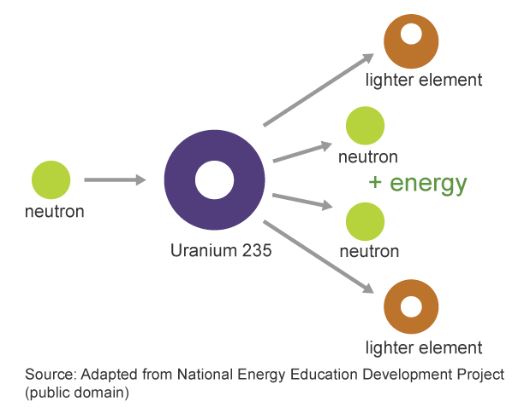
The heat from fission boils water into steam. That steam spins a turbine connected to a generator, which converts the kinetic energy of the spinning turbine into electricity. This steam-turbine setup is the same basic idea used in fossil fuel plants, but the heat source is fission instead of combustion.
Why Uranium Is Nonrenewable
Uranium-235 exists in a fixed amount and cannot be replaced at the rate it is used, which makes nuclear power a nonrenewable energy source. Because U-235 stays radioactive for a long time, used fuel has to be stored carefully so it does not contaminate the environment or groundwater.
Radioactivity and Half-Life
Radioactivity occurs when the nucleus of a radioactive isotope loses energy by emitting radiation. Uranium-235 remains radioactive long after it is used as fuel, which is the core reason nuclear waste disposal is so difficult.
A radioactive element's half-life is the time it takes for half of a radioactive sample to decay. You can use half-life to calculate the rate of decay and how much radioactivity remains at specific points in time.
A quick way to handle half-life problems:
- Start with the original amount.
- For each half-life that passes, the remaining amount is cut in half.
- After n half-lives, the fraction remaining is (1/2)^n.
For example, if a sample starts at 100 grams and the half-life is 10 years, after 10 years you have 50 grams, after 20 years you have 25 grams, and after 30 years you have 12.5 grams. Always track how many half-lives have passed and keep your units consistent.
Environmental Effects and Trade-Offs
Nuclear power is often called a cleaner energy source because it does not produce air pollutants like fossil fuel combustion does. That said, it still creates two important problems: thermal pollution from the warm water released after cooling, and hazardous solid waste in the form of long-lived radioactive material.
| Benefits | Drawbacks |
|---|---|
| No air pollutants released | Long-lived radioactive waste is hard to dispose of |
| Reliable, large-scale electricity | Thermal pollution from heated water |
| Low operating emissions | Risk of accidents releasing radiation |
Nuclear Accidents to Know
Because nuclear plants handle intense heat and radioactive material, accidents or natural disasters can release radiation with both short- and long-term environmental impacts. These are the three cases to know:
- Three Mile Island (1979): A cooling system malfunction in a reactor led to a partial meltdown and the release of radioactive gas.
- Chernobyl (1986): A power surge during operation damaged the reactor, causing explosions that released large amounts of radioactive material into the environment, with fatalities and long-term contamination.
- Fukushima Daiichi (2011): A tsunami knocked out power to a coastal plant, the cooling systems failed, and reactor buildings exploded, leaking radioactive materials into the surrounding environment.
How to Use This on the AP Environmental Science Exam
Free Response
When you describe how nuclear power works, walk through the full chain: neutron strikes U-235 in a fuel rod, the atom splits and releases heat, the heat boils water into steam, and the steam spins a turbine to generate electricity. Skipping a step can cost you points.
When you explain environmental effects, name specific outcomes instead of vague ones. Say "thermal pollution from heated water" and "long-lived radioactive solid waste," and note that nuclear power avoids air pollutants. If a question asks about accidents, connect a named case to its cause and its radiation release.
Problem Solving
For half-life questions, figure out how many half-lives fit in the time given, then halve the amount that many times. Show your steps and include units in your final answer. If the numbers do not divide evenly into whole half-lives, use the fraction remaining formula (1/2)^n.
Common Trap
When you compare nuclear to fossil fuels or renewables, be precise about what "clean" means. Nuclear avoids air pollution but is not waste-free, so a strong answer names both the benefit and the cost.
Common Misconceptions
- Misconception: All radiation is harmful or the same.Actually: Radiation comes in different types and amounts, and not every level is dangerous. The concern with nuclear waste is that U-235 stays radioactive at harmful levels for a very long time.
- Misconception: Nuclear power is renewable because it is "clean."Actually: Being low in air pollution does not make it renewable. Uranium-235 exists in a fixed amount, so nuclear power is nonrenewable.
- Misconception: Nuclear plants produce no pollution at all.Actually: They avoid air pollutants, but they still release thermal pollution and create hazardous solid waste.
- Misconception: Fission and fusion are the same thing.Actually: Power plants today run on fission, which splits atoms. Fusion combines atoms and is the process that powers the sun, but it is not how current nuclear plants generate electricity.
- Misconception: A meltdown is an explosion.Actually: A meltdown happens when the reactor core overheats and the fuel melts, often due to cooling failure. That is different from the steam or chemical explosions that can follow, even though both can release radiation.
Related AP Environmental Science Guides
Practice Questions for 6.6
1 of 10
The figure shows the relative radioactivity of spent nuclear fuel rods over time after removal from a reactor. As shown in the graph, the radioactivity drops from 100% to approximately 1% within the first 100 years due to the rapid decay of short-lived isotopes. However, the remaining radioactivity declines at a much slower rate, taking over 10,000 years to drop below 0.5% of the original level.
The trend shown in the figure best supports which conclusion regarding the management of spent nuclear fuel?
A.
While radioactivity drops quickly at first, long-lived isotopes need geologic isolation.
B.
The initial radioactivity decrease indicates that most isotopes decay completely within a few decades.
C.
Radioactivity levels stabilize after 1,000 years, eliminating the need for continued geologic isolation.
D.
Rapid initial decay means spent fuel can be safely stored in surface facilities after 10 years.
Vocabulary
The following words are mentioned explicitly in the AP® course framework for this topic.Term | Definition |
|---|---|
decay | The process by which a radioactive element transforms into a different element by emitting radiation. |
fuel rods | Cylindrical containers that store fissionable material (such as Uranium-235) in a nuclear reactor. |
half-life | The time required for half of a radioactive element's atoms to decay into a more stable form. |
neutron | A subatomic particle with no electric charge that strikes atomic nuclei to initiate nuclear fission. |
nonrenewable energy source | An energy source that cannot be replenished on human timescales, such as nuclear power derived from finite uranium deposits. |
nuclear energy | Energy released from the nucleus of an atom, used in power generation through controlled fission reactions. |
nuclear fission | The splitting of heavy atomic nuclei (such as Uranium-235) into smaller parts after being struck by a neutron, releasing large amounts of heat. |
nuclear waste | Hazardous solid waste produced by nuclear power generation, including spent fuel rods that remain radioactive for long periods. |
radiation | Energetic particles or waves emitted from radioactive materials that can damage living organisms and the environment. |
radioactive element | An element with an unstable nucleus that spontaneously emits radiation as it decays. |
radioactive isotope | An unstable form of an element whose nucleus emits radiation as it loses energy. |
radioactivity | The process by which unstable atomic nuclei emit radiation and decay over time. |
thermal pollution | The release of excess heat into the environment from nuclear power plants, which can harm aquatic ecosystems. |
turbine | A machine with rotating blades that converts the energy from steam into mechanical energy to generate electricity. |
Uranium-235 | A radioactive isotope of uranium used as fuel in nuclear reactors for power generation. |
Frequently Asked Questions
What is APES 6.6 about?
APES 6.6 covers nuclear power, including nuclear fission, Uranium-235 fuel rods, steam turbines, radioactive waste, thermal pollution, major nuclear accidents, and half-life calculations.
How does nuclear power work in AP Environmental Science?
Nuclear power uses fission. A neutron strikes Uranium-235 in fuel rods, the atom splits and releases heat, the heat makes steam, and the steam turns a turbine connected to a generator.
Is nuclear energy renewable in APES?
No. Nuclear power is nonrenewable because Uranium-235 exists in limited supply and cannot be replaced at the rate it is used.
Why is nuclear power considered cleaner than fossil fuels?
Nuclear power is considered cleaner because it does not release air pollutants during electricity generation, but it still creates thermal pollution and hazardous radioactive waste.
What nuclear accidents do APES students need to know?
APES students should know Three Mile Island, Chernobyl, and Fukushima as cases where accidents or natural disasters led to radiation releases with environmental impacts.
How does half-life show up in APES nuclear power questions?
Half-life questions ask you to calculate how much radioactivity remains after a given time. Each half-life cuts the remaining amount in half.
See Fiveable more often in Google
Mark Fiveable as a preferred source and Google is more likely to show you our guides in Top Stories, with a "preferred" badge in AI Mode and AI Overviews.