7.2 Photochemical Smog

♻️AP Environmental Science Unit 7 Review
7.2 Photochemical Smog
♻️ AP Environmental Science
Photochemical smog, the brownish haze often called brown smog, forms when nitrogen oxides (NOx) and volatile organic compounds (VOCs) react with heat and sunlight, producing ground-level ozone and other harmful secondary pollutants. In AP Environmental Science, connect smog to sunny, traffic-heavy cities, summer afternoon peaks, and effects on the eyes and respiratory system.
Photochemical Smog Formula
The APES shortcut for photochemical smog is:
NOx + VOCs + heat + sunlight -> ground-level ozone and photochemical smog
This is not a balanced chemical equation. It is the cause-and-effect formula you use on the exam: nitrogen oxides and volatile organic compounds react in warm sunlight, producing tropospheric ozone and other secondary pollutants.
Why This Matters for the AP Environmental Science Exam
Photochemical smog is a classic example of a secondary pollutant: it is not emitted directly but forms through chemical reactions in the atmosphere. On the AP Environmental Science exam, you may need to explain the causes of smog, connect it to time of day and season using graphs or data, and propose realistic solutions backed by evidence.
This topic also rewards cause-and-effect reasoning. Knowing that NOx and VOCs plus sunlight create ozone lets you explain patterns like the afternoon ozone peak, summer spikes, and why cities have more smog than rural areas. Free-response questions often ask you to propose and justify solutions, so be ready to tie reduction methods directly to NOx and VOC sources.
Key Takeaways
- Photochemical smog forms when NOx and VOCs react with heat and sunlight, creating ground-level (tropospheric) ozone and other secondary pollutants.
- Conditions that worsen it: urban areas, traffic congestion, warm sunny weather, and summer.
- Nitrogen oxide builds up early in the day from morning traffic, while ozone concentrations peak in the afternoon after sunlight drives the reactions.
- VOCs come from both human sources (gasoline, formaldehyde) and natural sources (trees).
- Smog is most common in cities because of the large number of motor vehicles.
- You reduce photochemical smog by reducing NOx and VOC emissions, which can cause respiratory problems and eye irritation.
What Photochemical Smog Is
The word "smog" comes from combining "smoke" and "fog." Photochemical smog is a type of air pollution that looks like a brownish-gray haze, and it is most common in urban areas with heavy traffic.
The key thing to remember is that it is a secondary pollutant. The starting materials, NOx and VOCs, are released directly (those are primary pollutants), but the smog itself forms only after these react with heat and sunlight in the atmosphere.
How It Forms
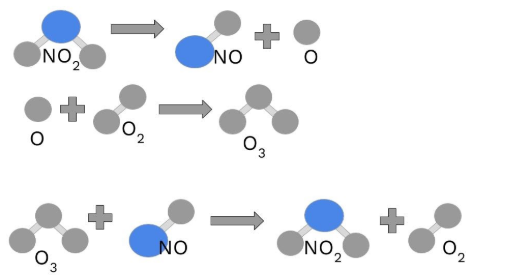
Photochemical smog is built from nitrogen oxides, VOCs, sunlight, and the ground-level ozone they produce.
The process roughly works like this:
- Nitrogen dioxide (NO2) comes from both natural and human sources, especially vehicle exhaust.
- Sunlight breaks NO2 apart, releasing a free oxygen atom and leaving nitrogen oxide (NO).
- That free oxygen atom bonds with atmospheric oxygen (O2), with sunlight's help, forming tropospheric ozone (O3).
- VOCs react with the NO in the air, forming photochemical oxidants. This interferes with the normal breakdown of ozone, so ozone builds up.
- The mix of ozone and other photochemical oxidants is what we call photochemical smog.
This chemistry explains the daily and seasonal patterns. Nitrogen oxide is produced early in the day, often from morning traffic. Ozone concentrations then peak in the afternoon, once sunlight has had time to drive the reactions. Ozone is also higher in summer, when there is more heat and sunlight.
Because so many VOCs come from gasoline and vehicle exhaust, brown smog is worse in large cities and on warm, sunny days. Keep in mind that trees are also a natural source of VOCs, so VOCs are not only a human-made problem.
Health and Environmental Effects
Photochemical smog can harm human health in several ways. The two effects to know for the exam are respiratory problems and eye irritation.
Ground-level ozone is a major concern because it irritates the respiratory system. It can cause coughing, wheezing, and shortness of breath, and it can make existing conditions like asthma worse.
Beyond direct health effects, ozone and related pollutants can also damage plants and reduce crop yields, which connects this topic to agricultural and economic impacts.
How to Reduce It
Since photochemical smog forms from NOx and VOCs, you reduce it by cutting those emissions at the source. Because vehicles are a major source, solutions that lower traffic emissions are especially effective.
Strategies that fit this topic include:
- Reducing nitrogen oxide emissions (for example, controlling vehicle and power plant exhaust).
- Reducing VOC emissions (for example, limiting gasoline vapor and evaporative emissions).
You will go deeper into specific control devices and policies, like catalytic converters and vapor recovery systems, in the air pollution reduction topic later in this unit. For smog specifically, the core idea is simple: less NOx and fewer VOCs mean less ozone and less smog.
How to Use This on the AP Environmental Science Exam
MCQ
Watch for questions that test whether you know smog is a secondary pollutant. If a question lists primary versus secondary pollutants, ozone formed in smog is secondary because it forms through reactions, not direct emission. Also expect questions tying smog to time of day, season, and urban traffic.
Free Response
If asked to explain causes, name NOx and VOCs reacting with heat and sunlight to form ozone and other pollutants. If asked to propose solutions, tie each one back to reducing NOx or VOCs, and use evidence or reasoning to justify why it works. Vague answers like "reduce pollution" usually do not earn the point; be specific about the source you are cutting.
Data Analysis
Be ready to read graphs showing ozone or NOx levels across a day or across seasons. Expect to explain why NO peaks in the morning, why ozone peaks in the afternoon, and why summer levels run higher. Connect the pattern back to sunlight driving the chemistry.
Common Trap
Do not confuse photochemical smog with the older "gray" industrial smog tied to coal burning and sulfur dioxide. For this topic, focus on the NOx, VOCs, sunlight, and ozone pathway that produces brown smog.
Common Misconceptions
- Misconception: Cars emit smog directly.Actually: Vehicles emit NOx and VOCs (primary pollutants). The smog itself is a secondary pollutant that forms later through reactions with sunlight.
- Misconception: The ozone in smog is good ozone.Actually: Ground-level (tropospheric) ozone is a harmful pollutant that irritates lungs. That is different from the protective ozone layer in the stratosphere.
- Misconception: Smog is just smoke or fog.Actually: It is a chemical mixture, not water vapor or simple smoke. The brown color comes from nitrogen compounds, not fog.
- Misconception: Only humans produce VOCs.Actually: Trees and other plants are natural VOC sources, even though human sources like gasoline drive most urban smog.
- Misconception: Smog is worst at night.Actually: For photochemical smog, ozone peaks in the afternoon because the reactions need sunlight, and it is generally worse in summer.
Related AP Environmental Science Guides
Practice Questions for 7.2
1 of 10
Primary pollutants and secondary pollutants were measured hourly in a major metropolitan area over a summer day to track photochemical smog formation, as shown in the figure.
Which statement is best supported by the data?
A.
Vehicles emit the most ozone during the late afternoon
B.
Sunlight converts morning nitrogen oxides into afternoon ozone
C.
Volatile organic compounds break down into ozone in the evening
D.
Atmospheric oxygen destroys nitrogen oxides by midday
Vocabulary
The following words are mentioned explicitly in the AP® course framework for this topic.Term | Definition |
|---|---|
eye irritation | A health effect caused by exposure to photochemical smog that causes discomfort and inflammation of the eyes. |
nitrogen oxides | Gaseous compounds of nitrogen and oxygen produced primarily from motor vehicle emissions and combustion processes that contribute to photochemical smog formation. |
ozone | A secondary pollutant produced through chemical reactions between oxygen and nitrogen oxides in the presence of sunlight, a major component of photochemical smog. |
photochemical smog | Air pollution formed when nitrogen oxides and volatile organic compounds react with heat and sunlight to produce various pollutants. |
respiratory problems | Health issues affecting the lungs and breathing system that can be caused by air pollutants such as tropospheric ozone. |
volatile organic compounds | Organic chemicals that have a high vapor pressure at room temperature and can be released into the environment during fossil fuel extraction and use. |
Frequently Asked Questions
What is the photochemical smog formula for APES?
The APES shortcut is NOx + VOCs + heat + sunlight -> ground-level ozone and photochemical smog. It is not a balanced chemical equation; it is the cause-and-effect pathway to remember.
What causes photochemical smog?
Photochemical smog forms when nitrogen oxides and volatile organic compounds react with heat and sunlight, producing ground-level ozone and other secondary pollutants.
Is photochemical smog a primary or secondary pollutant?
Photochemical smog is a secondary pollutant because it forms in the atmosphere from reactions involving primary pollutants such as NOx and VOCs.
Why does ozone peak in the afternoon?
Ozone peaks in the afternoon because sunlight drives the reactions that produce ozone. Nitrogen oxide builds earlier in the day, then ozone rises after sunlight has had time to react with the pollutants.
Why is photochemical smog worse in summer?
Photochemical smog is worse in summer because warmer temperatures and stronger sunlight speed the reactions that form ground-level ozone.
How can photochemical smog be reduced?
Photochemical smog can be reduced by lowering nitrogen oxide and VOC emissions, especially from vehicles, power plants, gasoline vapor, and other combustion or solvent sources.
See Fiveable more often in Google
Mark Fiveable as a preferred source and Google is more likely to show you our guides in Top Stories, with a "preferred" badge in AI Mode and AI Overviews.