3.5 Population Growth and Resource Availability

♻️AP Environmental Science Unit 3 Review
3.5 Population Growth and Resource Availability
♻️ AP Environmental Science
Population growth depends on how much resource and space a population can access. In AP Environmental Science, you should connect resource availability to exponential growth, logistic growth, carrying capacity, mortality, and fecundity.
Why This Matters for the AP Environmental Science Exam
This topic builds the core reasoning behind population dynamics, which shows up across Unit 3. You need to explain how limiting factors like food, water, and space control whether a population grows, levels off, or crashes. On the exam, you'll often read population graphs and data tables, then explain the trends, so connecting resource availability to growth rate is a skill you'll reuse for carrying capacity, age structure, and human population questions.
Key Takeaways
- Population growth is limited by environmental factors, especially available resources and space.
- The total resource base is finite over every time scale, so unlimited growth is impossible long term.
- When needed resources are abundant, population growth usually accelerates.
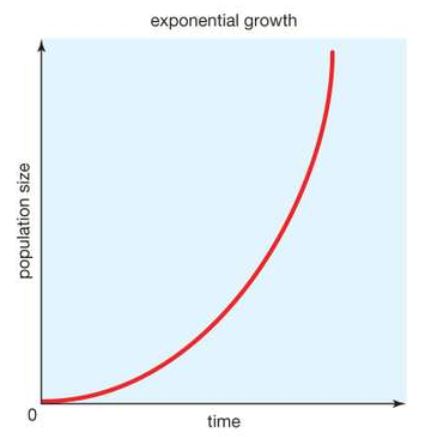
- Exponential growth produces a J-shaped curve when there are no limiting factors.
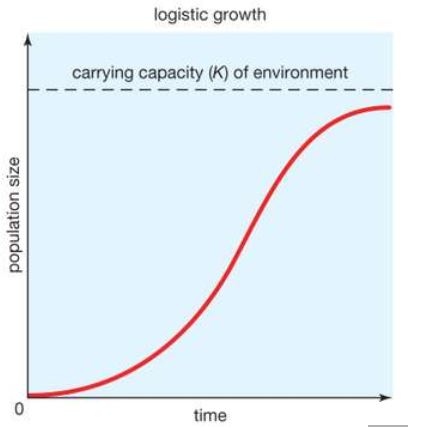
- Logistic growth produces an S-shaped curve as the population approaches carrying capacity (K).
- When the resource base shrinks, unequal access to resources raises mortality, lowers fecundity, or both, dropping growth to or below carrying capacity.
Population Growth Basics
Population growth describes how fast a population changes in size given the limits of its surroundings. The rate is shaped by competition with other species, the conditions of the environment, and how well the population can meet its own resource needs. When the resources a population needs are abundant, growth usually speeds up. When those resources get scarce, growth slows.
The big idea to anchor on: resource availability and the total resource base are limited and finite over all scales of time. No population can grow forever because the resources and space that support it eventually run out.
Exponential Growth
Exponential growth happens when a population grows at its intrinsic rate of increase (r) without limiting factors holding it back. This produces a J-shaped curve because growth accelerates as the population gets larger.
Bacteria are a common example. Under ideal conditions with no limiting factors, a bacterial population can grow exponentially, doubling again and again. This kind of growth is short-lived in nature because resources do not stay unlimited.
Logistic Growth
A logistic growth model shows a population growing quickly at first, then slowing as environmental resistance from limiting factors kicks in. The population levels off near its carrying capacity (K), the maximum size the environment can support over time. This produces an S-shaped curve.
If a population grows past carrying capacity, it goes into overshoot. When the resource base shrinks, resources get distributed unequally, which raises death rates, lowers birth rates, or both. The result is population growth declining to, or below, carrying capacity.
How to Use This on the AP Environmental Science Exam
MCQ
- Match the curve to the situation. A J-shaped curve means exponential growth with no limiting factors. An S-shaped curve means logistic growth approaching carrying capacity.
- Watch for cause and effect. If a question describes resources becoming scarce, expect higher mortality, lower fecundity, or growth dropping toward K.
Free Response
- When you explain a population graph, name the limiting factor (food, water, space) and describe how it changes the growth rate. Vague answers like "resources ran out" score lower than answers that connect the resource to birth and death rates.
- If asked why growth slows, tie it back to the finite resource base and unequal resource distribution, not just to a number cap.
- Use the right terms: intrinsic rate of increase (r), carrying capacity (K), overshoot. Accurate vocabulary helps your explanation earn points.
Common Trap
Do not assume every population follows a clean S-curve. Real populations can overshoot and crash. When the resource base shrinks, growth can fall below carrying capacity, not just settle at it.
Common Misconceptions
- Misconception: Exponential growth lasts forever.Actually: It doesn't. Because the resource base is finite, exponential growth is temporary and gives way to limits.
- Misconception: Carrying capacity is a fixed wall the population can't pass.Actually: Populations can overshoot K. The point is that the environment can't support that size long term, so a dieback or decline usually follows.
- Misconception: Overshoot just means growth stops.Actually: Overshoot can lead to higher mortality and lower birth rates, pushing the population down to or below carrying capacity.
- Misconception: More resources always mean steady growth.Actually: Abundant resources usually accelerate growth, but that growth is still limited by space and the finite total resource base.
- Misconception: Logistic and exponential growth are unrelated.Actually: Logistic growth starts out looking exponential, then slows as limiting factors take effect near carrying capacity.
Related AP Environmental Science Guides
Practice Questions for 3.5
1 of 10
A lake is experiencing exponential growth of cyanobacteria (algal blooms) due to excessive phosphorus runoff. The abundant nutrients eliminate natural growth limits, leading to severe dissolved oxygen depletion. Scientists tested four remediation methods and tracked the cyanobacteria population density over 60 days. The target is to stabilize the population below the bloom threshold of 10,000 cells/mL. The figure shows the population response to each method over time.
Based on the figure, which remediation method is best supported to address the root cause of the exponential population growth and maintain long-term stability?
A.
Method D, because it moderately reduces resources and prevents immediate algal blooms.
B.
Method C, because it limits the primary resource and stabilizes the population growth.
C.
Method A, because it produces the most rapid reduction in the cyanobacteria population.
D.
Method B, because it maintains a consistently high population without severe die-offs.
Vocabulary
The following words are mentioned explicitly in the AP® course framework for this topic.Term | Definition |
|---|---|
carrying capacity | The maximum population size that an environment can sustain indefinitely given available resources and conditions. |
environmental factors | Physical and biological conditions in an environment that limit or support population growth, including resource availability and space. |
fecundity | The biological capacity of a population to reproduce, which decreases when resources become scarce. |
mortality | The death rate in a population, which increases when resource availability declines and resources are unequally distributed. |
population growth | The increase in the number of individuals in a population over time, which is limited by environmental factors and available resources. |
resource availability | The presence and accessibility of resources needed by a population, such as food, water, and space, which directly influences the rate and sustainability of population growth. |
resource base | The total amount of resources available to support a population, which is finite and limited over all time scales. |
Frequently Asked Questions
How does resource availability affect population growth?
Resource availability controls how quickly a population can grow. When resources and space are abundant, growth usually accelerates. When resources become scarce or the resource base shrinks, mortality can rise, fecundity can fall, and growth declines toward or below carrying capacity.
What is exponential growth in AP Environmental Science?
Exponential growth happens when a population grows rapidly because limiting factors are not holding it back. It produces a J-shaped curve and is usually temporary because resources and space are finite.
What is logistic growth?
Logistic growth starts quickly but slows as limiting factors increase. The population levels off near carrying capacity, creating an S-shaped curve.
What is carrying capacity?
Carrying capacity, or K, is the maximum population size an environment can support over time based on available resources and space. Populations can overshoot K, but the environment cannot support that higher size long term.
What happens when a population resource base shrinks?
A shrinking resource base increases competition and unequal access to resources. That can raise mortality, lower fecundity, or both, causing population growth to slow or decline.
How is Topic 3.5 tested on the APES exam?
APES questions often ask you to interpret J-shaped and S-shaped population graphs, connect resources to growth rate, explain carrying capacity, or describe how reduced resources affect fecundity and mortality.
See Fiveable more often in Google
Mark Fiveable as a preferred source and Google is more likely to show you our guides in Top Stories, with a "preferred" badge in AI Mode and AI Overviews.