7.3 Thermal Inversion

♻️AP Environmental Science Unit 7 Review
7.3 Thermal Inversion
♻️ AP Environmental Science
A thermal inversion flips the normal atmosphere setup so that cooler air sits at the surface and warmer air sits above it. In AP Environmental Science, you should explain how that warm layer acts like a lid, trapping pollutants like smog and particulates close to the ground where people breathe.
Thermal Inversion APES Definition
In AP Environmental Science, a thermal inversion is an atmospheric condition where cooler air stays near Earth's surface while warmer air sits above it. This reverses the normal pattern where air temperature usually decreases with altitude.
The APES connection is pollution. The warm layer blocks cooler surface air from rising, so smog, particulates, vehicle exhaust, and industrial emissions stay concentrated near the ground. Thermal inversions are most dangerous in places where pollution sources and trapped air overlap, especially valleys and basins.
Why This Matters for the AP Environmental Science Exam
Thermal inversion connects weather conditions to air pollution problems, which is a common theme in Unit 7. On the exam, you may need to describe what happens to the temperature gradient during an inversion, explain why pollution gets trapped, and read graphs or diagrams that show how air temperature changes with altitude. Air pollution questions also show up in free-response prompts that ask you to explain patterns in data and propose solutions to protect human health, so understanding why inversions worsen air quality gives you useful cause-and-effect reasoning.
Key Takeaways
- During a thermal inversion, the air at the surface is cooler than the air higher up, which reverses the normal temperature gradient.
- Normally air temperature drops as altitude increases, so warm surface air can rise and carry pollution away.
- The warm layer above acts like a lid that traps pollution near the ground, especially smog and particulates.
- Geography matters: valleys surrounded by hills or mountains block wind and make inversions worse.
- Trapped pollutants can cause poor air quality, reduced visibility, and respiratory problems for people.
How an Inversion Works
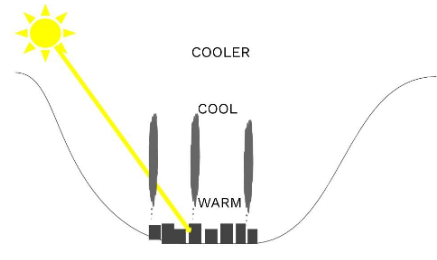
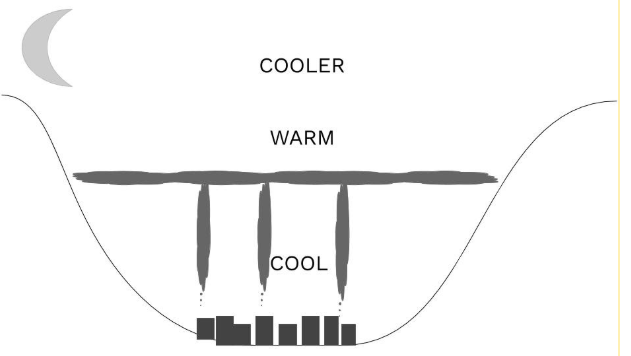
In a normal atmosphere, air temperature decreases as you go up. Warm air near the ground is less dense, so it rises and carries pollutants with it, spreading them out into the upper atmosphere.
During a thermal inversion, that pattern flips. The air at the Earth's surface becomes cooler than the air above it. Because the cooler surface air is denser, it stays put instead of rising. The warmer air sitting on top forms a stable layer that pollution cannot easily push through.
Think of it like a lid on a pot. The pollution that normally rises and disperses now has nowhere to go, so it builds up close to the ground.
Where Inversions Happen
Geography plays a big role in how strong an inversion gets.
- Open plains: Cities on flat, open land usually get steady winds. Sunlight heats the surface, warm air rises, and pollution moves out of the area.
- Valleys and basins: Cities surrounded by hills or mountains have a harder time. The surrounding terrain blocks the wind that would normally clear the air. When a warm layer settles on top, it traps pollution in the valley like a thermal blanket.
Inversions are more common in colder months because the surface can cool quickly, especially at night, leaving cold dense air trapped under warmer air above.
Inversions and Pollution
The biggest environmental concern with thermal inversions is pollution trapping. When the warm layer caps the cooler surface air, pollutants stay concentrated near the ground instead of dispersing.
Pollutants that commonly get trapped include:
- Smog, including photochemical smog formed from nitrogen oxides and volatile organic compounds reacting in sunlight.
- Particulate matter, such as soot, smoke from wildfires, and dust.
- Vehicle exhaust containing carbon monoxide, nitrogen oxides, and hydrocarbons.
- Industrial emissions from factories and power plants.
As these pollutants build up, air quality drops and visibility decreases. Breathing trapped pollutants can cause respiratory problems and make existing conditions worse. The inversion does not create new pollution, it just keeps existing pollution from spreading out.
How to Use This on the AP Environmental Science Exam
MCQ
Expect questions that test the basic definition. The key fact to lock in: during an inversion, surface air is cooler and the air above is warmer, which is the reverse of normal. If a question gives you a temperature-versus-altitude graph, look for a section where temperature increases with height. That section is the inversion layer.
Free Response
If a prompt asks about air pollution in a specific city or valley, you can use thermal inversion to explain why pollution concentrations get high. A strong answer connects the cause (warm air trapping cooler surface air) to the effect (pollution stays near the ground and harms human health). When asked for solutions, focus on reducing the pollution itself, since you cannot control the weather. Reducing vehicle emissions and industrial output lowers how much pollution can get trapped.
Common Trap
Do not mix up the temperature layers. Students often say the surface is warmer during an inversion because they remember the warm air being involved. The surface air is the cooler layer, and the warm air sits above it.
Common Misconceptions
- Misconception: Thermal inversions create pollution.Actually: They do not. Inversions trap and concentrate pollution that is already there; they do not produce new pollutants.
- Misconception: The surface is warmest during an inversion.Actually: It is the opposite. The surface air is cooler and the warmer air sits above it, which is what reverses the normal temperature gradient.
- Misconception: Inversions are just an air pollution issue.Actually: The trapping effect is what makes them dangerous, but they are fundamentally a temperature pattern in the atmosphere. The pollution problem is a result of that pattern.
- Misconception: Inversions can happen anywhere equally.Actually: Geography matters. Valleys and basins surrounded by mountains trap air far more easily than open plains with steady wind.
- Misconception: Hot weather causes inversions.Actually: They are actually more common in cooler months when the surface cools quickly, especially overnight.
Related AP Environmental Science Guides
Practice Questions for 7.3
1 of 10
Meteorologists recorded the atmospheric temperature profile shown in the figure during a severe winter pollution event in a densely populated valley. During this period, ground-level concentrations of carbon monoxide (CO) and particulate matter (PM) exceeded public health standards. The primary sources of these pollutants were identified as morning commuter traffic and residential heating.
Based on the atmospheric conditions shown in the figure, which combination of municipal responses would best protect public health during this event?
A.
Zoning all new residential developments outside of the valley's boundaries
B.
Issuing temporary burn bans and providing free access to public transportation
C.
Requiring all local industrial facilities to install new catalytic converters
D.
Planting extensive urban forests to absorb the trapped carbon monoxide gas
Vocabulary
The following words are mentioned explicitly in the AP® course framework for this topic.Term | Definition |
|---|---|
particulate matter | Small solid particles or liquid droplets suspended in the air that contribute to air pollution. |
smog | A type of air pollution formed when pollutants are trapped near the ground, typically consisting of a mixture of smoke and fog. |
temperature gradient | The rate of change in air temperature with altitude in the atmosphere. |
thermal inversion | An atmospheric condition where air temperature increases with altitude instead of the normal decrease, trapping cooler air near Earth's surface. |
Frequently Asked Questions
What is thermal inversion in APES?
A thermal inversion is when cooler air stays near Earth’s surface while warmer air sits above it. This reverses the normal temperature gradient and keeps surface air from rising.
What causes thermal inversion?
Thermal inversions often happen when the ground cools quickly, especially overnight or during colder months. Valleys and basins can make inversions stronger because surrounding mountains reduce air movement.
Why does thermal inversion trap pollution?
The warm air layer acts like a lid over cooler surface air. Because the cooler air cannot rise and mix, smog, particulates, and other pollutants build up near the ground.
What pollutants are trapped during a thermal inversion?
Thermal inversions commonly trap smog, particulate matter, vehicle exhaust, industrial emissions, nitrogen oxides, volatile organic compounds, and carbon monoxide near the surface.
Where are thermal inversions most likely to be severe?
Thermal inversions are often severe in valleys and basins because mountains or hills block wind and limit air mixing. Pollution sources in those areas make the air-quality effects worse.
How does thermal inversion show up on the AP Environmental Science exam?
APES questions may ask you to identify an inversion on a temperature-versus-altitude graph, explain why pollution stays near the ground, or propose ways to reduce emissions that get trapped.
See Fiveable more often in Google
Mark Fiveable as a preferred source and Google is more likely to show you our guides in Top Stories, with a "preferred" badge in AI Mode and AI Overviews.