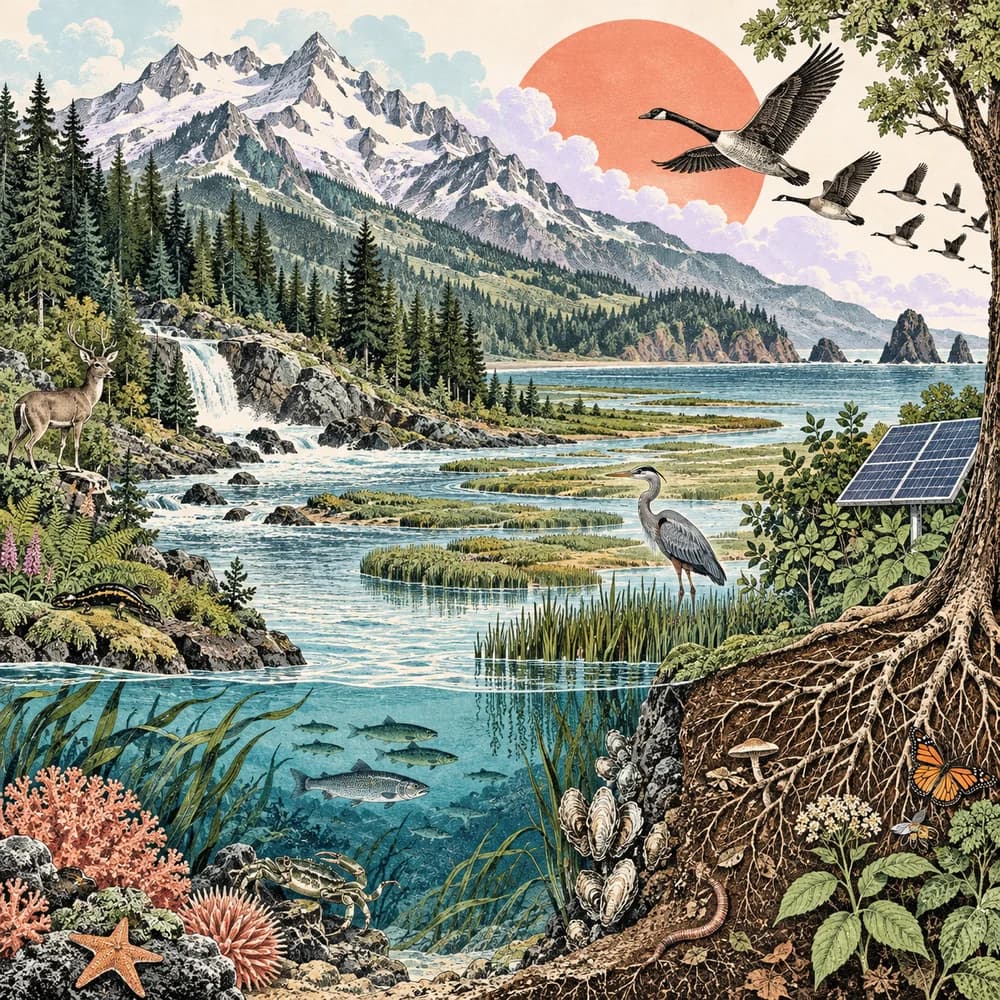
AP Environmental Science Unit 2, The Living World: Biodiversity, is about why the variety of life matters and what happens to ecosystems when that variety is disrupted. The single biggest idea is that more diverse systems (genetically, by species, and by habitat) are more resilient, meaning they recover from disturbances better than simple ones do. This unit is 6-8% of the AP exam and builds directly on the energy and matter flows you learned in Unit 1.
What this unit covers
The three levels of biodiversity and why they buffer ecosystems
- Biodiversity comes in three flavors: genetic (variety of genes inside a population), species (number and variety of species in an area), and habitat (variety of ecosystems and conditions in a region).
- More genetic diversity means a population can handle environmental stressors better, because there's a higher chance some individuals carry traits that let them survive a drought, disease, or temperature swing.
- A population bottleneck (a sharp drop in numbers) crushes genetic diversity, leaving the survivors with a thin gene pool and fewer options when the next stressor hits.
- Ecosystems with more species recover from disruptions more easily. If one species drops out, another can often fill its role.
- When habitat is lost, specialists (species with narrow needs) disappear first, followed by generalists. That order tells you a lot about how degraded an ecosystem is.
Ecosystem services and what we lose when they break
- Ecosystem services fall into four categories: provisioning (food, water, timber, medicine), regulating (climate control, water purification, pollination, flood control), cultural (recreation, aesthetic, spiritual value), and supporting (nutrient cycling, soil formation, photosynthesis that keeps the other three running).
- Human activities (anthropogenic disruptions) can degrade these services, and the damage shows up as both ecological consequences and economic costs.
- Example: lose the pollinators (a regulating service) and crop yields fall, which is a provisioning AND economic problem at the same time.
Island biogeography and the specialist trap
- Island biogeography is the study of how species colonize islands and how their community structures work. Islands get populated by new species arriving from elsewhere over time.
- Because islands have limited resources (food, territory), many island species evolve into specialists rather than generalists.
- That specialization is a liability. When invasive species (usually generalists) arrive, they outcompete the specialists, which can drive island species toward extinction.
- This is why islands are extinction hotspots. The species are finely tuned to a narrow setting, so any disruption hits hard.
Tolerance, disruptions, and adaptation over time
- Ecological tolerance is the range of conditions (temperature, salinity, flow rate, sunlight) an organism can survive before injury or death. It applies to individual organisms and to whole species.
- Natural disruptions (volcanic eruptions, wildfires, hurricanes, sea level change) can be as damaging as human-caused ones, sometimes more. They operate on different time scales that are periodic (regular), episodic (occasional), or random.
- Earth's climate has shifted over geological time, and sea level has risen and fallen with the amount of glacial ice. These long-term changes reshape where species can live.
- Organisms adapt through incremental genetic changes over short and long time scales. When the environment changes suddenly or gradually, a species has three options: change behavior, move, or die out.
Ecological succession and keystone species
- Primary succession starts on bare rock or lifeless surfaces with no soil (think a fresh lava flow). Pioneer species like lichens and mosses move in first and slowly build soil.
- Secondary succession happens where a disturbance cleared an existing community but soil remains (a field after a fire or abandoned farmland). It's faster because the soil is already there.
- A keystone species has an outsized effect on community structure. Remove it and the whole community shifts.
- An indicator species signals ecosystem health by its presence, absence, abundance, or chemical makeup.
- Over the course of succession, total biomass, species richness, and net productivity all change over time as the community matures.
Unit 2, The Living World: Biodiversity at a glance
|
| Genetic diversity | Variety of genes in a population | More genes = more options | Buffers against stressors; bottlenecks erase it |
| Species diversity | Number and variety of species | Habitat quality and size | More species = faster recovery from disruption |
| Ecosystem services | Benefits nature provides humans | Four categories of services | Disruption causes ecological and economic harm |
| Island biogeography | Distribution of life on islands | Colonization and isolation | Specialists are vulnerable to invasives |
| Ecological tolerance | Range of conditions survivable | Temperature, salinity, light, flow | Sets where a species can live |
| Succession | Community change over time | Primary vs secondary disturbance | Rebuilds biomass, richness, productivity |
Why Unit 2, The Living World: Biodiversity matters in APES
This unit is the course's argument for why losing species is a problem, not just a sad one but a functional one. It gives you the resilience principle that runs through the rest of APES: simple systems break, diverse systems bend and bounce back. Everything you'll later study about pollution, land use, and global change is really a story about disrupting biodiversity and ecosystem services.
- It defines resilience, the idea that diverse systems recover from disturbance, which you'll apply every time a later unit introduces a stressor.
- It connects ecology to economics through ecosystem services, the framework for putting a dollar value on what nature does for free.
- It explains adaptation and succession, so you understand how ecosystems respond to disruption over both short and geological time.
- It sets up invasive species and specialist vulnerability, themes that return in land use and global change.
How this unit connects across the course
- Builds directly on Unit 1 (Ecosystems). The energy flow, food webs, and biogeochemical cycles you learned there are the machinery that biodiversity keeps running, and ecosystem services are basically those cycles framed as human benefits.
- Feeds into Unit 3 (Populations). Genetic diversity, bottlenecks, and tolerance ranges all shape how populations grow, survive, and respond to limiting factors.
- Pays off in Unit 5 (Land and Water Use). Habitat loss, fragmentation, and invasive species, introduced here, become the main human pressures driving species loss.
- Comes full circle in Unit 9 (Global Change). Climate change, sea level rise, and mass extinction are the large-scale disruptions this unit's tolerance and adaptation concepts help you analyze.
Key equations and processes
- Primary succession: colonization of bare, soil-free surfaces by pioneer species (lichens, mosses) that slowly build soil over time. Use it when there was no prior soil, like after a glacier or lava flow.
- Secondary succession: regrowth of a community after a disturbance that left soil intact, like a fire or abandoned field. Faster than primary because the soil base is already there.
- Shannon Diversity Index (H'): a measure that combines species richness and evenness, calculated as H′=−∑i=1spilnpi, where s is the number of species and pi is the proportion of individuals in species i. Higher H' means more diversity.
- Simpson's Diversity Index: another diversity measure that weighs the probability that two randomly chosen individuals belong to different species. Higher value means more diverse.
- Genetic diversity and bottlenecks: track how a sharp population crash reduces the variety of genes available, lowering the population's ability to respond to future stressors.
Unit 2, The Living World: Biodiversity on the AP exam
This unit is 6-8% of the AP exam, so expect steady coverage in both the multiple-choice section and the free-response questions. Biodiversity content shows up in questions that ask you to explain why a diverse ecosystem recovers from disturbance better than a simple one, describe the four ecosystem service categories with examples, and identify whether a scenario shows primary or secondary succession.
- Explain and describe prompts are common. You'll define a level of biodiversity, an ecosystem service, or a type of succession and connect it to a real consequence.
- Stimulus analysis appears when you're given a data table or graph of species counts and asked to compare richness or evenness, or to interpret a diversity index.
- Cause and effect questions ask you to trace how a disruption (habitat loss, an invasive species, a bottleneck) leads to a specific loss of diversity or service.
- Calculation can appear if you're handed species counts and asked to apply or interpret a diversity index, so practice reading those formulas.
- Strong answers use the exact vocabulary (specialist, generalist, keystone, indicator species, resilience) and tie it to a concrete example rather than staying vague.
Essential questions
- Why does a genetically and species-diverse ecosystem recover from disturbance better than a simple one?
- How do natural disruptions and human disruptions compare in their effects on ecosystems and ecosystem services?
- Why are specialist species, especially on islands, so vulnerable to invasive generalists?
- How do ecosystems rebuild themselves through succession, and what changes in biomass, richness, and productivity along the way?
Key terms to know
- Genetic diversity: the variety of genes within a population, which determines how well it can respond to environmental stressors.
- Species diversity: the number and variety of species in an area; higher diversity means faster recovery from disruption.
- Habitat diversity: the variety of ecosystems and conditions across a region.
- Population bottleneck: a sharp reduction in population size that erases genetic diversity in the survivors.
- Specialist species: a species with narrow habitat or resource needs, vulnerable to change and lost first when habitat degrades.
- Generalist species: a species that tolerates a wide range of conditions and resources, making it more resistant to disruption.
- Ecosystem services: the benefits humans get from nature, grouped as provisioning, regulating, cultural, and supporting.
- Island biogeography: the study of how species colonize islands and form community structures under isolation.
- Invasive species: a non-native, usually generalist species that outcompetes native specialists and reduces diversity.
- Ecological tolerance: the range of conditions an organism or species can endure before injury or death.
- Keystone species: a species whose activities have an outsized effect on community structure.
- Indicator species: a species whose presence, abundance, or condition signals the health of an ecosystem.
- Primary succession: community development on bare surfaces with no existing soil, starting with pioneer species.
- Secondary succession: community regrowth after a disturbance that left the soil intact, which makes it faster.
Common mix-ups
- Primary vs secondary succession: the difference is the soil. Primary starts on bare rock with no soil; secondary follows a disturbance that left soil behind, so it goes faster.
- Keystone vs indicator species: a keystone species holds the community together (remove it and things collapse); an indicator species just signals ecosystem health by being present or absent.
- Specialist vs generalist: specialists have narrow needs and high vulnerability; generalists tolerate a wide range and usually win when conditions change, which is exactly why invasives tend to be generalists.
- Genetic vs species diversity: genetic diversity is variation within one species; species diversity is the count and variety of different species. Both build resilience, but at different levels.