1.4 The Carbon Cycle

♻️AP Environmental Science Unit 1 Review
1.4 The Carbon Cycle
♻️ AP Environmental Science
The carbon cycle is the movement of carbon atoms between sources and sinks, like the atmosphere, living things, oceans, soil, and fossil fuels. In AP Environmental Science, you should be able to explain fast carbon movement through photosynthesis and cellular respiration, plus slow storage in reservoirs that can hold carbon for millions of years.
Carbon Cycle APES Basics
In AP Environmental Science, the carbon cycle is the movement of carbon-containing atoms and molecules between sources and sinks. Major reservoirs include the atmosphere, living organisms, soil, oceans, sediments, rocks, and fossil fuels.
The key exam idea is residence time. Carbon moves quickly through living things by photosynthesis and cellular respiration, but some reservoirs hold carbon for long periods. Fossil fuels formed from plant and animal decomposition over millions of years, and combustion moves that stored carbon into the atmosphere as CO2 quickly.
Why This Matters for the AP Environmental Science Exam
This topic builds the skill of reading and explaining a biogeochemical cycle diagram. On the exam, you may need to identify steps in the carbon cycle, name where carbon is stored, and explain how carbon moves from one reservoir to another. A common task is predicting what happens to the rest of the cycle when one part changes, such as more fossil fuel burning or large-scale deforestation.
You should be ready to connect the carbon cycle to bigger course themes, especially how human activities speed up the movement of carbon and how that links to greenhouse gases and climate change in later units.
Key Takeaways
- The carbon cycle moves carbon-containing atoms and molecules between sources and sinks.
- Photosynthesis pulls CO2 out of the atmosphere; cellular respiration releases it back. This is the fast exchange in living things.
- Some reservoirs hold carbon for short periods (living organisms) and some hold it for very long periods (fossil fuels, sediments).
- Decomposition of plants and animals over millions of years created fossil fuel reservoirs.
- Burning fossil fuels moves long-stored carbon into the atmosphere as CO2 quickly, faster than natural processes return it to storage.
- Deforestation reduces the number of plants available to take in CO2, leaving more in the atmosphere.
The Carbon Cycle: Sources, Sinks, and Movement
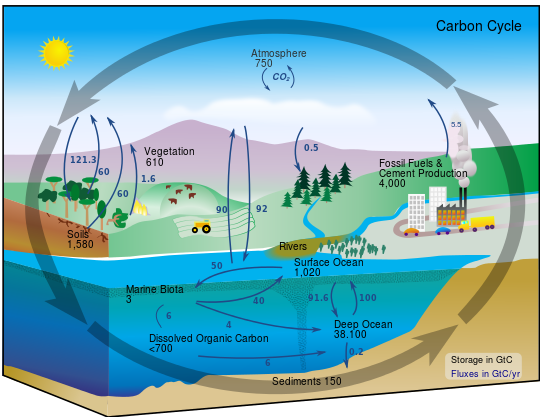
Carbon is the building block of living things, and the carbon cycle is just the movement of carbon between different storage spots on Earth. A source releases carbon into the atmosphere, and a sink (also called a reservoir) stores it. The same carbon atom can pass through the atmosphere, a plant, an animal, soil, the ocean, and rock over time.
A useful way to think about it is fast versus slow.
- Fast (short-term) reservoirs: living organisms exchange carbon quickly through photosynthesis and respiration. Carbon stays here for a short time.
- Slow (long-term) reservoirs: fossil fuels, deep ocean sediments, and rock can hold carbon for millions of years.
The length of time carbon stays in a reservoir is its residence time. Knowing which reservoirs are fast and which are slow is one of the most testable ideas in this topic.
Photosynthesis and Cellular Respiration: The Living Loop
In living things, carbon cycles between two key processes:
- Photosynthesis: plants and other producers take in CO2 from the atmosphere and use sunlight to build sugars (organic compounds). This removes carbon from the air.
- Cellular respiration: plants, animals, and other organisms break down those sugars to get energy, releasing CO2 back into the atmosphere.
When organisms die, decomposers break down their tissues. This returns carbon to the soil and air. This loop is the fast part of the cycle, and it keeps carbon moving constantly through the living world.
The Slow Cycle: Fossil Fuels and Long-Term Storage
Over millions of years, dead plants and animals that did not fully decompose got buried under layers of sediment. Heat and pressure slowly turned that organic matter into fossil fuels (coal, oil, and natural gas). This is how carbon ended up locked in long-term geological storage.
Oceans also store carbon. CO2 dissolves into seawater, and over time some of it forms sediments on the ocean floor. These slow processes naturally kept atmospheric carbon roughly balanced for long stretches of Earth's history.
Human Impacts on the Carbon Cycle
Two main human activities throw the cycle off balance:
- Burning fossil fuels: combustion takes carbon that was stored for millions of years and releases it into the atmosphere as CO2 in a very short time. Natural processes cannot return that carbon to storage anywhere near as fast as we release it. Fossil fuels are also nonrenewable, so we are using a slow-to-form resource quickly.
- Deforestation: cutting down forests removes producers that would otherwise take in CO2 through photosynthesis. With fewer plants pulling carbon out of the air, more CO2 stays in the atmosphere.
Because CO2 is a greenhouse gas, adding it to the atmosphere faster than it can be stored contributes to climate change. This connection between the carbon cycle and rising atmospheric CO2 is something you will see again in later units on atmospheric pollution and global change.
How to Use This on the AP Environmental Science Exam
MCQ
Expect questions that show a carbon cycle diagram and ask you to identify a process or a reservoir. Be ready to tell apart sources and sinks, and to recognize photosynthesis (CO2 in) versus respiration and combustion (CO2 out).
Free Response
If asked to describe steps in the carbon cycle, name the process and the direction carbon moves, not just the label. For example, write that photosynthesis removes CO2 from the atmosphere and stores carbon in plant tissue, rather than just writing "photosynthesis."
When a prompt asks you to predict the effect of a change, follow the carbon. If deforestation increases, fewer plants take in CO2, so atmospheric CO2 rises. If fossil fuel use increases, long-stored carbon moves into the atmosphere quickly and adds to greenhouse gases.
Common Trap
The reservoir that takes the longest to cycle is easy to miss. Slow reservoirs like fossil fuels and ocean sediments hold carbon for millions of years, while living organisms hold it briefly. Questions often test whether you can match a reservoir to its residence time.
Common Misconceptions
- Misconception: Carbon is created or destroyed in the cycle.Actually: Carbon is not created or destroyed in the cycle. Earth is a closed system for matter, so carbon atoms are recycled, not used up. Combustion moves carbon between reservoirs; it does not make new carbon.
- Misconception: Photosynthesis destroys CO2.Actually: Photosynthesis does not "harm" CO2. It converts CO2 into organic compounds (sugars). The carbon is still there, just stored in a different form.
- Misconception: Fossil fuels are separate from the slow carbon cycle.Actually: Fossil fuels are part of the slow carbon cycle, not a separate thing. They are a long-term carbon reservoir. The problem is the speed at which humans release that carbon, not that fossil fuels are outside the cycle.
- Misconception: Oceans only absorb carbon.Actually: Oceans both absorb and release carbon. The ocean is a major carbon sink, but it also returns CO2 to the atmosphere. It is not a one-way storage container.
- Misconception: Cellular respiration happens only in animals, not plants.Actually: Cellular respiration happens in plants too, not just animals. Plants carry out both photosynthesis and respiration, so they release some CO2 as well as take it in.
Related AP Environmental Science Guides
Practice Questions for 1.4
1 of 10
Marine scientists measured atmospheric carbon dioxide, surface ocean carbon dioxide, and ocean pH at a Pacific monitoring station from 1990 to 2020. The results of this long-term study are shown in the figure.
Based on the trends in the graph, which conclusion about the ocean's role in the carbon cycle is best supported?
A.
Seawater pH increases proportionally as the ocean absorbs more carbon dioxide.
B.
The ocean has reached its maximum capacity and can no longer absorb carbon gas.
C.
The ocean acts as a major carbon sink, absorbing emissions and lowering water pH.
D.
Rising atmospheric carbon dioxide causes the ocean to release its stored carbon.
Vocabulary
The following words are mentioned explicitly in the AP® course framework for this topic.Term | Definition |
|---|---|
carbon cycle | The biogeochemical process by which carbon moves between the atmosphere, living organisms, soil, and water systems. |
carbon dioxide | A greenhouse gas produced by combustion of fossil fuels and respiration; a principal contributor to global climate change. |
cellular respiration | The metabolic process in living organisms that breaks down organic compounds and releases carbon dioxide back into the atmosphere. |
decomposition | The process by which dead organic matter is broken down by microorganisms, releasing CO2 and other nutrients back into the environment. |
fossil fuels | Non-renewable energy sources formed from ancient organic matter, including coal, oil, and natural gas, that release carbon dioxide when burned. |
photosynthesis | The process by which plants convert carbon dioxide and light energy into organic compounds, removing carbon from the atmosphere. |
reservoir | A storage location or system that holds compounds (such as nitrogen, phosphorus, carbon, or water) for varying periods of time in biogeochemical cycles. |
sinks | Locations or systems that absorb and store substances (water, carbon, etc.) from the environment in biogeochemical cycles. |
sources | Origins or locations from which substances (water, carbon, etc.) are released into the environment in biogeochemical cycles. |
Frequently Asked Questions
What is the carbon cycle in APES?
The carbon cycle is the movement of carbon-containing atoms and molecules between sources and sinks. AP Environmental Science focuses on reservoirs, transfers, photosynthesis, cellular respiration, decomposition, and fossil fuel combustion.
What are carbon sources and sinks?
A carbon source releases carbon, often as CO2, while a carbon sink stores carbon. Examples of sinks include plants, soils, oceans, sediments, rocks, and fossil fuel deposits.
How do photosynthesis and cellular respiration affect the carbon cycle?
Photosynthesis removes CO2 from the atmosphere and stores carbon in organic compounds. Cellular respiration breaks down organic compounds and releases CO2 back into the atmosphere.
Which carbon reservoirs hold carbon the longest?
Long-term carbon reservoirs include fossil fuels, rocks, sediments, and parts of the deep ocean. These reservoirs can hold carbon for very long periods compared with living organisms.
How does burning fossil fuels change the carbon cycle?
Burning fossil fuels quickly moves carbon that was stored for millions of years into the atmosphere as carbon dioxide. This increases atmospheric CO2 faster than natural processes can return it to long-term storage.
How should you answer carbon cycle diagram questions?
Name the reservoir, name the process, and state the direction carbon moves. For example, photosynthesis moves carbon from atmospheric CO2 into plant tissue.
See Fiveable more often in Google
Mark Fiveable as a preferred source and Google is more likely to show you our guides in Top Stories, with a "preferred" badge in AI Mode and AI Overviews.