2.3 Island Biogeography

♻️AP Environmental Science Unit 2 Review
2.3 Island Biogeography
♻️ AP Environmental Science
What is island biogeography in AP Environmental Science?
Island biogeography is the study of how species reach, survive on, and shape communities on islands. The number of species an island can hold depends on a balance between new species arriving and species dying out, and island size and distance from the mainland strongly affect that balance. Because resources on islands are limited, many island species become specialists, which makes them vulnerable when generalist invasive species show up.
Island biogeography, the study of how species arrive on and die out on islands, builds on the biodiversity ideas you use across Unit 2. Its cause-and-effect reasoning also carries into later topics on invasive species and biodiversity loss.
What Sets Species Numbers on Islands
- Island biogeography studies the ecological relationships, distribution, and community structure of organisms living on islands.
- Islands gain species when new organisms arrive (colonization) and lose species through extinction; species number settles where these two rates balance.
- Larger islands and islands closer to the mainland tend to hold more species because they are easier to reach and have more room and resources.
- Limited resources push many island species to become specialists with narrow niches.
- Specialist island species can decline when generalist invasive species are introduced and compete for the same limited resources.
- Isolation on islands can drive species to evolve away from their mainland relatives over time.
How This Theory Works
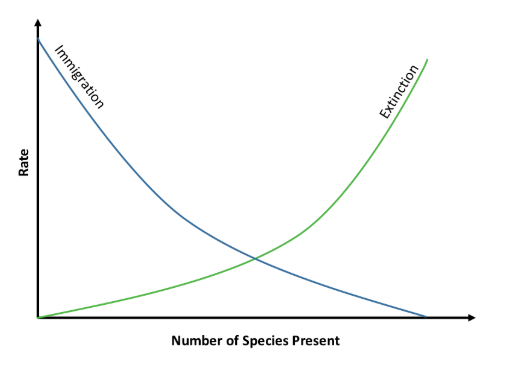
When a new island forms, it starts with no life. Over time, organisms arrive from other places and begin to settle, which is how islands get colonized. Two rates control how many species an island ends up with:
- Arrival (colonization): new species reaching the island
- Extinction: species dying out on the island
As more species arrive, space and resources run low, so the extinction rate rises while the arrival rate falls. Eventually these two rates meet at an equilibrium, the point where the number of species stays roughly steady even as which species are present may change.
Two factors strongly affect this balance:
- Size: larger islands generally hold more species because they have more space and resources.
- Distance: islands closer to the mainland are easier to reach, so they tend to receive more arriving species than far-off islands.
Why Island Species Are Vulnerable
Islands are often home to species found nowhere else, sometimes called endemic species. Because island resources like food and territory are limited, many of these species evolve to be specialists with a narrow set of conditions they can live in.
That specialization becomes a problem when invasive species arrive. Invasive species are usually generalists that can use a broad range of resources and often have few or no natural predators in the new location. When a generalist invasive species competes with a specialist for food or space, the specialist can be pushed toward extinction. This is a key cause-and-effect chain to be able to explain clearly.
Island Biogeography and Evolution
Isolation is a major driver of evolution on islands. When a small group of organisms reaches an island and little or no new arrivals follow, that population adapts to local conditions and can slowly evolve away from its mainland relatives. Different islands within a chain can have different pressures, such as available food types and habitats, which pushes populations in different directions.
Darwin's finches on the Galapagos Islands are a well-known example of this. A small population reached the islands from the South American mainland, and because there was little further arrival from the mainland, the birds adapted to island conditions and diversified over time. Treat this as an illustrative example of the concept, not a required case you must memorize.
Comparing Islands and Explaining Specialist Losses
MCQ:
- Expect questions that ask you to compare islands by size and distance. Remember: bigger and closer usually means more species.
- Watch for graph questions showing arrival and extinction rates crossing. The crossing point is the equilibrium number of species.
Free Response:
- If asked to describe island biogeography, mention the study of distribution, ecological relationships, and community structure of island organisms.
- If asked why island species go extinct, explain the specialist versus generalist contrast: narrow-niche specialists may lose access to resources when broad-niche invasive generalists arrive.
- Use clear cause and effect. State the change (invasive generalist arrives), then the result (specialist population declines or may be lost).
Common Trap:
- Do not say larger or closer islands automatically have zero extinction. They still lose species; they just tend to gain more.
Common Misconceptions
- Misconception: Equilibrium means the same species stay forever.Actually: Equilibrium does not mean the same species stay forever. The total number of species stays roughly steady, but which species are present can keep changing as some arrive and others die out.
- Misconception: Endemic species are invasive species.Actually: Endemic does not mean the same thing as invasive. Endemic species occur naturally in only one area; invasive species are introduced and spread where they are not native.
- Misconception: Specialists are better or stronger than generalists.Actually: Specialists are not "better" or "stronger" than generalists. Specialists do well in stable, specific conditions but struggle when conditions change or invasive generalists arrive.
- Misconception: Distance affects survival, but not arrival.Actually: Distance affects arrival, not just survival. Far islands get fewer new species because organisms have a harder time reaching them, not only because life there is harder.
- Misconception: Bigger islands do not support more species.Actually: A bigger island helping species richness is about space and resources, not magic. More area supports more individuals and more niches, which lowers extinction risk.
Related AP Environmental Science Guides
Practice Questions for 2.3
1 of 10
Four newly formed volcanic islands of similar size were monitored for 10 years to test whether bird colonization rates decline with increasing distance from the mainland. Mean numbers of new bird species colonizing each island per year were as follows: Island A, 50 km, ; Island B, 150 km, ; Island C, 300 km, ; Island D, 500 km, .
Which statement best interprets these results relative to the hypothesis?
A.
The data support the hypothesis because colonization rates decreased as distance from the mainland increased.
B.
The data are inconclusive because extinction rates on the islands were not measured.
C.
The data refute the hypothesis because the standard errors show no significant difference among islands.
D.
The data partially support the hypothesis, but island size must be varied to draw a conclusion.
Vocabulary
The following words are mentioned explicitly in the AP® course framework for this topic.Term | Definition |
|---|---|
colonization | The process by which new species arrive and establish themselves on islands from other locations. |
community structures | The composition and organization of populations of different species living together on islands. |
distribution of organisms | The spatial arrangement and presence of different species across islands. |
ecological relationships | The interactions and connections between organisms and their environment on islands. |
evolution | The process of change in species over time through adaptation and natural selection. |
generalist species | Species that can survive and reproduce in a wide variety of environmental conditions and food sources, and tend to be advantaged in changing habitats. |
invasive species | Non-native organisms introduced to an ecosystem that outcompete native species for resources and can disrupt ecological balance. |
island biogeography | The study of the distribution, diversity, and evolution of species on islands and how island characteristics affect species composition and adaptation. |
specialist species | Species that are adapted to specific environmental conditions and have narrow habitat requirements. |
See Fiveable more often in Google
Mark Fiveable as a preferred source and Google is more likely to show you our guides in Top Stories, with a "preferred" badge in AI Mode and AI Overviews.