4.4 Earth's Atmosphere

♻️AP Environmental Science Unit 4 Review
4.4 Earth's Atmosphere
♻️ AP Environmental Science
TLDR
Earth's atmosphere is a mix of gases shaped by nitrogen (about 78%) and oxygen (about 21%), with smaller amounts of argon, carbon dioxide, water vapor, and ozone. The atmosphere is divided into layers by temperature changes: the troposphere, stratosphere, mesosphere, thermosphere, and exosphere. For AP Environmental Science, you need to describe what the atmosphere is made of and how its layers are organized.
Layers of the Atmosphere for APES
For APES 4.4, know the atmospheric layers from the ground up: troposphere, stratosphere, mesosphere, thermosphere, exosphere. The layers are defined by temperature gradients, so the key pattern is temperature down in the troposphere, up in the stratosphere, down in the mesosphere, and up in the thermosphere.
You should also connect each layer to its APES role. Weather occurs in the troposphere, the protective ozone layer is in the stratosphere, and the atmosphere's major gases are mostly nitrogen and oxygen, with smaller amounts of argon, carbon dioxide, water vapor, and ozone.
Why This Matters for the AP Environmental Science Exam
This topic gives you the foundation for understanding weather, climate, and air pollution later in the course. When you study global wind patterns, the greenhouse effect, ozone depletion, and smog, you will use the atmospheric structure and gas composition from this topic. On the exam, expect to identify gases and their relative abundance, describe the layers in order, and explain how temperature changes through each layer. You may also be asked to read or interpret diagrams that show atmospheric layers and temperature gradients.
Key Takeaways
- Nitrogen and oxygen make up most of the atmosphere, with each major gas having its own relative abundance.
- The five layers, from the ground up, are troposphere, stratosphere, mesosphere, thermosphere, and exosphere.
- Layers are defined by temperature gradients, so temperature either rises or falls as you move up through each one.
- Weather happens in the troposphere, and temperature there decreases with altitude.
- The ozone layer sits in the stratosphere and absorbs harmful UV radiation, which causes temperature to increase with altitude there.
- Greenhouse gases like carbon dioxide, methane, and nitrous oxide trap heat in the atmosphere.
Major Gases
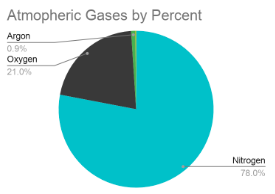
The atmosphere is made up of several major gases, each with its own relative abundance. By volume, the breakdown looks like this:
| Gas | Approximate Abundance |
|---|---|
| Nitrogen (N2) | about 78% |
| Oxygen (O2) | about 21% |
| Argon (Ar) | about 0.93% |
| Carbon dioxide (CO2) | about 0.04% |
| Water vapor (H2O) | variable, up to about 4% |
Nitrogen (N2) is the most abundant gas. It cycles into and out of the atmosphere through processes like denitrification (recall the nitrogen cycle). Oxygen (O2) is the next most abundant and is released through photosynthesis.
Water vapor (H2O) is variable, meaning its concentration changes from place to place. It tends to be more concentrated near the equator, where warm, humid conditions are common, and less concentrated near the poles.
Several gases play important roles even at low concentrations. Carbon dioxide (CO2), methane (CH4), and nitrous oxide (N2O) are greenhouse gases that trap heat in the atmosphere. Burning fossil fuels releases these gases, and because humans have burned large amounts of fossil fuels, greenhouse gas levels are rising and the planet is warming.
Ozone (O3) absorbs harmful UV radiation from the sun. The ozone layer reduces the amount of UV that reaches the surface, preventing many harmful effects. As an example of human impact, the ozone layer was damaged by past use of CFCs (chlorofluorocarbons), a connection you will study in more detail in the global change unit.
Layers of the Atmosphere
The atmosphere is divided into layers based on temperature gradients. From the ground up, the layers are the troposphere, stratosphere, mesosphere, thermosphere, and exosphere.
Troposphere: This is the layer closest to the ground. It starts at the surface and extends to roughly 10 km, about the cruising altitude of an airplane. All weather occurs here. Temperature decreases as altitude increases in the troposphere.
Stratosphere: This layer sits above the troposphere, from about 10 km to 50 km. It contains the ozone layer, which absorbs UV radiation. Because ozone absorbs UV and releases energy as heat, temperature increases with altitude in the stratosphere, the opposite of the troposphere.
Mesosphere: This layer runs from about 50 km to 80 km. Temperature decreases with altitude here, making it very cold. Temperatures can drop below -80 degrees C.
Thermosphere: This layer extends from about 80 km upward. It is sometimes associated with the ionosphere, where charged particles from the sun are trapped. Temperature increases with altitude because this layer absorbs a lot of high-energy solar radiation.
Exosphere: This is the outermost layer of the atmosphere. It gradually thins out and merges with space. The molecules here have extremely low density, and many satellites orbit in this region.
A helpful way to keep the layers straight is to notice the temperature pattern. Temperature falls in the troposphere, rises in the stratosphere, falls again in the mesosphere, and rises in the thermosphere. That alternating pattern is what defines where one layer ends and the next begins.
How to Use This on the AP Environmental Science Exam
MCQ
- Be ready to match each major gas to its approximate percentage, especially nitrogen and oxygen.
- Know the order of the layers from the ground up and be able to place a feature (weather, ozone, satellites) in the correct layer.
- Use the temperature pattern (down, up, down, up) to identify a layer from a description or a graph.
Free Response
- If a question asks you to describe the atmosphere, name specific gases with their relative abundance instead of saying "mostly gas."
- When explaining a layer, connect its name to a measurable feature, such as "the stratosphere warms with altitude because ozone absorbs UV radiation."
- Use precise cause and effect. For example, ozone absorbing UV is the reason the stratosphere heats up, not just a fact that happens nearby.
Common Trap
- Do not confuse the stratosphere's ozone (protective, absorbs UV) with ground-level ozone in smog. This topic focuses on the protective ozone layer.
Common Misconceptions
- Misconception: Oxygen is the most abundant gas.Actually: Nitrogen is the most abundant at about 78%, while oxygen is about 21%.
- Misconception: Temperature always drops as you go higher.Actually: It only drops in the troposphere and mesosphere. It rises in the stratosphere and thermosphere because those layers absorb solar energy.
- Misconception: The ozone layer is in the troposphere.Actually: The protective ozone layer is in the stratosphere. Ozone near the ground is a pollutant, which is a different idea.
- Misconception: Water vapor is a fixed part of the atmosphere.Actually: Water vapor is variable and changes with location and conditions, unlike nitrogen and oxygen, which stay fairly constant.
- Misconception: The layers are separated by sharp physical walls.Actually: The boundaries are defined by changes in the temperature trend, not by visible barriers.
Related AP Environmental Science Guides
Practice Questions for 4.4
1 of 10
The graph shows atmospheric temperature as a function of altitude. The atmosphere is divided into four layers, labeled A, B, C, and D, based on changes in temperature with increasing altitude.
Depletion of the gas causing the temperature increase in Layer B most directly leads to which consequence?
A.
Increased formation of photochemical smog in cities
B.
Acidification of terrestrial and aquatic ecosystems
C.
Increased rates of skin cancer and cataracts in humans
D.
Enhanced greenhouse effect and global climate warming
Vocabulary
The following words are mentioned explicitly in the AP® course framework for this topic.Term | Definition |
|---|---|
atmosphere | The layer of gases surrounding Earth that is composed of major gases in varying proportions and is organized into distinct layers based on temperature. |
exosphere | The outermost layer of Earth's atmosphere where gas molecules are sparse and gradually transition to outer space. |
mesosphere | The layer of the atmosphere above the stratosphere where temperature decreases with altitude and meteors burn up. |
stratosphere | The layer of the atmosphere above the troposphere where temperature increases with altitude and the ozone layer is located. |
temperature gradients | The changes in temperature with altitude that define and distinguish the different layers of the atmosphere. |
thermosphere | The layer of the atmosphere above the mesosphere where temperature increases with altitude due to absorption of solar radiation. |
troposphere | The lowest layer of Earth's atmosphere where temperature generally decreases with altitude and where most weather occurs. |
Frequently Asked Questions
What are the layers of the atmosphere for APES?
From the ground up, the layers are the troposphere, stratosphere, mesosphere, thermosphere, and exosphere. APES defines these layers by temperature gradients.
What happens in the troposphere?
The troposphere is the lowest atmospheric layer, where weather occurs. Temperature generally decreases as altitude increases in this layer.
Which layer contains the ozone layer?
The stratosphere contains the protective ozone layer. Ozone absorbs ultraviolet radiation, which causes temperature to increase with altitude in the stratosphere.
What are the main gases in Earth's atmosphere?
Earth's atmosphere is mostly nitrogen at about 78% and oxygen at about 21%, with smaller amounts of argon, carbon dioxide, water vapor, and ozone.
How does temperature change through the atmosphere?
Temperature decreases in the troposphere, increases in the stratosphere, decreases in the mesosphere, and increases in the thermosphere. That pattern defines the layers.
Why does APES 4.4 matter for later units?
Atmospheric layers and gases help explain weather, climate, greenhouse gases, ozone depletion, global wind patterns, and air pollution topics later in AP Environmental Science.
See Fiveable more often in Google
Mark Fiveable as a preferred source and Google is more likely to show you our guides in Top Stories, with a "preferred" badge in AI Mode and AI Overviews.