8.3 Fiber plants and textiles

🥀Intro to Botany Unit 8 Review
8.3 Fiber plants and textiles
Types of fiber plants
Fiber plants are cultivated for their fibrous tissues, used to make textiles, ropes, and many other products. The key distinction between fiber types comes down to which part of the plant the fibers are extracted from: seeds, stems, leaves, or fruits.

Top images from around the web for Seed fiber plants
Flowers of Kapok tree - Ceiba pentandra | At Mt Coot-tha Bot… | Flickr View original
Is this image relevant?
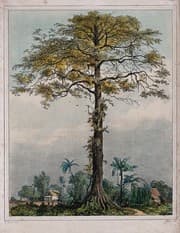
Kapok or silk cotton tree (Ceiba pentandra) growing by a village in Surinam. Coloured lithograph ... View original
Is this image relevant?
Cotton {gossypium hirsutum} | National Arboretum | Drew Avery | Flickr View original
Is this image relevant?
Flowers of Kapok tree - Ceiba pentandra | At Mt Coot-tha Bot… | Flickr View original
Is this image relevant?
Kapok or silk cotton tree (Ceiba pentandra) growing by a village in Surinam. Coloured lithograph ... View original
Is this image relevant?
Seed fiber plants
Seed fiber plants produce fibers attached directly to their seeds. Cotton (Gossypium spp.) is by far the most widely used seed fiber. Its fibers grow as elongated epidermal cells from the seed coat. Kapok (Ceiba pentandra) produces hollow fibers inside its seed pods, making them lightweight and buoyant, which is why they're used for stuffing and insulation rather than woven textiles.
Bast fiber plants
Bast fibers come from the inner bark (phloem region) of the stem. Flax (Linum usitatissimum), hemp (Cannabis sativa), and jute (Corchorus spp.) are the major bast fiber crops. Because these fibers run along the length of the stem, they tend to be long, strong, and durable, making them well-suited for textiles and cordage.
Leaf fiber plants
Leaf fibers are extracted from leaves or leaf sheaths. Sisal (Agave sisalana), abacá (Musa textilis), and New Zealand flax (Phormium tenax) are common examples. These fibers are generally coarser and more rigid than seed or bast fibers, so they're used for ropes, twine, and heavy-duty textiles rather than soft clothing.
Fruit fiber plants
Fruit fibers come from the fruit or fruit husk. Coir, derived from the outer husk of coconuts (Cocos nucifera), is the best-known fruit fiber. It's tough and resistant to saltwater, which makes it useful for doormats, brushes, and upholstery stuffing. Luffa (Luffa aegyptiaca) produces a fibrous fruit skeleton that works as a natural sponge.
Structure and composition of plant fibers
Plant fibers are made of elongated cells with thick cell walls. The chemical composition and arrangement of cell wall components determine how the fiber behaves, from its strength to its flexibility.
Cellulose content in fibers
Cellulose is the primary structural component, making up 60–90% of a fiber's dry weight. It's a linear polysaccharide built from glucose units linked by -1,4 glycosidic bonds. These chains pack tightly together into microfibrils, which is what gives plant fibers their strength, durability, and absorbency.
Lignin content in fibers
Lignin is a complex polymer that adds rigidity and compression resistance to cell walls. Bast fibers generally have lower lignin content than leaf or fruit fibers. Higher lignin makes fibers stiffer, which is useful for ropes but not ideal for soft clothing. This is a big reason why cotton (very low lignin) feels so different from sisal (higher lignin).
Other components of fibers
- Hemicellulose consists of shorter, branched polysaccharides that contribute to fiber flexibility
- Pectin, rich in galacturonic acid, is found in the middle lamella between cells and helps bind fibers together
- Waxes, proteins, and minerals are minor components that influence how fibers feel and how they respond to processing
Properties of plant fibers
A fiber's chemical composition, internal structure, and morphology together determine its physical properties. These properties dictate which applications a fiber is best suited for.
Tensile strength of fibers
Tensile strength is the maximum stress a fiber can handle before it breaks under a stretching force. Plant fibers generally have high tensile strength because of their cellulose content and the parallel alignment of cellulose microfibrils. Flax, hemp, and ramie are especially strong, making them good choices for ropes, canvas, and composite reinforcement.
Elasticity of fibers
Elasticity is a fiber's ability to return to its original length after being stretched. Plant fibers have limited elasticity compared to synthetic fibers like spandex, because cellulose chains are relatively rigid. Cotton has moderate elasticity, which is part of why cotton garments feel comfortable and hold their shape reasonably well.
Durability of fibers
Durability refers to how well a fiber resists wear, tear, and degradation over time. Fibers with high cellulose and low lignin, like flax and hemp, tend to be the most durable. Proper processing and finishing techniques can further extend the lifespan of plant-based textiles.
Absorbency of fibers
Absorbency is the ability to take up and retain moisture. Plant fibers are generally hydrophilic because the hydroxyl () groups in cellulose attract water molecules. Cotton is especially absorbent, which is why it dominates in towels, washcloths, and moisture-wicking garments. Absorbency also depends on fiber surface area, porosity, and any chemical treatments applied.

Cultivation and processing of fiber plants
Getting from a living plant to a usable fiber involves several stages, and each fiber type has its own specific requirements for growing, harvesting, and extraction.
Growing conditions for fiber plants
Different fiber plants need different environments. Cotton thrives in warm, sunny climates with well-drained soils. Flax and hemp prefer cooler temperatures and moist, fertile soils. Across all fiber crops, proper irrigation, fertilization, and pest management are critical for producing high-quality fibers.
Harvesting methods for fiber plants
Harvesting methods depend on the plant type and the fiber quality you're after. Cotton is harvested (by machine or hand) once the bolls (seed capsules) have matured and opened. Bast fiber plants like flax and hemp are often pulled from the ground entirely, rather than cut, to preserve the full length of the stem fibers.
Retting process for bast fibers
Retting separates bast fibers from the woody core and outer bark of the stem. There are two main approaches:
- Water retting involves submerging stems in water so that microbes break down the pectin and other substances binding the fibers. This is faster but can pollute waterways.
- Dew retting spreads stems out in a field and relies on fungi and bacteria to do the same job. It's slower but more environmentally friendly.
Degumming process for seed fibers
Degumming removes the gummy substances (pectin, hemicellulose) that bind fibers to seeds or to each other.
- For cotton, ginning first separates fibers from seeds mechanically, then scouring washes away remaining impurities like waxes and proteins.
- Kapok fibers are separated from seeds by mechanical means and then cleaned to remove dust and debris.
Major fiber crops
Several plant species form the backbone of the global textile industry. Each has distinct fiber properties that determine its best uses.
Cotton: properties and uses
Cotton is the most widely used natural fiber, valued for its softness, breathability, and absorbency. The fibers are composed of nearly pure cellulose, with a staple length of 20–60 mm. Cotton goes into an enormous range of products: clothing, bedding, towels, and medical supplies.
Flax: properties and uses
Flax fibers produce the textile known as linen. They're strong, durable, and have high tensile strength, with a staple length of 25–150 mm. Linen is used for high-quality clothing, tablecloths, and upholstery, as well as for paper and composite materials.
Hemp: properties and uses
Hemp fibers are long, strong, and durable, with natural antibacterial and moisture-wicking properties. Staple length ranges from 15–55 mm. Hemp is versatile: it's used for textiles, ropes, paper, building materials, and composite reinforcement.
Jute: properties and uses
Jute fibers are long, soft, and have a natural sheen, with staple lengths of 1–4 meters. They have high tensile strength but low extensibility (they don't stretch much). Jute is primarily used for sacks, bags, carpets, and as a backing material for linoleum.
Ramie: properties and uses
Ramie fibers are long (120–200 mm staple length), strong, and have a silky luster. They're naturally resistant to bacteria, mildew, and insect attack. Ramie is used for high-quality textiles, paper, and composites.
Sisal: properties and uses
Sisal fibers are strong and durable, with a staple length of 60–120 mm. They resist saltwater degradation and UV radiation, making them ideal for ropes, twine, sacks, and as reinforcement in composites and construction materials.
Environmental impact of fiber production
Growing and processing fiber plants carries real environmental costs. Understanding these impacts is important for evaluating the sustainability of different fibers.

Water usage in fiber production
Cotton is notoriously water-intensive. The global average water footprint for cotton is about 10,000 liters per kilogram of cotton lint. That's a huge strain on local water resources, especially in arid regions. Efficient irrigation techniques and drought-resistant varieties can help reduce this demand.
Pesticide use in fiber production
Cotton alone accounts for a disproportionate share of global pesticide use relative to its planted area. Pesticide application harms human health, non-target organisms, and surrounding ecosystems. Integrated pest management (IPM) strategies and genetically modified pest-resistant varieties are two approaches to reducing pesticide dependence.
Soil degradation from fiber production
Intensive fiber crop cultivation can cause soil erosion, nutrient depletion, and loss of organic matter. Monoculture and removal of crop residues make these problems worse. Crop rotation, cover cropping, and reduced tillage help maintain soil health over time.
Sustainable practices in fiber production
Sustainable fiber production tries to balance economic, social, and environmental goals. Key strategies include:
- Organic farming, which prohibits synthetic pesticides and fertilizers
- Recycled and regenerated fibers, such as recycled cotton and Tencel (lyocell), which reduce demand for virgin fiber
- Fair trade and ethical labor practices, which improve conditions for farmers and workers in the supply chain
Textile production from plant fibers
Turning raw plant fibers into finished textiles involves spinning, weaving or knitting, and finishing. Each step shapes the final product's properties and quality.
Spinning process for plant fibers
Spinning converts loose fibers into yarn by twisting them together. Ring spinning is the most common method for plant fibers and involves three steps: drafting (drawing fibers out), twisting (adding strength), and winding onto a bobbin. Other methods include rotor spinning (faster, produces coarser yarn) and air-jet spinning (high speed, smoother yarn).
Weaving techniques for plant fibers
Weaving interlaces two sets of yarns (warp and weft) at right angles to form fabric. The three basic weave structures are:
- Plain weave: simplest pattern, strong and durable
- Twill weave: diagonal pattern, more drape and softness
- Satin weave: smooth, lustrous surface with longer float yarns
Advanced techniques like jacquard and dobby weaving allow for intricate designs and textures.
Knitting techniques for plant fibers
Knitting creates fabric by interlocking loops of yarn. The two main categories are weft knitting (e.g., circular knitting, where loops run horizontally) and warp knitting (e.g., tricot, where loops run vertically). Knitted fabrics are stretchier and softer than woven fabrics and conform well to complex shapes.
Dyeing and finishing of plant-based textiles
Dyeing applies color using natural or synthetic dyes. Plant fibers can be dyed at the fiber, yarn, or fabric stage. Finishing treatments come after dyeing and include scouring (cleaning), bleaching (whitening), and softening. These treatments improve the appearance, feel, and performance of the final textile.
Innovations in plant-based textiles
Growing environmental concerns and advances in materials science are driving new developments in plant-based textiles. These innovations aim to improve both functionality and sustainability.
Blending of plant fibers with other materials
Blending plant fibers with other fibers can combine the best properties of each. Cotton-polyester blends, for example, are popular because they're durable, wrinkle-resistant, and easy to care for. Blending with regenerated fibers like Tencel or modal improves drape, softness, and moisture management.
Nanocellulose applications in textiles
Nanocellulose is derived from plant fibers and has unique properties: high strength, enormous surface area, and excellent barrier characteristics. When incorporated into textile fibers or coatings, nanocellulose can enhance mechanical strength, moisture management, and antimicrobial activity. It also has potential in smart textiles and wearable electronics.
Biodegradable and compostable textiles
Plant fibers like cotton, linen, and hemp are inherently biodegradable, but they're often blended with synthetic materials or treated with persistent chemicals that prevent full decomposition. Fully biodegradable textile solutions include 100% organic cotton and PLA (polylactic acid), a polymer derived from corn starch. These alternatives help reduce textile waste accumulating in landfills.
Smart textiles using plant fibers
Smart textiles can sense, react to, or adapt to external stimuli like temperature, moisture, or pressure. Plant fibers can be functionalized with conductive materials (carbon nanotubes, metal nanoparticles) to create these responsive fabrics. Examples include moisture-responsive fabrics, temperature-regulating textiles, and UV-protective clothing. Integrating plant fibers with electronic sensors and actuators opens the door to wearable technology and e-textiles.
See Fiveable more often in Google
Mark Fiveable as a preferred source and Google is more likely to show you our guides in Top Stories, with a "preferred" badge in AI Mode and AI Overviews.