3.2 Molecular genetics

🥀Intro to Botany Unit 3 Review
3.2 Molecular genetics
🥀 Intro to Botany
Molecular genetics is the study of genes at the molecular level. For botany, this matters because it explains how plants grow, respond to their environment, and pass traits to the next generation. This topic covers DNA structure, how genes get expressed, mutations, and the lab techniques used to study plant genomes.
Fundamentals of molecular genetics
Molecular genetics focuses on the structure, function, and inheritance of genes at the molecular level. In plants, this field helps explain everything from how a seedling develops into a mature organism to how a species adapts to drought or disease over generations.
The core concepts you'll need to know include:
- DNA structure and how it encodes genetic information
- Gene expression (transcription and translation)
- The genetic code and how mutations alter it
- Molecular techniques used in plant genetics research

Top images from around the web for Nucleotide composition
Amines and Amides | Chemistry: Atoms First View original
Is this image relevant?
Francis Crick - wikidoc View original
Is this image relevant?
File:DNA-labels.png - Wikimedia Commons View original
Is this image relevant?
Amines and Amides | Chemistry: Atoms First View original
Is this image relevant?
Francis Crick - wikidoc View original
Is this image relevant?
DNA structure and function
Nucleotide composition
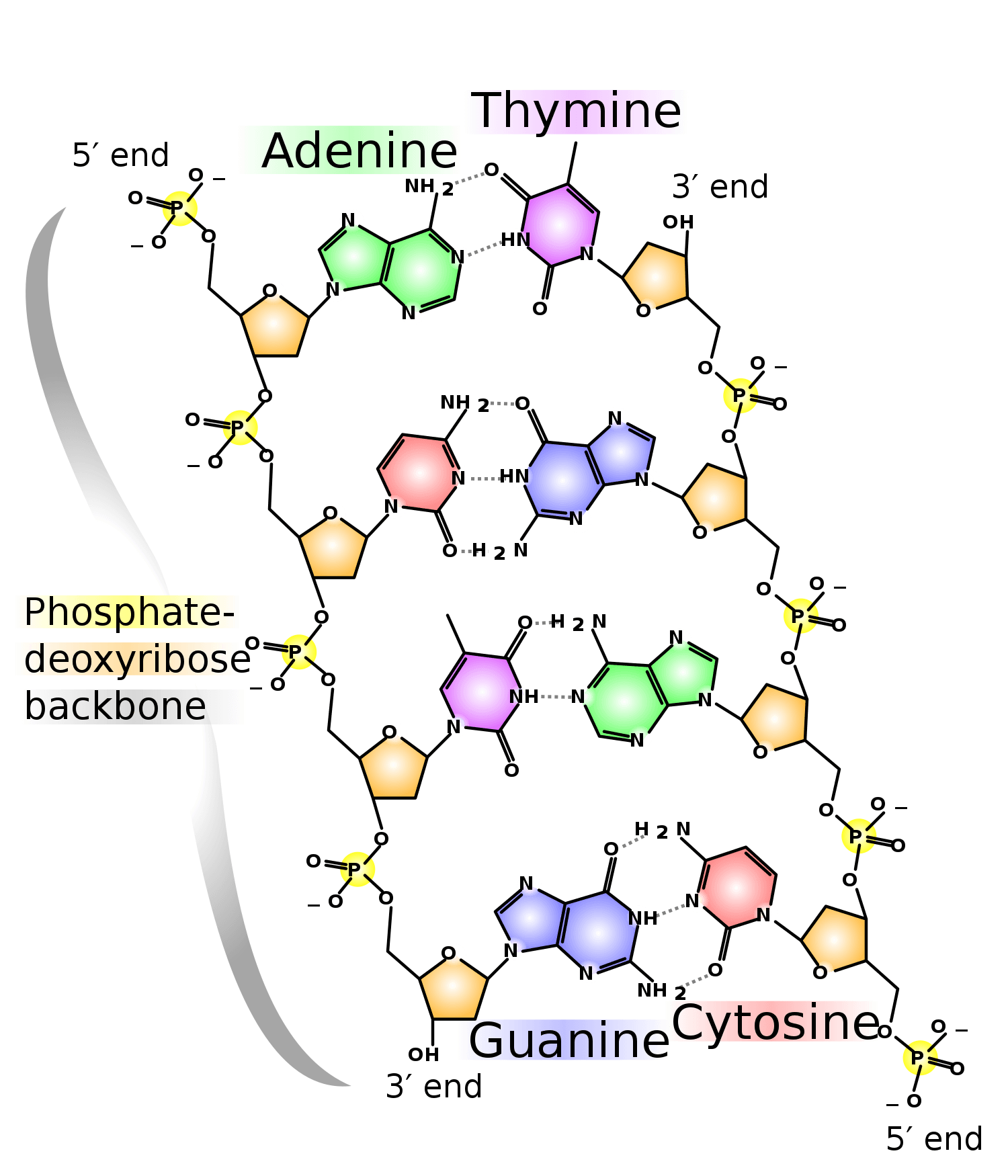
DNA is built from four types of nucleotides, each named for its nitrogenous base: adenine (A), thymine (T), guanine (G), and cytosine (C). Every nucleotide has three parts: a nitrogenous base, a deoxyribose sugar, and a phosphate group. The specific order of these nucleotides along the strand is what encodes genetic information. Think of it like an alphabet with only four letters, where the "words" are determined by the sequence.
Double helix structure
DNA takes the shape of a double helix, two complementary strands coiled around each other. Hydrogen bonds between complementary base pairs hold the two strands together: A always pairs with T (via two hydrogen bonds), and G always pairs with C (via three hydrogen bonds). This structure does two important things: it packages DNA compactly inside the cell, and it provides a built-in template for copying the molecule during replication.
Antiparallel strands and complementary base pairing
The two DNA strands run in opposite directions. One strand is oriented and the other . This antiparallel arrangement is essential for how DNA gets replicated, because DNA polymerase can only synthesize new DNA in the direction.
Complementary base pairing (A with T, G with C) ensures that each strand contains all the information needed to reconstruct the other. This is the basis of semi-conservative replication, where each new DNA molecule contains one original strand and one newly built strand.
Genome organization in plants
Nuclear genome vs organellar genomes
Plant cells are unusual because they carry genetic material in three locations: the nucleus, the mitochondria, and the chloroplasts. The nuclear genome is by far the largest and most complex, containing the majority of the plant's genes. Mitochondrial and chloroplast genomes are much smaller and typically circular in structure. These organellar genomes encode genes essential for their own functions (energy production in mitochondria, photosynthesis in chloroplasts).
Chromosomal structure and packaging
Inside the nucleus, DNA is organized into chromosomes. DNA wraps around clusters of histone proteins to form structures called nucleosomes, and this DNA-protein complex is called chromatin. This packaging system serves two purposes: it fits an enormous amount of DNA into a tiny nucleus, and it plays a role in regulating which genes are turned on or off.
Repetitive DNA sequences
A large portion of plant genomes consists of repetitive DNA, not unique genes. Two major categories:
- Tandem repeats are short sequences repeated in a head-to-tail pattern. Examples include satellite DNA and microsatellites, which are useful as genetic markers.
- Transposable elements are mobile stretches of DNA that can "jump" to new positions in the genome. Barbara McClintock first discovered these in maize. They contribute to genome evolution and can influence gene regulation when they land near or within genes.
DNA replication in plants
Replication process overview
Before a cell divides, it needs to copy all of its DNA. This happens through semi-conservative replication: the double helix unwinds, and each original strand serves as a template for building a new complementary strand. The result is two identical DNA molecules, each with one old strand and one new strand.
Key enzymes involved
Several enzymes work together during replication:
- Helicase unwinds the double helix, separating the two strands.
- DNA primase synthesizes short RNA primers that give DNA polymerase a starting point.
- DNA polymerase reads the template strand and adds complementary nucleotides to build the new strand (always in the direction).
- DNA ligase joins together the short fragments (called Okazaki fragments) that form on the lagging strand, since that strand must be synthesized in pieces.

Differences in nuclear vs organellar replication
Nuclear DNA replication is tightly coordinated with the cell cycle, occurring during S phase. Organellar DNA (in mitochondria and chloroplasts) replicates independently of the cell cycle, using its own timing and a distinct set of enzymes. Some of those enzymes are encoded by the organellar genomes themselves, while others are encoded in the nucleus and imported into the organelle.
Gene expression and regulation
Transcription in plants
Transcription is the process of copying a gene's DNA sequence into RNA. RNA polymerases carry out this work by reading the DNA template strand and assembling a complementary RNA molecule. Plants use different RNA polymerases for different jobs. For instance, RNA polymerase II transcribes protein-coding genes into messenger RNA (mRNA).
RNA processing and modifications
The initial RNA transcript (called pre-mRNA for protein-coding genes) isn't ready to use right away. It goes through several processing steps:
- 5' capping adds a modified nucleotide to the front of the transcript, which helps with stability and ribosome recognition.
- 3' polyadenylation adds a tail of adenine nucleotides to the end, protecting the RNA from degradation.
- Splicing removes non-coding sequences called introns and joins the remaining coding sequences called exons.
Plants can also perform RNA editing, which chemically alters individual nucleotides in the transcript after it's been made. This is especially common in organellar RNAs.
Translation and protein synthesis
Translation converts the information in mRNA into a protein. Ribosomes in the cytoplasm read the mRNA sequence three nucleotides at a time. Each three-nucleotide unit is called a codon, and each codon specifies either a particular amino acid or a stop signal. The ribosome assembles amino acids into a polypeptide chain according to the codon sequence.
Three codons signal the ribosome to stop: , , and .
Regulatory mechanisms of gene expression
Plants regulate gene expression at multiple levels to control growth, development, and environmental responses:
- Transcriptional regulation: Transcription factors bind to specific DNA sequences (promoters and enhancers) to activate or repress transcription of target genes.
- Post-transcriptional regulation: Mechanisms like alternative splicing (producing different mRNA variants from the same gene), RNA stability, and RNA silencing via microRNAs control how much functional mRNA is available.
- Translational and post-translational regulation: Even after mRNA is made, the cell can control how much protein is produced and how active that protein is. Modifications like phosphorylation or ubiquitination can change a protein's activity or mark it for degradation.
Genetic code and mutations
Codon-amino acid correspondence
The genetic code is the set of rules mapping each three-nucleotide codon to a specific amino acid. It's nearly universal across all life, with only minor variations in some organisms. There are 64 possible codons, but only 20 amino acids, so most amino acids are encoded by more than one codon. This redundancy is called degeneracy of the genetic code.
Types of mutations and their effects
Mutations are changes in the DNA sequence. They range in scale and impact:
- Point mutations involve a single nucleotide substitution. These can be:
- Silent: the new codon still codes for the same amino acid (no effect on the protein)
- Missense: the new codon codes for a different amino acid (may or may not affect protein function)
- Nonsense: the new codon is a stop signal, producing a truncated protein
- Insertions and deletions (indels) add or remove nucleotides. If the number of nucleotides isn't divisible by three, the reading frame shifts downstream, called a frameshift mutation. These tend to be severe because they alter every codon after the change.
- Chromosomal mutations involve large-scale rearrangements like duplications, inversions, and translocations.
Mutagens and DNA repair mechanisms
Mutagens are agents that increase mutation rates. Common examples include UV radiation, certain chemicals, and some viruses. Plants are especially exposed to UV since they can't move out of sunlight.
To protect genome integrity, plants use several DNA repair pathways:
- Base excision repair fixes small base modifications
- Nucleotide excision repair removes bulky DNA lesions (like UV-induced damage)
- Mismatch repair corrects errors missed by DNA polymerase during replication
- Double-strand break repair fixes the most dangerous type of DNA damage
Key enzymes in these processes include DNA glycosylases (which recognize damaged bases) and DNA ligases (which seal repaired strands).
Plant gene families and evolution

Multigene families and paralogous genes
Many plant genes belong to multigene families, groups of related genes that arose from a common ancestor through duplication events. Genes within the same species that originated by duplication are called paralogs. Over time, paralogs can diverge and take on different functions. One advantage of multigene families is functional redundancy: if one gene copy is lost or damaged, another copy can often compensate.
Mechanisms of gene duplication
Gene duplication happens through several mechanisms:
- Unequal crossing over during meiosis, when homologous chromosomes misalign and one chromosome ends up with an extra copy of a gene
- Retrotransposition, where an mRNA is reverse-transcribed and inserted back into the genome as a new gene copy (notably, this copy lacks introns)
- Whole-genome duplication (polyploidization), which duplicates every gene at once. This is remarkably common in plant evolution. Many crop species, including wheat and cotton, are polyploids.
Role in plant adaptation and diversification
After duplication, gene copies can follow different evolutionary paths:
- Neofunctionalization: one copy acquires a new function
- Subfunctionalization: the two copies divide the original gene's functions between them
These processes have driven the evolution of new metabolic pathways, disease resistance mechanisms, and morphological features. A well-studied example is the MADS-box gene family, whose diversification was crucial for the evolution of floral structures and reproductive strategies in flowering plants.
Molecular techniques in plant genetics
DNA extraction and purification methods
Before you can study plant DNA, you need to isolate it from plant tissue. Two common approaches:
- The CTAB method (cetyltrimethylammonium bromide) is a classic protocol well-suited to plants because CTAB helps separate DNA from the polysaccharides and secondary metabolites that plant cells contain in abundance.
- Commercial kit-based methods use spin columns and are faster but more expensive.
Purification steps like phenol-chloroform extraction and ethanol precipitation remove protein contaminants and concentrate the DNA sample.
PCR amplification and sequencing
Polymerase chain reaction (PCR) amplifies a specific DNA sequence from a tiny starting sample into millions of copies. The process uses:
- Primers: short DNA sequences that flank the target region
- Taq polymerase: a heat-stable DNA polymerase (originally from the bacterium Thermus aquaticus)
- Repeated cycles of denaturation (separating strands with heat), annealing (primers bind to target), and extension (polymerase builds new strands)
DNA sequencing determines the exact nucleotide order of a DNA fragment. Sanger sequencing is the traditional method, while next-generation sequencing (NGS) technologies can sequence millions of fragments simultaneously, making large-scale plant genome projects feasible.
Genetic markers and mapping
Genetic markers are DNA sequences at known chromosomal locations used to track inheritance of genes or traits. Common types in plant genetics:
- RFLPs (restriction fragment length polymorphisms)
- SSRs (simple sequence repeats, also called microsatellites)
- SNPs (single nucleotide polymorphisms), the most abundant type
Genetic mapping uses these markers to build linkage maps showing the relative positions of markers and genes on chromosomes. These maps are valuable for plant breeding, identifying genes underlying important traits, and comparative genomics between species.
Plant genetic engineering and transformation
Genetic engineering involves directly modifying a plant's genome by introducing foreign DNA or editing existing genes. Two main delivery methods are used:
- Agrobacterium-mediated transformation: The soil bacterium Agrobacterium tumefaciens naturally transfers a segment of its DNA (called T-DNA) into plant cells. Researchers replace the T-DNA's natural genes with genes of interest, and the bacterium delivers them into the plant genome.
- Particle bombardment (biolistics): A gene gun fires DNA-coated metal microparticles directly into plant cells. This method works on species that don't respond well to Agrobacterium.
Genetically engineered crops have been developed for traits like insect resistance (Bt crops that produce bacterial toxins targeting specific pests), herbicide tolerance, and enhanced nutritional content (such as Golden Rice with increased vitamin A precursors).
Applications of molecular genetics in botany
Crop improvement and breeding
Molecular genetics has transformed plant breeding. Marker-assisted selection (MAS) uses genetic markers to identify plants carrying desirable gene variants without waiting for the trait to show up physically. This speeds up breeding programs significantly.
Genetic engineering adds traits that conventional breeding can't easily achieve, such as Bt insect resistance or herbicide tolerance. Molecular tools also help breeders introgress (transfer) useful genes from wild relatives into cultivated crops, broadening genetic diversity.
Molecular systematics and phylogenetics
DNA sequence data have reshaped how we classify plants. Molecular systematics compares sequences from regions like chloroplast DNA or nuclear ribosomal DNA to reconstruct evolutionary relationships. These molecular phylogenies have resolved many taxonomic debates and helped clarify the origin and diversification of flowering plants (angiosperms). Molecular data have also revealed cryptic species, organisms that look identical but are genetically distinct.
Ecological and evolutionary studies
Molecular genetics provides tools for studying plants in natural settings:
- Population genetics approaches (microsatellite analysis, genome-wide association studies) reveal patterns of genetic diversity, gene flow, and local adaptation across plant populations.
- Molecular markers help researchers study mating systems, seed dispersal patterns, and spatial genetic structure.
- Comparative genomics and transcriptomics uncover the molecular basis of adaptive traits like stress tolerance and pollinator attraction.
- Studies of plant-microbe interactions, including nitrogen-fixing symbioses and mycorrhizal relationships, increasingly rely on molecular genetic tools to understand how these partnerships function at the gene level.
See Fiveable more often in Google
Mark Fiveable as a preferred source and Google is more likely to show you our guides in Top Stories, with a "preferred" badge in AI Mode and AI Overviews.