11.3 Ex situ conservation and botanical gardens

🥀Intro to Botany Unit 11 Review
11.3 Ex situ conservation and botanical gardens
🥀 Intro to Botany
Ex situ conservation and botanical gardens are two of the most important tools for preserving plant diversity. When species can't be adequately protected in the wild, these approaches provide a backup by maintaining plants, seeds, and genetic material in controlled environments. This topic covers the main ex situ methods, how botanical gardens operate, and how the two work together.
Ex situ conservation
Ex situ conservation means conserving species outside their natural habitats, in human-controlled environments. Think seed vaults, tissue culture labs, and the curated collections in botanical gardens. It doesn't replace protecting plants in the wild (that's in situ conservation), but it acts as a critical safety net, especially for species that are rare, threatened, or endangered.

Top images from around the web for Importance of ex situ conservation
Collecting near mature and immature orchid seeds for ex situ conservation: ‘in vitro collecting ... View original
Is this image relevant?
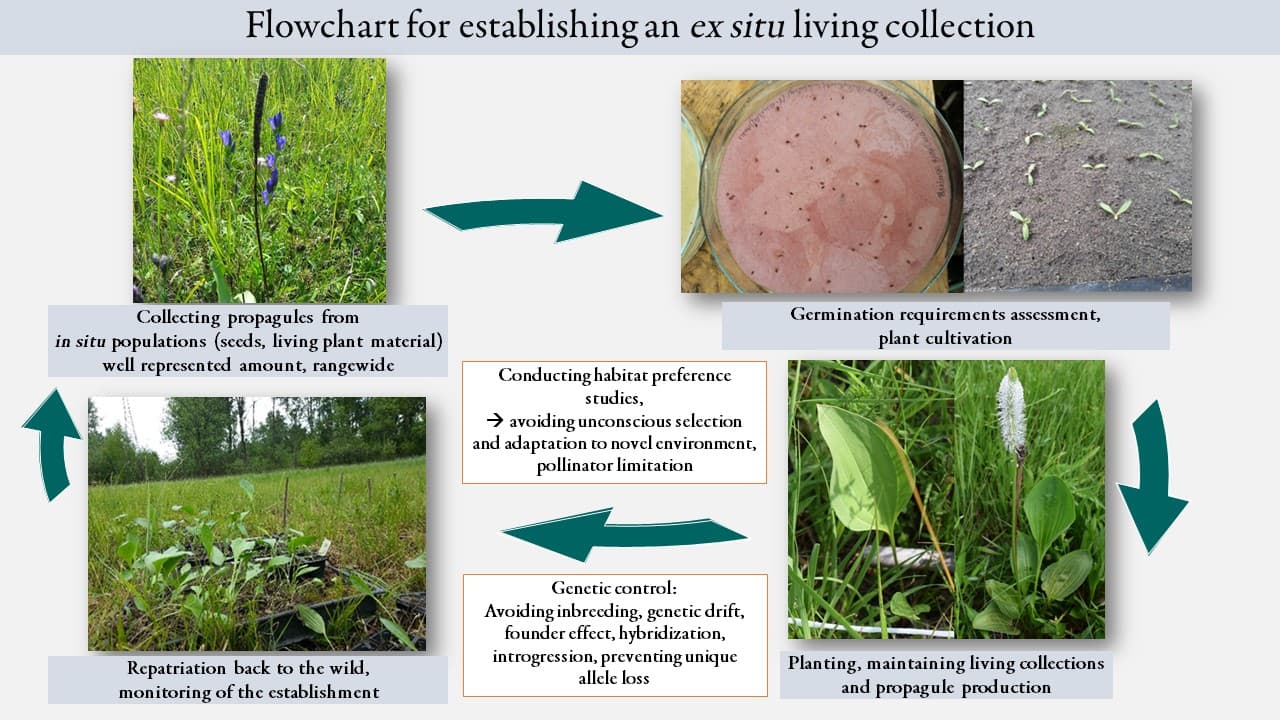
Ex situ conservation in botanical gardens – challenges and scientific potential preserving plant ... View original
Is this image relevant?
Propagation and ex-situ conservation of Lomelosia minoana subsp. minoana and Scutellaria hirta ... View original
Is this image relevant?
Collecting near mature and immature orchid seeds for ex situ conservation: ‘in vitro collecting ... View original
Is this image relevant?
Ex situ conservation in botanical gardens – challenges and scientific potential preserving plant ... View original
Is this image relevant?
Importance of ex situ conservation
Why not just protect habitats and call it a day? Because sometimes that's not enough. Habitats get destroyed, climates shift, and invasive species take over. Ex situ conservation:
- Safeguards plant genetic resources from threats like habitat destruction, climate change, and invasive species
- Preserves species that are extremely difficult to conserve in the wild (e.g., plants with tiny remaining populations or very specific habitat needs)
- Provides source material for research, education, and ecological restoration
- Helps maintain genetic diversity within populations, reducing the risk of inbreeding depression (reduced fitness from closely related parents breeding) and genetic drift (random loss of genetic variation in small populations)
Methods of ex situ conservation
There are four main approaches, each suited to different situations:
- Seed banks and genebanks store seeds under controlled conditions for long-term preservation
- In vitro conservation maintains plant tissues or organs in sterile lab environments
- Cryopreservation uses ultra-low temperatures to preserve plant material almost indefinitely
- Living collections in botanical gardens and arboretums keep whole plants growing for conservation, research, and education
Seed banks and genebanks
Seed banks store seeds under optimal conditions, typically at low temperature and low humidity, to keep them viable for decades or even centuries. Genebanks are broader: they conserve plant genetic resources including seeds, tissues, and DNA samples.
Two major examples:
- The Svalbard Global Seed Vault in Norway is a backup facility for seed banks worldwide, storing over 1 million seed samples deep inside an Arctic mountain. If a regional seed bank is destroyed by war or disaster, Svalbard holds duplicates.
- The Millennium Seed Bank Partnership, led by the Royal Botanic Gardens, Kew, set a goal to conserve 25% of the world's bankable plant species by 2020 and has since expanded its targets.
In vitro conservation
In vitro conservation means growing plant tissues or organs in sterile containers like test tubes or petri dishes. This is especially useful for species with recalcitrant seeds, which are seeds that can't survive the drying and freezing that seed banks require (many tropical species fall into this category).
Key techniques include:
- Micropropagation, which rapidly multiplies plant material to produce genetically identical individuals (clones)
- Slow growth storage, which reduces the growth rate of cultures so they don't need to be transferred to fresh media as often
Cryopreservation techniques
Cryopreservation stores plant tissues, seeds, or embryos at ultra-low temperatures, typically in liquid nitrogen at . At that temperature, all biological activity stops, so material can be preserved long-term without degradation or the need for frequent subculturing.
Several techniques exist, including vitrification, encapsulation-dehydration, and droplet-vitrification. The specific method depends on the type of tissue and species involved. Cryopreservation has been successfully applied to crops, medicinal plants, and endangered species alike.
Challenges of ex situ conservation
- Genetic integrity: Conserved populations can experience genetic drift over time, especially if collections are small or poorly managed
- Viability: Stored seeds and tissues must remain genetically stable and capable of germination or regrowth, which requires careful monitoring
- Species-specific protocols: Different species have very different storage requirements, and developing protocols for each one takes time and expertise
- Funding: Long-term conservation is expensive, and consistent funding is hard to secure
- Legal and ethical issues: Access and benefit-sharing of plant genetic resources (governed by frameworks like the Nagoya Protocol) adds complexity to international conservation work
Botanical gardens
Botanical gardens are institutions that maintain living collections of plants for scientific research, conservation, education, and public display. There are over 1,800 botanical gardens worldwide, and collectively they house an estimated 30-40% of all known plant species. That's a remarkable concentration of diversity in managed settings.
History of botanical gardens
The idea of cultivating plant collections goes back to ancient Egypt, Mesopotamia, and China, but modern botanical gardens emerged during the European Renaissance. The Orto Botanico di Pisa in Italy (1544) and the Oxford Botanic Garden in England (1621) were among the first.
During the 18th and 19th centuries, botanical gardens expanded rapidly, often tied to colonial exploration and the cataloging of newly discovered species. Today, their focus has shifted toward plant conservation, research, and public education.

Roles of botanical gardens
Botanical gardens wear many hats:
- Research: Studies on plant taxonomy, ecology, evolution, and conservation biology
- Conservation: Preserving plant diversity through living collections, seed banks, and other ex situ methods
- Education: Teaching the public about plant diversity and why conservation matters
- Public engagement: Providing spaces for people to connect with nature
- Collaboration: Working with other institutions to tackle global plant conservation challenges
Research in botanical gardens
Research in botanical gardens spans a wide range of topics: plant systematics, ecology, evolution, pollination biology, plant-animal interactions, and the impacts of climate change on plant communities. Many gardens also investigate the potential of plants for medicinal, agricultural, and industrial uses.
Collaborative projects with universities, research institutes, and other gardens help advance scientific knowledge and directly inform conservation strategies.
Education in botanical gardens
Botanical gardens offer educational programs for students, teachers, and the general public. These include guided tours, workshops, lectures, and school programs aligned with curriculum standards. Interpretive signage, exhibits, and multimedia displays throughout the gardens help visitors understand plant biology and the urgency of conservation.
Conservation in botanical gardens
Conservation is now a central mission for most botanical gardens. They maintain living collections of rare and endangered species, participate in seed banking and tissue culture programs, and conduct research in population genetics, restoration ecology, and species reintroduction. Public outreach and education raise awareness about threats to plant diversity.
Living collections in botanical gardens
Living collections are the cornerstone of any botanical garden. They represent a diverse array of species from around the world, organized by taxonomic group, geographic origin, or theme (medicinal plants, endangered species, etc.).
Curators and horticulturists manage these collections carefully, ensuring proper care, maintenance, and documentation. Every accession (individual plant record) is tracked, making the collection a valuable resource for research and conservation.
Herbaria in botanical gardens
A herbarium is a collection of preserved plant specimens used as a reference for identification and research. Specimens are pressed, dried, and mounted on archival paper along with data about where and when they were collected.
Most botanical gardens maintain herbaria to support taxonomic research and document the diversity of their living collections. Herbarium specimens also provide a historical record of plant distribution, which researchers can use to track how populations have shifted over time.
Botanical gardens vs. arboretums
Botanical gardens focus on a wide range of plant species, from mosses to flowering plants.
Arboretums specialize in woody plants (trees and shrubs) and tend to have larger, more naturalistic landscapes.
Both contribute to plant conservation, research, and education, and many institutions combine elements of both.
Famous botanical gardens worldwide
- Royal Botanic Gardens, Kew (London, UK): Over 50,000 living plants and a herbarium with more than 7 million specimens
- New York Botanical Garden (New York, USA): 50 specialty gardens and a 50-acre old-growth forest
- Singapore Botanic Gardens (Singapore): A UNESCO World Heritage Site, renowned for its extensive orchid collection
- Jardim Botânico do Rio de Janeiro (Brazil): Covers 140 hectares and houses over 8,000 plant species

Challenges facing botanical gardens
- Securing consistent funding for research, conservation, and education
- Adapting collections and management practices to climate change
- Controlling invasive species that threaten native plant communities
- Engaging younger and more diverse audiences in plant conservation
- Navigating legal frameworks around access and benefit-sharing of genetic resources
Ex situ conservation in botanical gardens
Botanical gardens are among the most important ex situ conservation facilities in the world. They don't just grow pretty plants; they integrate seed banking, tissue culture, cryopreservation, and living collections into comprehensive conservation programs.
Botanical gardens as ex situ facilities
By maintaining living collections in controlled environments, botanical gardens provide a safety net for species facing threats in the wild. Collections are carefully curated to preserve genetic diversity, and they serve as a source of plant material for research, habitat restoration, and reintroduction into the wild.
Integrating ex situ and in situ conservation
The most effective conservation strategies combine both approaches. Here's how they connect:
- Ex situ collections preserve genetic material and living plants as insurance against wild population loss
- When wild populations decline, ex situ material can be used for reintroduction (releasing plants back into natural habitats) or restoration (rebuilding degraded ecosystems)
- In situ efforts like habitat protection ensure that reintroduced species have a viable environment to return to
Neither approach works as well alone. Ex situ without in situ means you have plants with no habitat to return to. In situ without ex situ means a single catastrophe could wipe out an entire species.
Botanical gardens and seed banking
Many botanical gardens participate in seed banking initiatives. They collect seeds from their living collections and from wild populations, process and test them for viability, and store them under optimal conditions. These efforts feed into larger global networks, contributing to the preservation of plant genetic resources worldwide.
Botanical gardens and plant reintroductions
Reintroduction is one of the most tangible outcomes of ex situ conservation. Botanical gardens provide the plant material (grown from seeds or tissue culture), the scientific expertise to plan the reintroduction, and the long-term monitoring needed to evaluate whether the effort succeeds.
Collaborations between botanical gardens
No single garden can conserve everything. That's why collaboration is essential. Gardens exchange seeds and plant material, run joint research projects, and develop shared best practices. Botanic Gardens Conservation International (BGCI) is the main global network facilitating cooperation and knowledge sharing among botanical gardens worldwide.
Botanical gardens and climate change
Climate change is both a threat to botanical garden collections and a major research focus. Gardens study how species respond to changing conditions, which helps predict vulnerability and inform conservation priorities. Ex situ collections also serve as a backup for species whose wild habitats are shifting or disappearing due to warming temperatures and altered precipitation patterns. Public education programs at gardens help communicate the link between climate change and biodiversity loss.
Future of ex situ conservation in botanical gardens
As threats to plant diversity intensify, botanical gardens will play an even larger role in conservation. Priorities going forward include adapting strategies to address climate change, strengthening international collaborations, investing in new preservation technologies, and expanding public engagement to build broader support for plant conservation.
See Fiveable more often in Google
Mark Fiveable as a preferred source and Google is more likely to show you our guides in Top Stories, with a "preferred" badge in AI Mode and AI Overviews.