10.1 Plant microscopy and histology

🥀Intro to Botany Unit 10 Review
10.1 Plant microscopy and histology
Plant microscopy and histology give you the tools to see what's actually happening inside plants at the cellular and tissue level. Without these techniques, most of what we know about plant anatomy, development, and function would be invisible to us. This guide covers the major microscopy methods, how plant tissues are prepared for observation, and the key structures and tissue systems you'll need to recognize.
Microscopy in plant biology
Microscopy is how researchers study plant structures too small to see with the naked eye. Different techniques reveal different things: light microscopy shows general cell and tissue organization, while electron microscopy reveals fine details of organelles and surfaces. Together, these approaches give a complete picture of plant anatomy from the tissue level down to the molecular level.

Top images from around the web for Bright field microscopy
Leaves | OpenStax Biology 2e View original
Is this image relevant?
Leaves | OpenStax: Biology View original
Is this image relevant?
Leaves | OpenStax: Biology View original
Is this image relevant?
Leaves | OpenStax Biology 2e View original
Is this image relevant?
Leaves | OpenStax: Biology View original
Is this image relevant?
Light microscopy techniques
Bright field microscopy
This is the most basic and commonly used form of light microscopy. Specimens appear dark against a bright (white) background. It works well for observing general plant cell and tissue shapes, like a cross-section through a leaf. The tradeoff is that resolution and contrast are limited compared to more specialized techniques, so thin or transparent structures can be hard to see without staining.
Dark field microscopy
Dark field microscopy illuminates specimens from the side rather than from below. This causes the specimen to appear bright against a dark background, which boosts contrast significantly. It's especially useful for unstained or naturally transparent samples like plant fibers, where bright field wouldn't show much detail.
Phase contrast microscopy
Phase contrast converts tiny differences in how light passes through a specimen (phase shifts) into visible brightness differences. The big advantage: you can see internal structures in live, unstained cells without killing or altering them. This makes it great for observing living algal cells or watching cellular processes in real time.
Fluorescence microscopy
This technique uses fluorescent dyes or fluorescent proteins to label specific molecules or structures within cells. When excited by a particular wavelength of light, these labels glow, letting you selectively visualize targeted components like chloroplasts or cell walls. It's also useful for tracking dynamic processes in living cells, since you can watch labeled molecules move and interact.
Confocal laser scanning microscopy
Confocal microscopy uses a laser and a pinhole aperture to eliminate out-of-focus light, producing sharp optical "slices" through a specimen. These slices can be stacked to reconstruct detailed 3D images of structures like plant vascular systems. It's commonly paired with fluorescent labeling for precise localization of cellular components at high resolution.
Electron microscopy techniques
Scanning electron microscopy (SEM)
SEM scans a focused beam of electrons across the surface of a specimen, generating high-resolution 3D images of surface features. It's ideal for examining surface topography: leaf stomata, pollen grain textures, trichome shapes. Samples require significant preparation before imaging:
- Fixation to preserve the tissue
- Dehydration to remove all water
- Coating with a thin layer of metal (often gold) to make the surface conductive
Transmission electron microscopy (TEM)
TEM passes a beam of electrons through ultra-thin sections of a specimen, producing high-resolution 2D images of internal structures. This is how researchers visualize organelle ultrastructure, such as thylakoid membrane organization inside chloroplasts or the distinct layers of a cell wall. Sample preparation is extensive:
- Fixation to preserve cellular structures
- Embedding in resin to support the tissue
- Ultra-thin sectioning (typically 50–100 nm thick) using an ultramicrotome
- Staining with electron-dense heavy metals for contrast
Plant tissue preparation
Fixation and embedding
Fixation preserves plant tissues by cross-linking proteins and stabilizing cellular structures so they don't degrade or distort. Common fixatives include formaldehyde, glutaraldehyde, and osmium tetroxide (osmium tetroxide is particularly useful for preserving lipid membranes in TEM prep).
After fixation, tissues are embedded by infiltrating them with a supportive medium. Paraffin wax is standard for light microscopy, while resin (like epoxy resin) is used for electron microscopy because it can support much thinner sections.
Sectioning techniques
Sectioning produces thin, uniform slices of tissue for microscopic examination.
- Paraffin-embedded tissues are cut using a microtome, which produces sections typically 5–15 µm thick for light microscopy.
- Resin-embedded tissues are cut using an ultramicrotome, producing sections thin enough (50–100 nm) for electron beams to pass through in TEM.
Staining methods
Staining adds contrast and highlights specific structures within plant cells and tissues. Without staining, many features would be nearly invisible.
- Light microscopy stains: Safranin stains lignified walls and nuclei red; fast green stains cellulose walls green; toluidine blue is a versatile stain that differentiates multiple tissue types by staining them different colors.
- Electron microscopy stains: Uranyl acetate and lead citrate are heavy metal stains that bind to cellular components and scatter electrons, creating contrast in TEM images.
Plant cell ultrastructure

Cell wall composition and layers
Plant cell walls are composed primarily of cellulose microfibrils, along with hemicellulose and pectin. The primary cell wall is thin and flexible, which allows the cell to grow and expand. Once growth stops, some cells deposit a secondary cell wall that is thicker, more rigid, and often reinforced with lignin. Secondary walls provide structural support and are characteristic of cells like xylem vessels.
Plasma membrane structure
The plasma membrane sits just inside the cell wall and acts as a selectively permeable barrier controlling what enters and exits the cell. It's composed of a phospholipid bilayer with embedded proteins that handle transport, signaling, and cell-to-cell communication.
Cytoplasmic organelles
- Chloroplasts are the site of photosynthesis. They contain chlorophyll pigments organized within thylakoid membranes.
- Mitochondria carry out cellular respiration, generating ATP for the cell's energy needs.
- The endoplasmic reticulum (ER) and Golgi apparatus work together in protein synthesis, modification, and transport to other parts of the cell or outside it.
Nucleus and chromosomes
The nucleus houses the cell's DNA, organized into chromosomes. The nuclear envelope is a double membrane with pores that regulate molecular traffic between the nucleus and cytoplasm. Inside the nucleus, the nucleolus is where ribosomal RNA (rRNA) is synthesized and ribosomes begin assembly.
Plant tissue systems
Dermal tissue system
The dermal system covers and protects the plant body. In non-woody plants, the epidermis forms a single outer cell layer that secretes a waxy cuticle to reduce water loss. In woody plants, the epidermis is eventually replaced by the periderm, a thicker protective covering that also allows gas exchange through lenticels.
Ground tissue system
Ground tissue makes up the bulk of the plant body and contains three cell types:
- Parenchyma cells are living, thin-walled, and metabolically active. They handle photosynthesis, storage, and secretion.
- Collenchyma cells have unevenly thickened primary walls and provide flexible support in growing regions.
- Sclerenchyma cells have thick, lignified walls and provide rigid mechanical support.
Vascular tissue system
The vascular system is the plant's transport network:
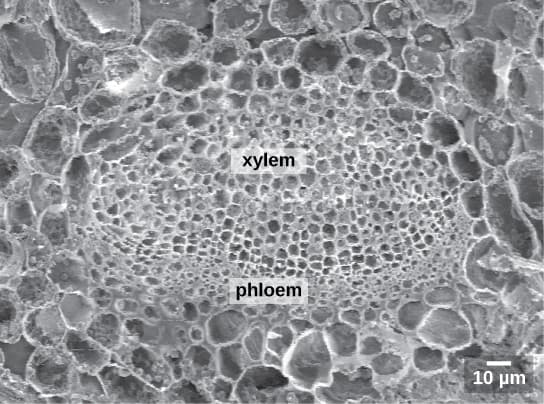
- Xylem conducts water and dissolved minerals upward from roots to leaves.
- Phloem transports sugars and other organic compounds (photosynthates) from where they're made (usually leaves) to where they're needed.
Meristematic tissues
Meristems are regions of actively dividing, undifferentiated cells that produce new growth.
Apical meristems
Located at the tips of roots and shoots, apical meristems drive primary growth (elongation). Their rapidly dividing cells give rise to all the primary tissues of the plant. The two main examples are the root apical meristem and the shoot apical meristem.
Lateral meristems
Found along the sides of stems and roots, lateral meristems are responsible for secondary growth (thickening). The vascular cambium produces secondary xylem (toward the inside) and secondary phloem (toward the outside). The cork cambium (phellogen) produces the periderm.
Intercalary meristems
These are located at the base of internodes, particularly in monocot stems like grasses. They allow for rapid elongation of internodes and enable regrowth after mowing or grazing damage.
Permanent tissues
Parenchyma
Parenchyma is the most abundant and versatile plant cell type. These are living cells with thin primary walls and large central vacuoles used for storing water, nutrients, and waste products. They're found throughout the plant and participate in photosynthesis, storage, secretion, and wound healing.

Collenchyma
Collenchyma cells are living cells with unevenly thickened primary cell walls. They're typically elongated and arranged in strands or sheets, commonly found in young, growing parts of the plant like petioles and young stems. Because their walls are not lignified, they can stretch as the plant grows while still providing support.
Sclerenchyma
Unlike parenchyma and collenchyma, sclerenchyma cells are dead at maturity. Their secondary cell walls are heavily thickened and reinforced with lignin, making them rigid. Two main types exist:
- Fibers are long, slender cells found in bundles (phloem fibers, xylem fibers) that provide tensile strength.
- Sclereids are shorter, irregularly shaped cells found in structures like nut shells and seed coats, where they provide hardness.
Epidermis and periderm
Cuticle and wax layers
The cuticle is a waxy, water-resistant layer secreted by epidermal cells onto the outer surface of the plant. It prevents water loss, offers some protection against pathogens, and reduces UV damage. Cuticle thickness and composition vary by species and by organ; leaves in dry environments tend to have thicker cuticles.
Stomata and guard cells
Stomata are small pores in the epidermis that allow gas exchange ( in, out) and transpiration (water vapor loss). Each stoma is flanked by two guard cells that control its opening and closing. When guard cells take up water and become turgid, the stoma opens; when they lose water, it closes. This mechanism helps the plant balance gas exchange with water conservation.
Trichomes and emergences
Trichomes are hair-like outgrowths from the epidermis that serve various functions, including protection from herbivores, reduction of water loss, and secretion. Glandular trichomes are a specialized type that secrete substances like essential oils, resins, or digestive enzymes (as seen in sundew plants, which trap insects).
Emergences differ from trichomes because they involve both epidermal and subepidermal tissues. Thorns and prickles are common examples.
Cork and lenticels
Cork (phellem) is a layer of dead, suberized cells produced by the cork cambium in woody plants. Suberin makes cork waterproof, so it provides insulation and reduces water loss. Lenticels are raised, porous areas in the periderm that allow gas exchange between the internal tissues and the atmosphere, since cork itself is largely impermeable to gases.
Primary vs secondary growth
Primary growth comes from apical meristems and results in the elongation of roots and shoots. It produces the primary tissues: epidermis, ground tissue, and primary vascular tissue.
Secondary growth comes from lateral meristems and results in the thickening of stems and roots. It produces secondary xylem (wood), secondary phloem, and periderm. This is why woody plants get wider over time, while herbaceous plants that lack secondary growth generally do not.
Xylem tissue
Tracheids and vessel elements
Both tracheids and vessel elements are dead at maturity and conduct water. Tracheids are elongated, tapered cells with lignified secondary walls and pits that allow water to pass laterally between cells. Vessel elements are shorter and wider, arranged end-to-end to form continuous tubes called vessels. Vessel elements have perforated end walls (perforation plates), which makes water transport more efficient than in tracheids alone.
Primary vs secondary xylem
- Primary xylem develops from the procambium during primary growth. It includes protoxylem (formed first, often stretched and destroyed as the organ elongates) and metaxylem (formed later, with larger cells).
- Secondary xylem develops from the vascular cambium during secondary growth. It contains both an axial system (fibers, tracheids, vessel elements, parenchyma) and a radial system (rays that transport materials laterally).
Xylem development and differentiation
Xylem cells go through a defined sequence during differentiation:
- Cell elongation
- Secondary wall deposition and lignification
- Programmed cell death (the cell contents are removed, leaving a hollow, reinforced tube)
Lignification provides both mechanical support and waterproofing. Bordered pits in the cell walls allow lateral water movement between adjacent xylem elements.
Phloem tissue
Sieve tube elements and companion cells
Sieve tube elements are living cells (though highly modified) that form continuous tubes for transporting sugars and other organic compounds. They lose their nucleus and most organelles during maturation, so they depend on adjacent companion cells for metabolic support. Companion cells also help load and unload sugars into and out of the sieve tubes.
Primary vs secondary phloem
- Primary phloem develops from the procambium during primary growth, consisting of protophloem (first-formed) and metaphloem (later-formed).
- Secondary phloem develops from the vascular cambium during secondary growth and includes sieve tube elements, companion cells, parenchyma, fibers, and rays.
Phloem development and differentiation
During differentiation, sieve tube elements lose their nucleus and most organelles but remain alive, connected to companion cells via plasmodesmata. Sieve plates with pores develop at the end walls of sieve tube elements, allowing continuous flow of phloem sap between cells.
P-proteins (phloem proteins) and callose accumulate near sieve plates. Callose can rapidly seal off damaged sieve tube elements to prevent sap loss, functioning somewhat like a wound-sealing response.
See Fiveable more often in Google
Mark Fiveable as a preferred source and Google is more likely to show you our guides in Top Stories, with a "preferred" badge in AI Mode and AI Overviews.