3.1 Mendelian genetics

🥀Intro to Botany Unit 3 Review
3.1 Mendelian genetics
🥀 Intro to Botany
Mendelian genetics lays the foundation for understanding inheritance patterns in organisms. It explains how traits pass from parents to offspring through genes and alleles, following principles like segregation and independent assortment. These ideas, discovered through Gregor Mendel's pea plant experiments, form the basis of classical genetics and are essential for understanding plant breeding and evolution.
Mendel's Laws of Inheritance
Gregor Mendel, often called the "father of modern genetics," worked out the fundamental rules of inheritance by carefully crossing pea plants and tracking traits across generations. His laws apply to sexually reproducing organisms and describe how alleles behave during reproduction.

Top images from around the web for Law of segregation
Mendel's Investigation ‹ OpenCurriculum View original
Is this image relevant?
14.8: Patterns of Inheritance - Biology LibreTexts View original
Is this image relevant?
Laws of Inheritance | Boundless Biology View original
Is this image relevant?
Mendel's Investigation ‹ OpenCurriculum View original
Is this image relevant?
14.8: Patterns of Inheritance - Biology LibreTexts View original
Is this image relevant?
Law of Segregation
During gamete formation (the making of egg and sperm cells), the two alleles for each gene separate from each other. Each gamete ends up carrying only one allele for each gene. At fertilization, the offspring receives one allele from each parent, restoring the pair.
Think of it this way: you have two copies of every gene, but you can only pass one copy to your offspring. Which copy gets passed along is random.
Law of Independent Assortment
Alleles for one gene segregate independently of alleles for other genes during gamete formation. The inheritance of one trait doesn't influence the inheritance of another. This is what allows offspring to show up with new combinations of traits that neither parent had.
Exceptions to Mendel's Laws
Mendel's laws hold true for genes on different chromosomes or genes far apart on the same chromosome. However:
- Linkage: Genes close together on the same chromosome tend to be inherited as a package, violating independent assortment.
- Epistasis: One gene can influence the expression of a different gene, creating unexpected phenotypic ratios.
These exceptions become more relevant as you study real inheritance patterns beyond simple textbook crosses.
Monohybrid Crosses
A monohybrid cross involves two individuals that differ in a single trait controlled by one gene with two alleles. It's the simplest type of genetic cross and the best place to start learning how to predict offspring outcomes.
Punnett Squares
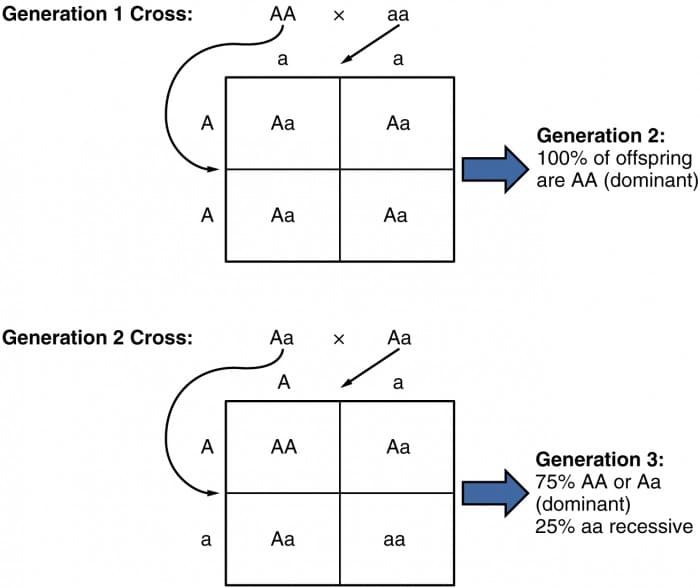
A Punnett square is a grid that helps you predict the genotypes and phenotypes of offspring. For a monohybrid cross, you use a 2×2 grid.
Here's how to set one up:
- Write one parent's two alleles across the top (one per column).
- Write the other parent's two alleles down the left side (one per row).
- Fill in each box by combining the allele from its column with the allele from its row.
- Read the completed grid to determine genotypic and phenotypic ratios.
Genotypic Ratios
In a cross between two heterozygous individuals (), the expected genotypic ratio is 1:2:1:
- 25% homozygous dominant ()
- 50% heterozygous ()
- 25% homozygous recessive ()
Phenotypic Ratios
The phenotypic ratio from the same cross () is 3:1:
- 75% show the dominant phenotype ( and )
- 25% show the recessive phenotype ()
The 3:1 ratio is one of the most recognizable results in genetics. If you see it in experimental data, it strongly suggests a single gene with simple dominance.
Dihybrid Crosses
A dihybrid cross tracks two traits at once, each controlled by a separate gene. This is where you can observe independent assortment in action.
Punnett Squares for Dihybrid Crosses
For a dihybrid cross, you need a 4×4 Punnett square (16 boxes total). Each parent contributes a two-allele combination (one allele per gene) to each box.
Setting this up takes care. List all four possible gamete combinations for each parent. For a parent with genotype , the possible gametes are: , , , and .

Genotypic Ratios in Dihybrid Crosses
A cross of produces a genotypic ratio of 1:2:1:2:4:2:1:2:1 across nine distinct genotype classes. You don't need to memorize this ratio, but you should understand that it results from combining two independent 1:2:1 ratios.
Phenotypic Ratios in Dihybrid Crosses
The classic phenotypic ratio from is 9:3:3:1:
- 9/16 show both dominant phenotypes
- 3/16 show dominant for the first trait, recessive for the second
- 3/16 show recessive for the first trait, dominant for the second
- 1/16 show both recessive phenotypes
This 9:3:3:1 ratio is a hallmark of independent assortment. If your experimental data deviates significantly from it, that's a clue the genes might be linked or interacting.
Genetic Terminology
Getting comfortable with these terms is essential. Genetics problems become much easier once the vocabulary is second nature.
Alleles vs. Genes
A gene is a segment of DNA that encodes a specific trait. Alleles are different versions of that gene. For example, the gene for flower color in pea plants has an allele for purple flowers and an allele for white flowers. Every individual carries two alleles for each gene (one from each parent).
Homozygous vs. Heterozygous
- Homozygous: both alleles are the same ( or )
- Heterozygous: the two alleles are different ()
Dominant vs. Recessive Traits
A dominant allele is expressed whenever it's present (in or ). A recessive allele is only expressed when two copies are present (). In a heterozygous individual, the dominant allele masks the recessive one.
Genotype vs. Phenotype
- Genotype = the alleles an organism carries (e.g., )
- Phenotype = the observable trait that results (e.g., purple flowers)
Two organisms can share the same phenotype but have different genotypes. A purple-flowered pea plant could be or .
Probability in Mendelian Genetics
Probability lets you predict the likelihood of specific outcomes in genetic crosses. Two rules handle most situations you'll encounter.
Product Rule
The product rule applies when you want the probability of two independent events happening together. You multiply their individual probabilities.
Example: If the probability of an offspring being tall is and the probability of having white flowers is , the probability of being tall and having white flowers is:
This rule is especially useful for dihybrid and multi-trait problems.

Sum Rule
The sum rule applies when you want the probability of either one event or another occurring. For mutually exclusive events, you simply add the probabilities. When the events can overlap, you subtract the probability of both occurring together.
Example with overlap: If the probability of brown seeds is and the probability of tall stems is , the probability of brown seeds or tall stems (or both) is:
Pedigree Analysis
A pedigree is a diagram showing how a trait passes through a family across generations. By applying Mendel's laws and probability rules to a pedigree, you can:
- Determine likely genotypes of family members
- Predict the chance of future offspring inheriting a trait
- Figure out whether a trait is dominant, recessive, autosomal, or sex-linked
Squares typically represent males, circles represent females, and filled symbols indicate individuals expressing the trait.
Extensions of Mendelian Genetics
Mendel's laws describe the simplest inheritance patterns, but real genetics is often more complex. These extensions explain patterns that don't fit the classic dominant/recessive model.
Incomplete Dominance
In incomplete dominance, the heterozygote's phenotype falls between the two homozygous phenotypes. Neither allele fully masks the other.
The classic botany example: in snapdragons, crossing a red-flowered plant () with a white-flowered plant () produces pink-flowered offspring (). The F2 phenotypic ratio is 1:2:1 (red : pink : white), which matches the genotypic ratio exactly. That's different from the 3:1 you see with simple dominance.
Codominance
In codominance, both alleles are fully expressed in the heterozygote. Rather than blending, both traits appear simultaneously.
The textbook example is human ABO blood types. An individual with genotype has blood type AB, expressing both A and B antigens on their red blood cells. Neither allele is masked.
Multiple Alleles
Some genes have more than two alleles in the population. The ABO blood type system is one example (three alleles: , , and ). Another is rabbit coat color, which has four alleles with a dominance hierarchy: (full color) > (chinchilla) > (himalayan) > (albino).
Any individual still carries only two alleles, but the population as a whole has more than two versions to draw from.
Polygenic Inheritance
Polygenic traits are controlled by multiple genes, each contributing a small additive effect. This produces a continuous range of phenotypes rather than distinct categories.
Examples include human skin color, height, and grain color in wheat. Because many genes are involved, polygenic traits often show a bell-curve distribution in a population.
Chromosomal Basis of Inheritance
Genes physically sit on chromosomes, and chromosome behavior during meiosis is what drives Mendel's laws at the cellular level.
Linkage of Genes
Genes located close together on the same chromosome are linked. They tend to be inherited together, which means they don't follow the law of independent assortment. The closer two genes are on a chromosome, the stronger the linkage.
Recombination of Genes
Recombination (crossing over) can separate linked genes during meiosis. Homologous chromosomes exchange segments, creating new allele combinations on the resulting chromosomes. The farther apart two genes are on a chromosome, the more frequently crossing over occurs between them.
Genetic Mapping
Genetic mapping uses recombination frequencies to estimate the relative positions of genes on a chromosome. The logic is straightforward: genes that recombine more often are farther apart.
Recombination frequencies are measured in map units (also called centimorgans). A 1% recombination frequency equals 1 map unit of distance. These maps help researchers predict inheritance patterns and locate genes associated with specific traits or disorders.
See Fiveable more often in Google
Mark Fiveable as a preferred source and Google is more likely to show you our guides in Top Stories, with a "preferred" badge in AI Mode and AI Overviews.