6.5 Plant defense mechanisms

🥀Intro to Botany Unit 6 Review
6.5 Plant defense mechanisms
🥀 Intro to Botany
Types of plant defenses
Plants can't run from threats, so they've evolved an impressive toolkit of defenses against herbivores, pathogens, and environmental stresses. These defenses are classified along two axes: how they work (physical vs. chemical) and when they're active (constitutive vs. induced).

Top images from around the web for Constitutive vs induced defenses
Frontiers | Wounding in the plant tissue: the defense of a dangerous passage View original
Is this image relevant?
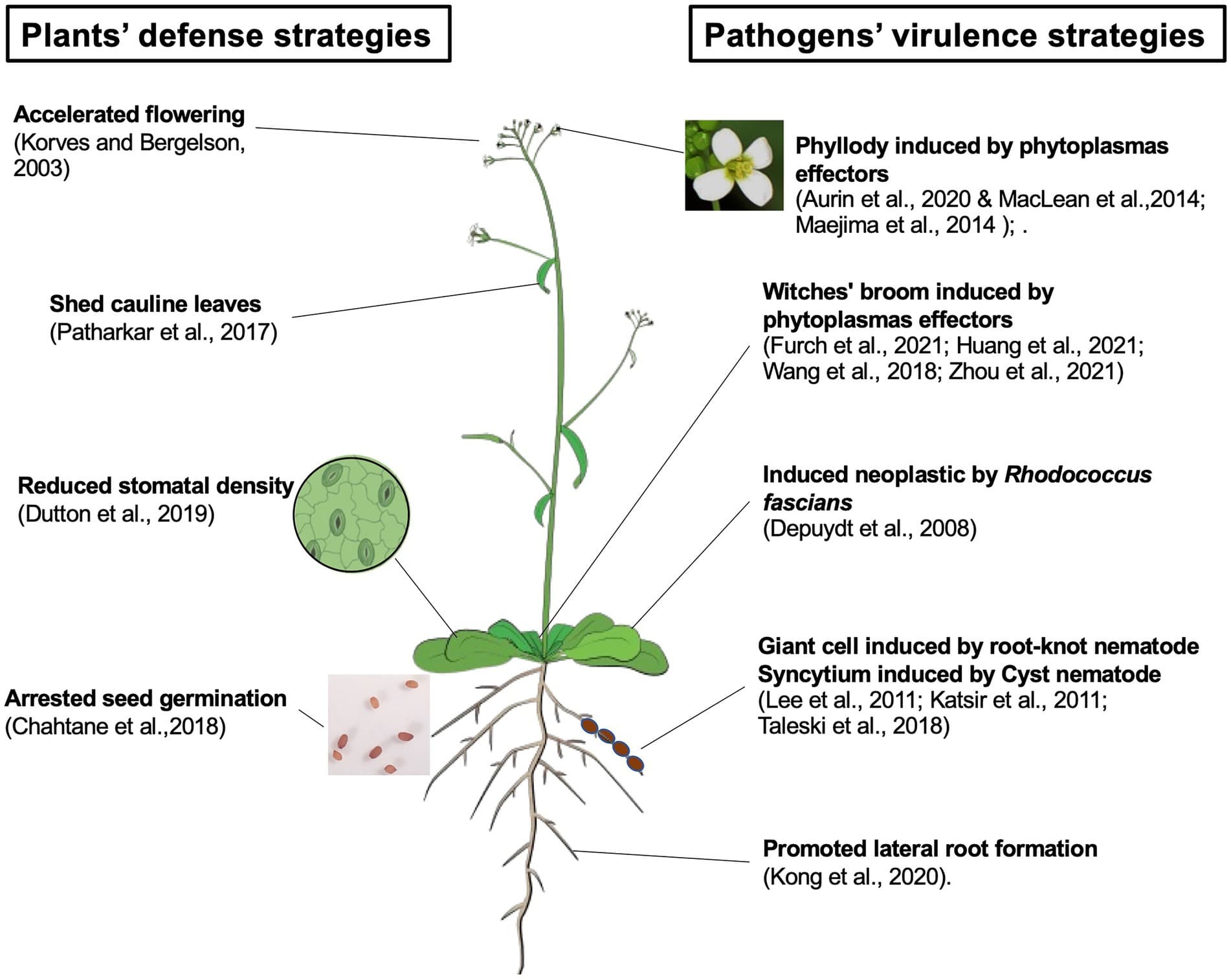
Frontiers | Pathogen-triggered changes in plant development: Virulence strategies or host ... View original
Is this image relevant?
Frontiers | Activation of the Transducers of Unfolded Protein Response in Plants View original
Is this image relevant?
Frontiers | Wounding in the plant tissue: the defense of a dangerous passage View original
Is this image relevant?
Frontiers | Pathogen-triggered changes in plant development: Virulence strategies or host ... View original
Is this image relevant?
Constitutive vs induced defenses
Constitutive defenses are always present in the plant, whether or not a threat is nearby. Think thorns, trichomes, and thick cuticles. They provide immediate protection but cost the plant energy and resources to maintain around the clock.
Induced defenses are activated only in response to damage or infection. Examples include the production of toxic compounds or the strengthening of cell walls after an insect starts feeding. These are more cost-effective because the plant only pays for them when needed, but there's a vulnerability window between the start of an attack and when the defense kicks in.
Physical vs chemical defenses
Physical defenses are structural barriers that deter or block herbivores and pathogens. Chemical defenses involve producing toxic or deterrent compounds. In practice, these two categories often work together as a multi-layered system. A leaf might have a waxy cuticle (physical) that also contains antimicrobial compounds (chemical).
Physical defense mechanisms
Physical defenses are the first line of protection, creating barriers that prevent or limit access to plant tissues.
Structural barriers
Structural barriers are physical features that impede the entry or movement of herbivores and pathogens. Examples include:
- Thick cuticles that resist penetration by fungal hyphae or insect mouthparts
- Lignified cell walls that are too tough for many organisms to break through
- Calcium oxalate crystals embedded in leaves, which are abrasive and irritating to chewing insects
Trichomes and thorns
Trichomes are hair-like structures on the surface of leaves, stems, and other organs. They can physically deter herbivores and trap small insects. Some trichomes go further: glandular trichomes produce toxic or sticky substances. Tomato plants, for example, have glandular trichomes that trap and poison small arthropods.
Thorns are modified branches or leaves that deter large herbivores from browsing on vulnerable plant parts like stems, leaves, and fruits. Hawthorn and acacia are classic examples.
Waxy cuticles
The cuticle is a waxy layer covering the surface of leaves and other aerial parts. It serves double duty: reducing water loss and blocking pathogen entry. A thick, waxy cuticle makes it harder for insects to grip the plant surface and for fungal spores to germinate and penetrate tissue.
Some plants produce epicuticular waxes that form crystals or filaments on the leaf surface, creating a slippery or abrasive texture that further deters herbivores.
Lignified cell walls
Lignin is a complex polymer that reinforces plant cell walls, making them resistant to mechanical damage and pathogen invasion. Lignified cell walls are especially important in woody tissues (stems and roots), which face greater mechanical stress and pathogen pressure.
Some plants also increase lignin deposition in damaged tissues as an induced response, essentially walling off the site of attack.
Chemical defense mechanisms
Chemical defenses involve producing compounds that harm, repel, or deter herbivores and pathogens. The diversity of these compounds across the plant kingdom is enormous.
Primary vs secondary metabolites
Primary metabolites (sugars, amino acids, fatty acids) are essential for growth and development. Secondary metabolites are not required for basic survival but play critical roles in defense and ecological interactions. The major classes of defensive secondary metabolites are alkaloids, terpenes, phenolics, and glycosides.
Secondary metabolites are often produced in response to specific environmental cues like herbivory or pathogen attack, though some are present constitutively.
Alkaloids and glycosides
Alkaloids are nitrogen-containing compounds that are often toxic to animals. Familiar examples include nicotine (tobacco), caffeine (coffee), and morphine (opium poppy). They can disrupt nervous system function, inhibit enzymes, or cause other harmful effects in herbivores.
Glycosides consist of a sugar molecule bound to a non-sugar (often toxic) molecule. Two important types:
- Cyanogenic glycosides release hydrogen cyanide (HCN) when plant tissue is damaged (more on these below)
- Glucosinolates, found in mustard family plants (Brassicaceae), break down into pungent, toxic compounds when cells are crushed

Terpenes and phenolics
Terpenes are derived from isoprene units and represent one of the largest classes of plant secondary metabolites. They serve diverse defensive roles:
- Acting as direct toxins or feeding deterrents
- Attracting natural enemies of herbivores (predators and parasitoids) through volatile emissions
Terpenes are classified by size: monoterpenes, sesquiterpenes, diterpenes, and so on.
Phenolics contain a phenol group and include flavonoids, tannins, and lignin. Tannins, for instance, bind to proteins in an herbivore's gut, reducing digestibility and making the plant a poor food source.
Cyanogenic compounds
Cyanogenic compounds are glycosides that release toxic hydrogen cyanide (HCN) when plant tissue is damaged by chewing or digestion. This is a classic "chemical bomb" defense: the cyanogenic glycoside and the enzyme that breaks it down are stored in separate cellular compartments. When an herbivore crushes the cells, the two mix and HCN is released rapidly.
Cyanogenic compounds are found in a wide range of species, including cassava, almonds, and cherry laurel. In cassava, improper preparation of the root can leave enough cyanogenic compounds to be dangerous to humans.
Induced defense responses
Induced defenses are activated after damage or infection has already begun. They provide a more targeted and cost-effective defense than maintaining all defenses at all times.
Hypersensitive response (HR)
The hypersensitive response is a rapid, localized cell death reaction at the site of pathogen infection. The plant essentially sacrifices a small cluster of cells to prevent the pathogen from spreading.
How it works:
- The plant detects a pathogen at the infection site.
- Reactive oxygen species (ROS) are rapidly produced.
- Programmed cell death is triggered in the infected cells and their immediate neighbors.
- The dead tissue forms a barrier that starves the pathogen of living host cells.
HR is especially effective against biotrophic pathogens, which need living host tissue to survive and reproduce.
Systemic acquired resistance (SAR)
While HR is localized, systemic acquired resistance provides broad-spectrum, long-lasting protection throughout the entire plant. After a localized infection triggers HR, signaling molecules (particularly salicylic acid) travel to uninfected tissues and activate defense-related genes there.
SAR is effective against a wide range of pathogens, including viruses, bacteria, and fungi. You can think of it as the plant's version of an immune system "memory," though the mechanism is very different from animal immunity.
Phytoalexin production
Phytoalexins are low molecular weight antimicrobial compounds produced in response to pathogen infection. They inhibit pathogen growth by disrupting cell membranes, blocking enzyme activity, or interfering with nucleic acid synthesis.
Different plant species produce different phytoalexins. For example, Arabidopsis produces camalexin, while soybeans produce glyceollin. This specificity means phytoalexins are often studied as markers of defense activation in particular species.
Pathogenesis-related (PR) proteins
PR proteins are a diverse group of proteins induced by pathogen infection or stress. They serve various antimicrobial functions:
- Chitinases and glucanases degrade pathogen cell walls
- Protease inhibitors block pathogen enzymes
- Defensins and thionins directly kill pathogen cells
PR proteins are commonly used as molecular markers for SAR and other induced defense responses in research.
Signaling in plant defense
Plants detect threats and coordinate their defenses through hormone-based signaling pathways. Three hormones are central to defense signaling: jasmonic acid (JA), salicylic acid (SA), and ethylene (ET).
Jasmonic acid (JA) pathway
Jasmonic acid is synthesized from linolenic acid in response to wounding or herbivory. It activates genes involved in producing protease inhibitors, volatile organic compounds, and other anti-herbivore defenses.
The JA pathway is the primary regulator of defense against herbivores and necrotrophic pathogens (pathogens that kill host cells and feed on dead tissue). It often works together with the ethylene pathway.
Salicylic acid (SA) pathway
Salicylic acid is synthesized from chorismate in response to pathogen infection. It activates genes for PR protein production and is the key signal for establishing SAR.
The SA pathway is the primary regulator of defense against biotrophic pathogens. Notably, the SA and JA pathways tend to be mutually antagonistic: activating one suppresses the other. This forces the plant to prioritize its defense strategy based on the type of attacker.

Ethylene (ET) signaling
Ethylene is a gaseous hormone synthesized from methionine in response to wounding, infection, or other stresses. It activates genes involved in phytoalexin production and other defense responses.
ET signaling typically works alongside the JA pathway against necrotrophic pathogens, but it can also modulate the balance between SA and JA responses depending on the context.
Cross-talk between defense pathways
The JA, SA, and ET pathways don't operate independently. They engage in complex cross-talk that fine-tunes the plant's response to specific threats:
- SA and JA are generally antagonistic. When a plant faces a biotrophic pathogen, SA signaling ramps up and suppresses JA. When facing herbivores or necrotrophs, JA dominates and suppresses SA.
- ET can tip the balance, promoting JA responses in some situations and SA responses in others.
- Other hormones like abscisic acid (ABA), gibberellins, and cytokinins also influence defense signaling, adding further complexity.
This cross-talk allows plants to tailor their defense response rather than deploying a one-size-fits-all strategy.
Resistance mechanisms
Resistance mechanisms describe the genetic and molecular basis for a plant's ability to prevent or limit damage from specific pathogens or herbivores.
Non-host resistance
Non-host resistance is the most common form: an entire plant species is resistant to a particular pathogen. For example, wheat doesn't get tomato blight. This resistance is typically mediated by preformed barriers (cell wall composition, cuticle properties) combined with inducible responses.
Non-host resistance is generally broad-spectrum and durable because it involves multiple defense layers that are difficult for a pathogen to overcome simultaneously.
Race-specific resistance
Race-specific resistance occurs when a particular plant genotype resists a specific strain (race) of a pathogen. It's governed by gene-for-gene interactions: a plant resistance (R) gene recognizes a specific pathogen avirulence (Avr) gene, triggering a strong defense response (often HR).
The downside is that this resistance can be overcome relatively quickly. If the pathogen mutates or loses the recognized Avr gene, a new race emerges that can infect previously resistant plants.
Quantitative resistance
Quantitative resistance is controlled by multiple genes, each contributing a small effect. Unlike race-specific resistance, it doesn't provide complete immunity but reduces disease severity.
The advantage is durability: because many genes are involved, it's much harder for a pathogen to evolve ways around all of them at once. However, quantitative resistance can be influenced by environmental factors like temperature and nutrient availability.
R gene-mediated resistance
R genes encode proteins that recognize pathogen effectors and trigger defense responses. Most R genes encode NB-LRR proteins (nucleotide-binding leucine-rich repeat), which are involved in pathogen recognition and downstream signaling.
R gene-mediated resistance can be race-specific (recognizing a single pathogen effector) or broad-spectrum (recognizing multiple effectors or conserved pathogen-associated molecular patterns, or PAMPs).
Costs and trade-offs
Defense is not free. Every resource a plant invests in defense is a resource it can't use for growth or reproduction.
Resource allocation
Producing defense compounds and structures requires energy, carbon, and nutrients. Plants must balance defense investment against other needs based on the level of threat and available resources. This trade-off is influenced by both genetics (some genotypes invest more in defense) and environment (nutrient-poor soils may limit defense production).
Growth vs defense
Allocating resources to defense can result in smaller or slower-growing plants. This growth-defense trade-off is especially pronounced in resource-limited environments, where plants may need to prioritize survival over rapid growth.
Some plants take the opposite approach: they employ "escape" strategies, growing and reproducing as fast as possible to complete their life cycle before herbivores or pathogens cause serious damage. Many annual weeds use this strategy.
Constitutive vs induced defenses
The choice between constitutive and induced defenses also involves trade-offs:
- Constitutive defenses provide immediate protection but carry a constant metabolic cost, even when no threat is present.
- Induced defenses save resources when threats are absent but leave the plant vulnerable during the lag time before they activate.
The optimal balance depends on how predictable and frequent attacks are. Plants in environments with constant herbivore pressure tend to invest more in constitutive defenses, while plants facing sporadic attacks may rely more on induced responses.
Ecological and evolutionary implications
Plant defense shapes broader ecological and evolutionary dynamics:
- Defense compounds influence herbivore feeding preferences, which in turn affects the composition of herbivore communities.
- The evolution of new defenses in plants drives the evolution of counter-adaptations in herbivores and pathogens, creating an ongoing evolutionary arms race.
- Defenses can also have indirect effects on other organisms. For instance, volatile compounds released during herbivory can attract predators of the herbivore, benefiting the plant. But those same compounds might also deter pollinators, creating additional trade-offs.
See Fiveable more often in Google
Mark Fiveable as a preferred source and Google is more likely to show you our guides in Top Stories, with a "preferred" badge in AI Mode and AI Overviews.