6.4 Plant hormones and signaling molecules

🥀Intro to Botany Unit 6 Review
6.4 Plant hormones and signaling molecules
🥀 Intro to Botany
Types of plant hormones
Plant hormones (also called phytohormones) are chemical messengers produced in very small amounts that regulate nearly every aspect of a plant's life. From germination to flowering to death, these molecules coordinate growth, development, and responses to the environment. Different hormones often work together or against each other to fine-tune how a plant behaves.

Top images from around the web for Auxins
Frontiers | A Growing Stem Inhibits Bud Outgrowth – The Overlooked Theory of Apical Dominance View original
Is this image relevant?
Frontiers | LAZY Gene Family in Plant Gravitropism View original
Is this image relevant?
Frontiers | Developmental Roles of AUX1/LAX Auxin Influx Carriers in Plants View original
Is this image relevant?
Frontiers | A Growing Stem Inhibits Bud Outgrowth – The Overlooked Theory of Apical Dominance View original
Is this image relevant?
Frontiers | LAZY Gene Family in Plant Gravitropism View original
Is this image relevant?
Auxins
Auxins, especially indole-3-acetic acid (IAA), are the primary hormones controlling cell elongation and directional growth. They're synthesized mainly in young leaves, shoot tips, and developing seeds, then transported basipetally (from shoot toward root).
Key roles of auxins:
- Cell elongation in shoots, which drives stem growth
- Apical dominance: the shoot tip produces auxin that suppresses lateral bud growth, keeping the main stem dominant
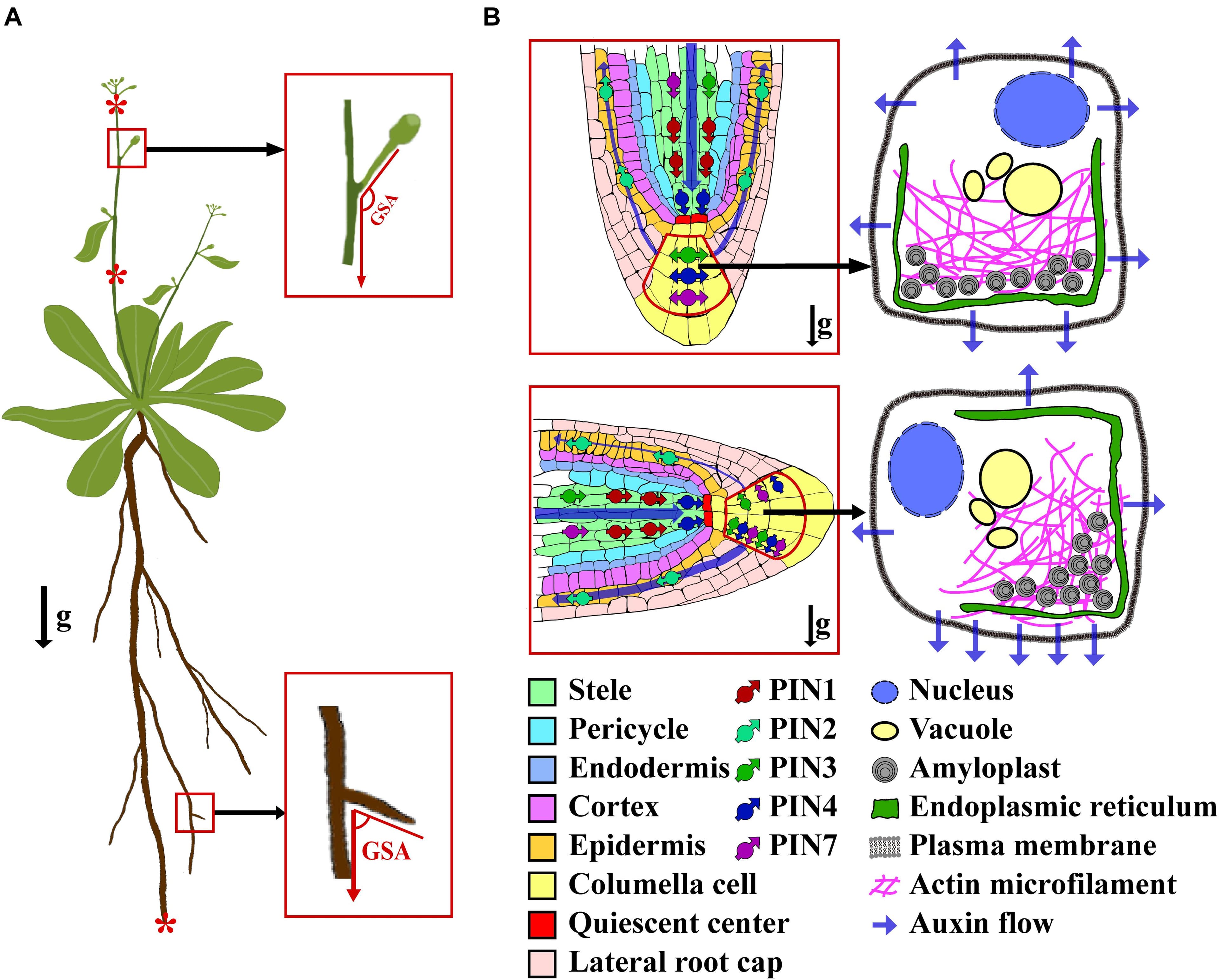
- Tropisms: auxin redistribution causes phototropism (bending toward light) and gravitropism (root growth downward)
- Vascular tissue differentiation: auxin helps organize xylem and phloem development
- Adventitious root formation: this is why auxin-based rooting powder works on stem cuttings
Gibberellins
Gibberellins (GAs) are a large family of hormones that promote growth by stimulating stem elongation, seed germination, and fruit development. They're synthesized in young leaves, roots, and developing seeds, and can travel both acropetally and basipetally.
GAs work in part by promoting the degradation of DELLA proteins, which are growth repressors. Once DELLAs are removed, growth proceeds.
Notable gibberellin-mediated responses:
- Bolting: the rapid stem elongation you see in rosette plants like lettuce when they prepare to flower
- Seed germination: GAs trigger the production of alpha-amylase in cereal seeds, which breaks down starch reserves to fuel the growing embryo
- Fruit development: GAs can promote fruit set even without pollination in some species
Cytokinins
Cytokinins (such as zeatin and kinetin) promote cell division and are synthesized primarily in root tips and developing seeds. They travel acropetally through the xylem to reach the shoots.
- Promote cell division and shoot branching (they counteract auxin's suppression of lateral buds)
- Delay senescence: cytokinins keep leaves green and photosynthetically active longer
- Regulate source-sink relationships, influencing where nutrients get directed in the plant
- In tissue culture, the ratio of auxin to cytokinin determines whether a callus produces roots (high auxin) or shoots (high cytokinin)
Ethylene
Ethylene is unique among plant hormones because it's a gas. It's synthesized from the amino acid methionine and produced in response to stress, wounding, or developmental cues.
- Fruit ripening: ethylene is the main trigger for ripening in climacteric fruits like bananas, tomatoes, and apples. This is why placing a ripe banana next to unripe fruit speeds up ripening.
- Leaf and flower abscission: ethylene promotes the formation of the abscission zone where organs detach
- Senescence: accelerates the breakdown of chlorophyll and cellular components
- Stress responses: produced after wounding or pathogen attack, helping coordinate defense
Abscisic acid
Abscisic acid (ABA) is often called the "stress hormone" because it mediates responses to drought, salinity, and other unfavorable conditions. It's synthesized in roots and mature leaves.
- Stomatal closure: when water is scarce, ABA signals guard cells to close stomata, reducing water loss
- Seed dormancy: ABA maintains dormancy and prevents premature germination, working against gibberellins
- Promotes the accumulation of storage proteins and lipids in developing seeds
- Can be transported both acropetally and basipetally
Other signaling molecules
Beyond the five classical hormones, several other signaling molecules play significant roles:
- Brassinosteroids: steroid hormones that promote cell elongation and division, and contribute to vascular differentiation and stress tolerance
- Jasmonates (jasmonic acid, methyl jasmonate): lipid-derived signals that activate defense responses against herbivores and necrotrophic pathogens
- Salicylic acid: a phenolic compound that triggers systemic acquired resistance (SAR), a plant-wide defense response against biotrophic pathogens. It also influences flowering time.
Hormone synthesis and regulation
The levels of active hormones in a plant depend on a balance between synthesis, degradation, and inactivation. Environmental conditions constantly shift this balance.

Biosynthetic pathways
Each hormone class has its own biosynthetic pathway starting from a different precursor:
- Auxins: synthesized from the amino acid tryptophan, primarily through the indole-3-pyruvic acid (IPyA) pathway
- Gibberellins: built from geranylgeranyl diphosphate (GGDP) through a series of oxidation reactions involving terpene synthases and cytochrome P450 enzymes
- Cytokinins: derived from adenine nucleotides; the key step is the addition of an isoprenoid side chain by isopentenyltransferase (IPT) enzymes
- Ethylene: synthesized from methionine via the Yang cycle. The amino acid S-adenosylmethionine (SAM) is converted to 1-aminocyclopropane-1-carboxylic acid (ACC) by ACC synthase, then ACC oxidase converts ACC to ethylene
- Abscisic acid: derived from carotenoids (specifically violaxanthin) through cleavage and oxidation reactions involving enzymes like 9-cis-epoxycarotenoid dioxygenase (NCED)
Factors affecting hormone production
Environmental conditions strongly influence which hormones a plant produces and how much:
- Light: different wavelengths have different effects. Red light promotes gibberellin and cytokinin synthesis, while far-red light inhibits their production.
- Temperature: low temperatures generally reduce hormone production; high temperatures increase it.
- Nutrient availability: deficiencies in nitrogen or phosphorus often lead to reduced hormone levels.
- Stress: drought, salinity, wounding, and pathogen attack trigger production of specific hormones. For example, drought ramps up ABA production, while wounding increases ethylene and jasmonates.
Hormone degradation and inactivation
Plants don't just control hormone levels by making more or less of them. They also break hormones down or deactivate them:
- Enzymatic degradation: specific enzymes like auxin oxidases and cytokinin dehydrogenases break down active hormones
- Conjugation: hormones can be attached to sugars or amino acids, converting them to inactive storage forms. For instance, auxin conjugated with glucose forms IAA-Glc, which is biologically inactive but can be reactivated later.
The balance between synthesis, degradation, and conjugation determines how much active hormone is available at any given time and place in the plant.
Hormone transport and distribution
For hormones to work properly, they need to get from where they're made to where they're needed. Plants use both long-distance and short-distance transport systems to distribute these signals.
Long-distance transport
Hormones travel long distances through the vascular system:
- Xylem transport (driven by transpiration, moves upward): carries cytokinins from roots to shoots, and also transports ABA
- Phloem transport (driven by pressure-flow, moves from source to sink): carries gibberellins and other organic signals
Auxins are a special case. While they can move through the vasculature, their primary long-distance transport is polar auxin transport, a directional, cell-to-cell mechanism (described below). Ethylene, being a gas, diffuses through air spaces within the plant rather than traveling through the vasculature.
Short-distance transport
At the local level, hormones move between neighboring cells through two routes:
- Symplastic: through plasmodesmata (the cytoplasmic connections between cells). Cytokinins and gibberellins primarily use this route.
- Apoplastic: through cell walls and intercellular spaces. ABA can move this way.
Auxin short-distance transport is particularly well-studied. It relies on influx carriers (AUX1) and efflux carriers (PIN proteins) embedded in cell membranes. The asymmetric placement of PIN proteins on one side of each cell creates directional, polar transport.
Hormone gradients and localization
The uneven distribution of hormones creates gradients that drive development:
- Auxin gradients direct vascular tissue formation, establish apical dominance, and control tropic responses. Auxin maxima (high-concentration zones) at root tips guide root growth direction.
- Cytokinin gradients regulate shoot branching: high cytokinin promotes bud outgrowth, low cytokinin inhibits it.
- ABA gradients control stomatal aperture: high ABA in guard cells triggers closure, low ABA allows opening.
The combination of localized hormone production, directional transport, and the spatial arrangement of receptors gives plants remarkably precise control over where and when growth occurs.

Hormone receptors and signaling pathways
Hormones only work when they bind to receptors, which then trigger signaling cascades that change gene expression and cell behavior.
Receptor types and structures
Plant hormone receptors fall into three broad categories:
- Receptor kinases: transmembrane proteins with an extracellular ligand-binding domain and an intracellular kinase domain. The brassinosteroid receptor BRI1 and ethylene receptors ETR1/ERS1 are examples.
- Nuclear receptors: intracellular proteins that bind hormones and directly regulate gene transcription. The gibberellin receptor GID1 and ABA receptors PYR/PYL/RCAR work this way.
- Soluble receptors: cytoplasmic proteins that mediate signaling through protein-protein interactions. The auxin receptor TIR1, part of the SCF ubiquitin ligase complex, is a key example.
Signal transduction mechanisms
What happens after a hormone binds its receptor depends on the receptor type:
-
Receptor kinases autophosphorylate (add phosphate groups to themselves), then phosphorylate downstream targets in a cascade. Brassinosteroid binding to BRI1 triggers phosphorylation of the co-receptor BAK1, which activates further kinases that ultimately change gene expression.
-
Nuclear receptors undergo shape changes upon hormone binding that let them interact with DNA or with other regulatory proteins. When GID1 binds gibberellin, it grabs onto DELLA repressor proteins and targets them for destruction by the 26S proteasome. With DELLAs gone, growth-promoting genes are freed up.
-
Soluble receptors often regulate protein stability. When auxin binds TIR1, the complex tags Aux/IAA repressor proteins for ubiquitination and degradation. Once these repressors are destroyed, auxin-responsive genes can be transcribed.
Crosstalk between signaling pathways
Hormone pathways don't work in isolation. They constantly interact, and these interactions are called crosstalk.
- Auxin vs. cytokinin (antagonistic): auxin suppresses lateral bud growth while cytokinin promotes it. The balance between these two determines branching patterns.
- Gibberellin vs. ABA (antagonistic): GAs promote seed germination; ABA maintains dormancy. The ratio of these hormones determines whether a seed germinates or stays dormant.
- Ethylene + jasmonates (synergistic): these pathways work together to mount defense responses against necrotrophic pathogens.
This crosstalk allows plants to integrate multiple signals and produce coordinated responses to complex environmental situations.
Physiological effects of plant hormones
Growth and development
Each hormone contributes to growth and development in distinct ways:
- Auxins: drive cell elongation in shoots, promote lateral root formation, and guide vascular tissue development
- Gibberellins: stimulate stem elongation, leaf expansion, seed germination, and flowering
- Cytokinins: promote cell division, shoot branching, and delay leaf aging
- Ethylene: inhibits cell elongation, promotes fruit ripening and abscission, and stimulates root hair formation (including nodulation in legumes)
- ABA: inhibits germination, maintains seed and bud dormancy, and regulates stomatal closure for water conservation
Stress responses and adaptation
Plants can't run away from threats, so hormones coordinate their defense and survival strategies:
- ABA is the primary drought-response hormone. It closes stomata, promotes deeper root growth, and triggers accumulation of osmoprotectants like proline and sugars.
- Ethylene and jasmonates activate defenses against necrotrophic pathogens (those that kill cells to feed) and herbivores, inducing antimicrobial compounds and cell wall reinforcement.
- Salicylic acid drives systemic acquired resistance (SAR) against biotrophic pathogens (those that feed on living cells), upregulating pathogenesis-related (PR) proteins throughout the plant.
- Cytokinins and brassinosteroids help plants tolerate abiotic stresses like cold, heat, and salinity by boosting antioxidant systems.
Senescence and abscission
Senescence (programmed aging) and abscission (organ shedding) are tightly regulated by hormone balance:
- Ethylene and ABA promote senescence by inducing chlorophyll breakdown, protein degradation, and the expression of senescence-associated genes (SAGs). They also promote abscission zone formation.
- Auxins and cytokinins delay senescence by maintaining chlorophyll and photosynthetic activity and suppressing SAG expression.
The tug-of-war between these opposing signals determines when a leaf yellows and falls.
Fruit ripening and seed germination
These two processes are critical for plant reproduction and dispersal:
- Fruit ripening: In climacteric fruits (tomatoes, bananas, apples), ethylene triggers the cascade of changes in color, texture, flavor, and aroma. Non-climacteric fruits (grapes, strawberries) rely less on ethylene.
- Seed germination: Gibberellins break dormancy and activate enzymes that mobilize stored nutrients. ABA opposes this process, keeping seeds dormant until conditions are favorable. The GA-to-ABA ratio is what tips the balance toward germination or continued dormancy.
See Fiveable more often in Google
Mark Fiveable as a preferred source and Google is more likely to show you our guides in Top Stories, with a "preferred" badge in AI Mode and AI Overviews.