4.1 Plant classification systems

🥀Intro to Botany Unit 4 Review
4.1 Plant classification systems
🥀 Intro to Botany
Plant classification systems organize the enormous diversity of plant species into a framework that reveals how plants are related to each other. Without classification, there would be no standardized way for scientists to communicate about specific plants, and no way to understand how different species evolved over time.
These systems have changed dramatically over the centuries. Early systems grouped plants by visible features like growth habit or flower structure. Modern systems use DNA data to build classifications that reflect actual evolutionary history.
Importance of plant classification
Plant classification does three main things for us:
- Organizes diversity. There are over 350,000 known plant species. Classification gives us a logical way to sort through all of them.
- Standardizes communication. A plant might have dozens of common names in different languages, but its scientific name is the same worldwide. This prevents confusion among botanists, farmers, and anyone else working with plants.
- Reveals evolutionary relationships. By classifying plants based on shared ancestry, we can understand how traits developed over time and predict characteristics of newly discovered species.

Top images from around the web for Theophrastus' early contributions
Classification: Form and Function ‹ OpenCurriculum View original
Is this image relevant?
Theophrastus - Wikipedia View original
Is this image relevant?
Theophrastus - Wikipedia View original
Is this image relevant?
Classification: Form and Function ‹ OpenCurriculum View original
Is this image relevant?
Theophrastus - Wikipedia View original
Is this image relevant?
Artificial classification systems
Artificial classification systems group plants based on one or a few easily observed features. They're called "artificial" because the groupings don't necessarily reflect how plants are actually related.
Theophrastus' early contributions
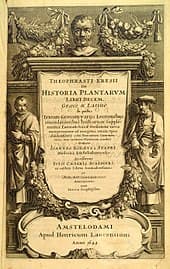
Theophrastus (c. 371–287 BCE) was a Greek philosopher often called the "Father of Botany." He classified plants based on their morphology (physical form), growth habits, and uses. His system divided plants into four groups: trees, shrubs, undershrubs, and herbs. This was practical for the time, but it lumped together many unrelated species just because they happened to look similar.
Linnaeus' sexual system
Carl Linnaeus, an 18th-century Swedish botanist, built a classification system around plant reproductive parts. He divided plants into 24 classes based on stamen characteristics (the male parts) and further sorted them into orders based on carpel characteristics (the female parts).
More importantly, Linnaeus introduced binomial nomenclature, the two-part naming system still used today. Every species gets a unique name made up of its genus and specific epithet (for example, Rosa canina for the dog rose).
Limitations of artificial systems
- They often grouped unrelated plants together based on superficial similarities. A tall herb and a tall grass might end up in the same category despite having very different evolutionary origins.
- They didn't reflect true evolutionary relationships.
- Newly discovered species that didn't fit neatly into existing categories were hard to place.
Natural classification systems
Natural classification systems improved on artificial ones by considering multiple shared characteristics rather than just one or two features. The goal was to group plants that genuinely seemed related based on their overall similarity.
Antoine and Bernard de Jussieu
These French botanists developed a natural classification system in the 18th century. Instead of relying on a single feature like stamen number, they grouped plants based on many shared characteristics. They also recognized the importance of plant embryos and seed structure as classification tools.
Candolle's natural system
Swiss botanist Augustin Pyramus de Candolle refined the natural approach in the early 19th century. He introduced the concept of taxa, which are groups of plants at various hierarchical levels (family, genus, species). His system emphasized both morphology (external form) and anatomy (internal structure) when determining relationships.
Bentham and Hooker's system
British botanists George Bentham and Joseph Dalton Hooker published their classification system in the late 19th century. They divided flowering plants into three main groups: Dicotyledons, Gymnosperms, and Monocotyledons, and arranged plant families in a sequence meant to reflect evolutionary relationships. Note that placing gymnosperms among the flowering plants is now considered incorrect, but this system was influential for decades.
Engler and Prantl's system
German botanists Adolf Engler and Karl Prantl developed a comprehensive system in the late 19th and early 20th centuries. They incorporated a wider range of characteristics, including anatomical and biochemical features. The Engler system became one of the most widely adopted classification systems and remained influential well into the 20th century.
Phylogenetic classification systems

Emergence of phylogenetic systems
Starting in the mid-20th century, botanists shifted their focus from overall similarity to evolutionary history as the basis for classification. Phylogenetic systems aim to group plants based on shared derived characteristics (synapomorphies) and common ancestry, rather than just looking alike.
Hennig's phylogenetic principles
German entomologist Willi Hennig developed the principles of cladistics in the 1950s. His key contributions:
- He argued that only shared derived characters (new traits that evolved in a common ancestor) should be used to determine relationships. Shared ancestral characters (traits inherited from a much older ancestor) don't tell you who's most closely related.
- He introduced the concept of monophyletic groups (clades), which include an ancestor and all of its descendants. A valid group in cladistics must be monophyletic.
Molecular phylogenetics
Advances in molecular biology and DNA sequencing transformed plant classification in the late 20th century. Instead of relying solely on physical traits (which can be misleading when unrelated plants evolve similar features), scientists could now compare DNA sequences directly. Molecular data provide a more objective way to infer evolutionary relationships and have resolved many long-standing debates about how plant groups are related.
APG (Angiosperm Phylogeny Group)
The APG system is an international collaborative effort to classify flowering plants based on their evolutionary relationships. It uses molecular data and cladistic analysis to build a comprehensive phylogenetic tree of angiosperms.
The APG classification has gone through several revisions (APG I in 1998, APG II in 2003, APG III in 2009, APG IV in 2016) as new data become available. This is a strength, not a weakness: the system is designed to update as our understanding improves.
Advantages over previous systems
- Reflects actual evolutionary history rather than superficial similarity
- Accommodates newly discovered species by placing them based on phylogenetic relationships
- Identifies monophyletic groups, which are more meaningful and predictive than artificial groupings
- Provides a framework for understanding how plant traits and adaptations evolved
Major plant groups
Bryophytes vs vascular plants
Bryophytes (mosses, liverworts, hornworts) are non-vascular plants. They lack true roots, stems, and leaves, and they have no specialized internal transport tissues. Because they rely on water for reproduction and nutrient transport, they tend to be small and restricted to moist environments.
Vascular plants possess xylem (for water transport) and phloem (for sugar transport). These specialized tissues allow them to grow much larger and colonize a wide range of terrestrial environments. Vascular plants include seedless vascular plants, gymnosperms, and angiosperms.
Seedless vascular plants
This group includes ferns, horsetails, and lycophytes (club mosses). They have vascular tissues but reproduce via spores rather than seeds, and they lack flowers and fruits. These plants dominated terrestrial ecosystems during the Carboniferous period (about 360–300 million years ago), and their remains formed much of the coal we use today.
Gymnosperms vs angiosperms
Gymnosperms are seed-bearing plants that lack flowers and fruits. The name means "naked seed" because their seeds are not enclosed in an ovary. This group includes conifers (pines, spruces), cycads, ginkgos, and gnetophytes. They are typically wind-pollinated and often produce cone-like reproductive structures.
Angiosperms (flowering plants) are the most diverse group of land plants, with roughly 300,000 species. They produce flowers and bear seeds enclosed within a fruit (a mature ovary). Angiosperms include trees, shrubs, herbs, vines, and aquatic plants, and they dominate most terrestrial ecosystems today.
Monocots vs dicots
Angiosperms are traditionally divided into monocots and dicots (though modern classification recognizes that "dicots" aren't a single evolutionary group; the term eudicots is more accurate for the largest clade).
| Feature | Monocots | Dicots (Eudicots) |
|---|---|---|
| Cotyledons (seed leaves) | One | Two |
| Leaf venation | Parallel | Netted (branching) |
| Floral parts | Multiples of 3 | Multiples of 4 or 5 |
| Examples | Grasses, orchids, lilies, palms | Roses, sunflowers, oaks, legumes |

Nomenclature and taxonomy
Binomial nomenclature
This is the formal naming system proposed by Linnaeus and still in use today. Each species gets a two-part Latin name:
- Genus name (capitalized): tells you which group of closely related species it belongs to
- Specific epithet (lowercase): identifies the particular species within that genus
The full name is always italicized (e.g., Quercus alba for white oak). This system ensures every species has a unique, universally recognized name regardless of language.
Ranks and hierarchical structure
Taxonomy organizes life into a nested hierarchy. The main ranks, from broadest to most specific:
Domain → Kingdom → Phylum → Class → Order → Family → Genus → Species
A helpful mnemonic: Dear King Philip Came Over For Good Spaghetti.
Each species sits within this nested system. For example, the common sunflower (Helianthus annuus) belongs to the family Asteraceae, order Asterales, and so on up the hierarchy.
Species concept in plants
Defining what counts as a "species" in plants is trickier than in animals because plants commonly hybridize, undergo polyploidy (whole-genome duplication), and reproduce asexually. There are several competing concepts:
- Morphological species concept: species are distinguished by distinct physical characteristics. This is the most traditional approach.
- Biological species concept: species are groups of interbreeding populations that are reproductively isolated from other groups. This works well for animals but is harder to apply to plants that hybridize freely.
- Phylogenetic species concept: species are the smallest monophyletic groups that are diagnosably distinct from other such groups. This aligns well with modern molecular approaches.
Hybrids and cultivars
Hybrids result from interbreeding between different species or subspecies. They can occur naturally or be produced deliberately by plant breeders. Hybrids often show intermediate characteristics or enhanced traits known as hybrid vigor (heterosis).
Cultivars (short for "cultivated varieties") are plants selected and propagated for specific desirable traits like fruit size, flower color, or disease resistance. Cultivar names follow the species name and are enclosed in single quotes, e.g., Malus domestica 'Granny Smith'.
Codes of nomenclature
Two main codes govern plant naming:
- ICN (International Code of Nomenclature for algae, fungi, and plants): governs scientific names for wild plants
- ICNCP (International Code of Nomenclature for Cultivated Plants): provides rules for naming cultivars
These codes ensure stability, universality, and uniqueness in plant names, preventing the confusion that would arise if different researchers named the same plant differently.
Applications of plant classification
Biodiversity conservation
Accurate classification is essential for conservation. You can't protect a species if you can't identify it or distinguish it from related species. Classification helps identify rare, threatened, or endangered species, locate biodiversity hotspots, and prioritize where conservation resources should go.
Medicinal and economic botany
Classification helps researchers identify plants with medicinal properties or economic value. Closely related species often share similar chemistry, so knowing a plant's classification can guide the search for new pharmaceuticals or natural products. It also prevents dangerous mix-ups between similar-looking species that may have very different properties.
Horticulture and agriculture
Plant breeders rely on classification to select and cross species with desirable traits like higher yield, disease resistance, or ornamental qualities. Classification also helps identify and manage pests, pathogens, and invasive species that threaten crops and gardens.
Evolutionary studies
Phylogenetic classification provides the framework for studying how plants evolved. By mapping traits onto a phylogenetic tree, researchers can trace when and how adaptations arose, compare patterns across different lineages, and understand the processes driving plant diversification.
See Fiveable more often in Google
Mark Fiveable as a preferred source and Google is more likely to show you our guides in Top Stories, with a "preferred" badge in AI Mode and AI Overviews.