4.2 Algae and bryophytes

🥀Intro to Botany Unit 4 Review
4.2 Algae and bryophytes
🥀 Intro to Botany
Algae and bryophytes represent two major groups you'll encounter in plant classification. Algae are photosynthetic organisms that dominate aquatic environments and serve as primary producers. Bryophytes (mosses, liverworts, and hornworts) are the simplest land plants, lacking vascular tissue. Together, these groups help illustrate how photosynthetic life transitioned from water to land.
Characteristics of algae
Algae are a diverse group of photosynthetic organisms found mostly in aquatic ecosystems. They range from single-celled species invisible to the naked eye to giant seaweeds stretching over 50 meters long. While most algae live in water, some species grow on soil, rocks, and tree bark.

Top images from around the web for Diversity in algal forms
4.2.4 Phylogenetic Trees and Classification | Digital Atlas of Ancient Life View original
Is this image relevant?
Algae | Microbiology View original
Is this image relevant?
Changes in Phytoplankton and Zooplankton Communities View original
Is this image relevant?
4.2.4 Phylogenetic Trees and Classification | Digital Atlas of Ancient Life View original
Is this image relevant?
Algae | Microbiology View original
Is this image relevant?
Diversity in algal forms
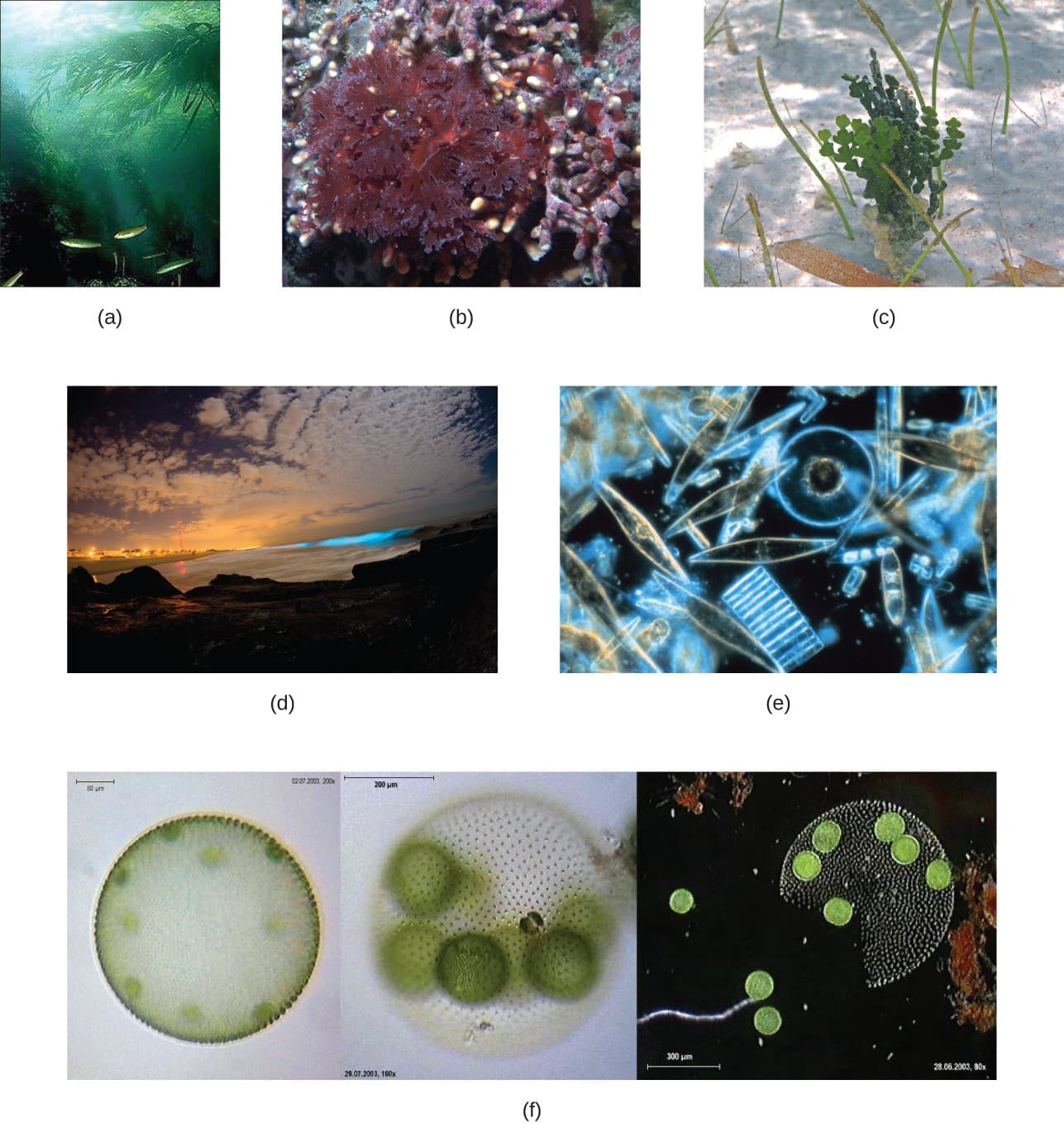
Algae come in a huge variety of shapes and sizes. They can be spherical, oval, filamentous (thread-like), or sheet-like. Kelp, for example, can grow over 50 meters long and form dense underwater forests. Algae can also be categorized by where they live: planktonic algae float freely in the water column, while benthic algae attach to surfaces like rocks or the seafloor.
Unicellular vs multicellular algae
- Unicellular algae like Chlorella and Chlamydomonas consist of a single cell and are often microscopic.
- Multicellular algae like Ulva (sea lettuce) and Sargassum have specialized cells that perform different functions and form complex body structures.
- Colonial algae like Volvox fall somewhere in between. Individual cells are connected into a colony but each cell maintains some independence.
Pigments and photosynthesis
All algae contain chlorophyll a as their primary photosynthetic pigment. Beyond that, different groups carry additional pigments that let them absorb light at different wavelengths. Carotenoids and phycobilins are two common accessory pigment types. These extra pigments are the reason algae aren't all green. Red algae get their color from phycobilins, brown algae from fucoxanthin (a carotenoid), and golden algae from other carotenoid combinations.
Cell wall composition
Cell wall composition varies across algal groups, and it's actually a useful way to tell groups apart:
- Many algae have cellulose-based walls, similar to land plants
- Diatoms have walls made of silica, giving them intricate, glass-like structures
- Brown algae contain alginates in their walls
- Red algae contain carrageenans
- Some algae have walls with glycoproteins instead of or in addition to cellulose
Reproductive strategies
Algae reproduce both asexually and sexually. Asexual methods include binary fission (cell division), fragmentation (pieces breaking off and growing independently), and spore formation. These allow populations to grow rapidly.
Sexual reproduction involves the fusion of gametes, which can be isogamous (gametes similar in size) or anisogamous (gametes differing in size, with a larger egg and smaller sperm). Many algal species also exhibit alternation of generations, cycling between haploid and diploid life stages.
Ecological roles of algae
Algae are foundational to aquatic ecosystems. They produce a significant portion of Earth's oxygen through photosynthesis, form the base of aquatic food webs, and participate in nutrient cycling.
Primary producers in aquatic ecosystems
Algae convert light energy into chemical energy, making them the primary producers in most aquatic environments. Phytoplankton, the microscopic algae suspended in the water column, are especially important. They support food webs across open oceans and freshwater lakes alike. In coastal and shallow waters, benthic algae like seaweeds contribute substantially to primary production as well.
Symbiotic relationships
Algae form partnerships with many other organisms:
- Lichens are a symbiosis between algae (or cyanobacteria) and fungi. The algae photosynthesize and share sugars, while the fungi provide physical structure and help acquire minerals.
- Coral reefs depend on dinoflagellate algae called zooxanthellae living inside coral polyps. The algae supply the coral with energy from photosynthesis, and the coral provides shelter and nutrients in return.
- Some algae also live symbiotically inside invertebrates like giant clams and sponges, boosting their hosts' growth and survival.
Algal blooms and environmental impacts
Algal blooms happen when algal populations explode in response to favorable conditions, often excess nutrients (like nitrogen and phosphorus from agricultural runoff) or warmer water temperatures. Some blooms are natural and harmless, but harmful algal blooms (HABs) produce toxins dangerous to marine life and humans.
As massive blooms die and decompose, bacteria consume oxygen in the water, leading to hypoxia (oxygen depletion). This can cause fish kills and disrupt entire aquatic communities.
Economic importance of algae
Algae have wide-ranging commercial uses, from food to fuel. Their fast growth rates and ability to grow in conditions unsuitable for traditional crops make them an increasingly attractive resource.
Algae as food sources
Many algal species are eaten directly, especially in Asian cuisines. Nori (red algae) wraps sushi, kombu (brown algae) flavors broths, and sea lettuce (green algae) is used in salads. Microalgae like Spirulina and Chlorella are sold as dietary supplements because of their high protein content. Algae are also used as feed in aquaculture, providing a sustainable protein source for farmed fish and shellfish.

Industrial applications
- Agar and carrageenan, extracted from algae, serve as thickening and gelling agents in food products, pharmaceuticals, and lab media
- Compounds like beta-carotene and astaxanthin are used as natural pigments and antioxidants in food and cosmetics
- Algal biomass can be used in wastewater treatment, where algae efficiently absorb excess nutrients and pollutants from water
Potential in biofuels
Microalgae can produce large amounts of lipids (oils) that can be converted into biodiesel. Because algae grow fast, can be cultivated on non-arable land, and absorb as they grow, they're a promising alternative to fossil fuels. Research is ongoing to bring down the cost of algal cultivation, harvesting, and processing to make biofuel production commercially viable.
Characteristics of bryophytes
Bryophytes are non-vascular plants, meaning they lack xylem and phloem (the transport tissues found in ferns, conifers, and flowering plants). The three groups of bryophytes are mosses, liverworts, and hornworts. They're among the earliest land plants and have adapted to terrestrial life without developing the complex internal plumbing of vascular plants.
Non-vascular plant structure
Without vascular tissue, bryophytes rely on diffusion and capillary action to move water and nutrients through their bodies. This limits their size, which is why most bryophytes are small.
Their body plan has two phases:
- The gametophyte is the main, visible plant body. It's the green, photosynthetic part you'd recognize as a moss or liverwort.
- The sporophyte grows attached to the gametophyte and depends on it for nutrition. Its main job is producing spores.
This is the opposite of vascular plants, where the sporophyte (the leafy plant you see) is dominant.
Gametophyte-dominant life cycle
In bryophytes, the gametophyte is the long-lived, independent generation. It produces reproductive structures: antheridia (male, producing sperm) and archegonia (female, containing eggs). Fertilization requires water because the sperm must physically swim through a film of moisture to reach the egg in the archegonium. This water dependence is a key reason bryophytes tend to thrive in moist habitats.
Adaptations to terrestrial environments
Despite lacking vascular tissue, bryophytes have evolved several strategies for life on land:
- A waxy cuticle on their surfaces reduces water loss and provides some UV protection
- Some species have hydroids, simple water-conducting cells that help move water internally
- Growing in dense clumps or mats helps retain moisture and buffer against temperature swings and drying winds
Many bryophytes can also tolerate desiccation, drying out almost completely and then resuming activity when water returns.
Diversity of bryophytes
Bryophytes are divided into three groups: mosses (Bryophyta), liverworts (Marchantiophyta), and hornworts (Anthocerotophyta). They occupy habitats ranging from tropical rainforests to arctic tundra, and even deserts.
Mosses, liverworts, and hornworts
Mosses are the most diverse group, with over 12,000 species. They typically have a stem-like axis with small, simple leaves arranged spirally or in rows.
Liverworts include around 7,000 species. Some have a flattened, ribbon-like body (a thallus), while others have a leafy form with leaves arranged in two rows. The name "liverwort" comes from the liver-shaped lobes of some thalloid species.
Hornworts are the smallest group, with roughly 200 species. They have a simple, flattened gametophyte, and their sporophyte is distinctive: a horn-shaped structure that grows upward from the thallus surface.
Morphological and anatomical differences
These three groups differ in several notable ways:
- Mosses have a central strand of conducting tissue that helps transport water and nutrients
- Liverworts lack a central strand but contain oil bodies in their cells. These oil bodies hold aromatic compounds that may help with defense against herbivores and water retention.
- Hornworts have a unique chloroplast structure with a single large pyrenoid, which concentrates for photosynthesis (similar to what you see in some algae)
- In mosses and liverworts, the sporophyte is typically raised on a stalk called a seta. In hornworts, the sporophyte is embedded directly in the gametophyte tissue.
Habitat preferences and distribution
Bryophytes occupy a wide range of habitats. Many species have very specific microhabitat preferences, growing only on certain types of rock, tree bark, or soil. Some are adapted to aquatic environments and live submerged or floating in water. In their habitats, bryophytes regulate moisture levels, stabilize soil, and provide shelter for small invertebrates like mites and springtails.
Reproductive strategies in bryophytes
Bryophytes alternate between gametophyte and sporophyte generations, and they rely on water for sexual reproduction. They also have several asexual strategies for spreading without sex.

Alternation of generations
Here's how the bryophyte life cycle works, step by step:
- The gametophyte (haploid) produces sperm in antheridia and eggs in archegonia through mitosis.
- Sperm swim through a film of water to reach an egg in the archegonium.
- Fertilization produces a diploid zygote.
- The zygote develops into a sporophyte, which stays attached to and nutritionally dependent on the gametophyte.
- Inside the sporophyte's capsule (sporangium), cells undergo meiosis to produce haploid spores.
- Spores are released and, if they land in a suitable spot, germinate into new gametophytes.
The gametophyte is the dominant, persistent generation. The sporophyte is smaller, shorter-lived, and dependent.
Spore dispersal and germination
Spores are tiny, tough structures dispersed primarily by wind, though water and animals can also carry them. Their small size and resistance to harsh conditions allow them to travel long distances. When a spore lands in a favorable environment with adequate moisture, it germinates and grows into a new gametophyte. The young gametophyte develops rhizoids (root-like anchoring structures) and begins photosynthesizing independently.
Asexual reproduction
Bryophytes also reproduce asexually through several methods:
- Fragmentation: Pieces of the gametophyte break off and grow into new, independent plants
- Gemmae: Small clusters of cells (especially common in liverworts) that form in cup-shaped structures called gemmae cups. Rain splashes the gemmae out, and each can grow into a new plant.
- Brood bodies: Similar structures found in some mosses
Asexual reproduction lets bryophytes colonize new areas quickly without needing water for fertilization.
Ecological significance of bryophytes
Despite their small size, bryophytes have outsized ecological importance. They contribute to nutrient cycling, build soil, and provide microhabitats for countless small organisms.
Roles in nutrient cycling
Bryophytes absorb nutrients from the atmosphere, rainwater, and their substrate across their entire surface (since they lack roots). They trap and accumulate nutrients like nitrogen and phosphorus, making these available to other organisms. When bryophytes decompose, those nutrients are released back into the soil. Bryophyte mats also influence soil pH and moisture, which in turn affects nutrient availability for surrounding plants.
Contributions to soil formation
Bryophytes are pioneer species, often the first organisms to colonize bare rock. They trap dust, organic debris, and moisture, which accelerates rock weathering and the gradual buildup of soil particles. Their dense mats stabilize this developing soil and prevent erosion. As generations of bryophytes grow and die, their decomposing tissue adds organic matter, improving soil structure and fertility for other plants that follow.
Interactions with other organisms
Bryophyte mats create microhabitats for insects, spiders, mites, and other invertebrates, which use them for shelter, feeding, and breeding. Some bryophytes host nitrogen-fixing cyanobacteria in symbiotic relationships, gaining access to a source of fixed nitrogen. Bryophytes also form associations with fungi that can enhance nutrient uptake and water retention, somewhat analogous to the mycorrhizal relationships seen in vascular plants.
Evolution and classification
Algae and bryophytes represent key stages in the evolutionary history of photosynthetic life, particularly the transition from water to land. Advances in molecular techniques have significantly reshaped how these organisms are classified.
Evolutionary history of algae and bryophytes
Algae originated in aquatic environments over 1.5 billion years ago. Over time, some lineages evolved multicellularity and specialized cell types, setting the stage for the eventual colonization of land. Bryophytes are among the earliest land plants, with fossil evidence placing them on land roughly 470 million years ago. The move to land required new adaptations: protection against drying out, defense against UV radiation, and structural support without the buoyancy of water.
Phylogenetic relationships
Molecular studies have clarified the relationships between these groups. Green algae (Chlorophyta) are the closest living relatives of land plants, with charophytes (a specific group of green algae) being the most closely related. Think of charophytes as a "bridge" group between aquatic algae and terrestrial plants.
Within bryophytes, current evidence suggests liverworts diverged earliest, followed by mosses and then hornworts. Whether bryophytes as a whole form a single lineage (monophyletic group) or represent multiple independent lineages is still debated, though recent molecular analyses increasingly support monophyly.
Current taxonomic classifications
Algal classification has changed substantially with molecular data. Traditional groupings based on color and morphology have given way to classifications reflecting evolutionary relationships:
- Rhodophyta (red algae)
- Chlorophyta (green algae)
- Phaeophyceae (brown algae)
- Bacillariophyta (diatoms)
Bryophytes are classified into three divisions:
- Marchantiophyta (liverworts)
- Bryophyta (mosses)
- Anthocerotophyta (hornworts)
Within each division, further classification relies on a combination of morphological, anatomical, and molecular characteristics.
See Fiveable more often in Google
Mark Fiveable as a preferred source and Google is more likely to show you our guides in Top Stories, with a "preferred" badge in AI Mode and AI Overviews.