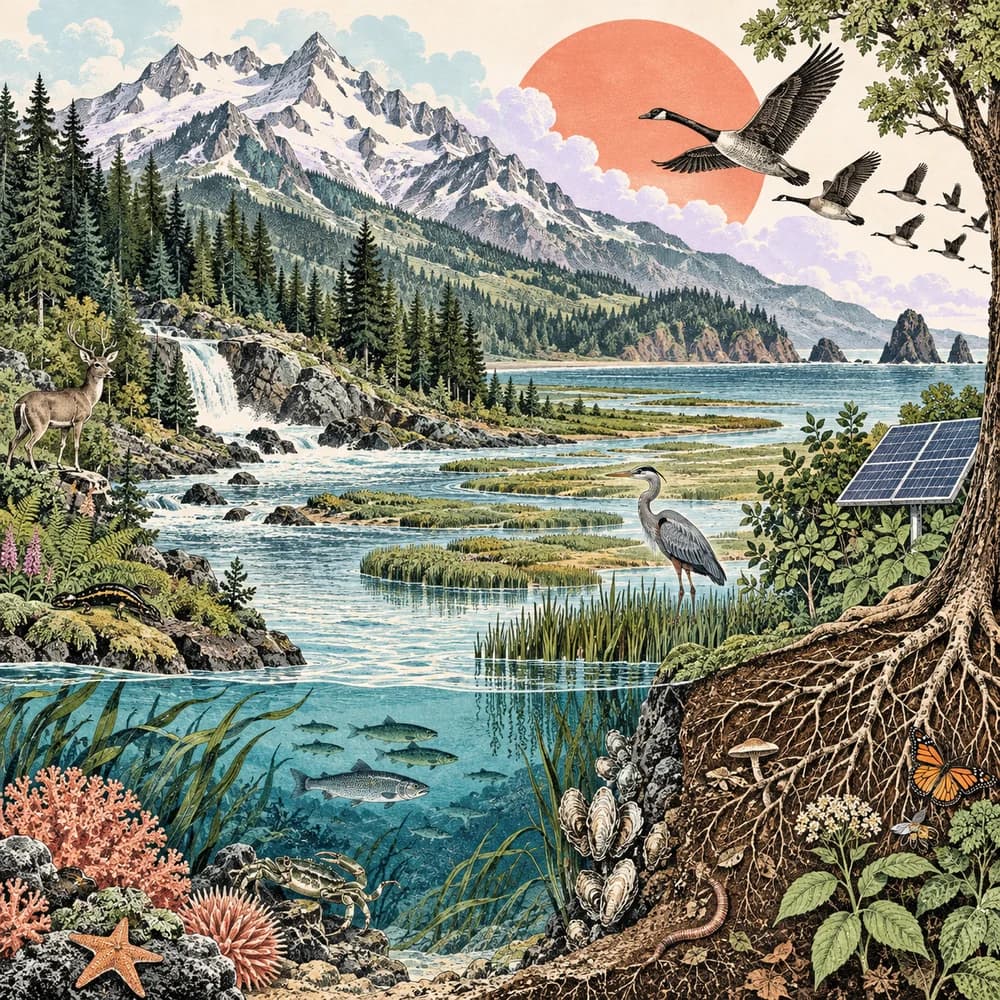
earth systems & resources
Earth Systems & Resources explores the intricate connections between Earth's physical components. This unit covers the planet's structure, plate tectonics, atmosphere, hydrosphere, and biosphere, examining how these systems interact and shape our environment. Understanding Earth's systems is crucial for addressing environmental challenges. By studying these interconnected processes, we gain insights into climate change, resource management, and ecosystem dynamics, enabling us to develop sustainable solutions for the future.
What is APES Unit 4 (Earth Systems and Resources) about?
Unit 4 is essentially a survey of how Earth's physical systems interact. You’ll study plate tectonics, soils, the atmosphere, climate and global wind patterns, watersheds, solar radiation, and El Niño/La Niña. It explains how solar energy and system interactions shape weather and long-term climate, how plate boundaries build mountains and produce earthquakes and volcanoes, and how soils form, erode, and differ in properties. Expect map-reading, interpreting climatograms, and soils/watershed analyses. It’s roughly 10–15% of the AP Exam and typically takes about 11–12 class periods. Full unit details are here (https://library.fiveable.me/ap-enviro/unit-4). For focused review, Fiveable offers a unit study guide, cheatsheets, cram videos, and extra practice questions (https://library.fiveable.me/practice/enviro).
What topics are covered in APES Unit 4?
You’ll cover the full Unit 4 lineup: 4.1 Plate Tectonics; 4.2 Soil Formation and Erosion; 4.3 Soil Composition and Properties; 4.4 Earth's Atmosphere; 4.5 Global Wind Patterns; 4.6 Watersheds; 4.7 Solar Radiation and Earth's Seasons; 4.8 Earth's Geography and Climate; and 4.9 El Niño and La Niña. This unit (10–15% of the exam, ~11–12 class periods) focuses on plate-boundary processes, soil horizons and tests, atmospheric layers and composition, how insolation and the Coriolis effect drive winds, watershed characteristics, how tilt and latitude create seasons, and climate impacts like rain shadows and ENSO events. For a targeted review, Fiveable has a Unit 4 study guide, cheatsheets, cram videos, and practice questions at https://library.fiveable.me/ap-enviro/unit-4.
How much of the APES exam is Unit 4?
Unit 4 (Earth Systems and Resources) makes up about 10%–15% of the AP Environmental Science exam; see Fiveable's Unit 4 study guide (https://library.fiveable.me/ap-enviro/unit-4). That percentage is the College Board’s listed weighting and shows up across both multiple-choice and free-response questions. All nine units contribute to the exam, but Unit 4’s topics—plate tectonics, soils, atmosphere and climate patterns, and El Niño/La Niña—are commonly tested. In class pacing, the CED suggests roughly 11–12 periods. For targeted practice and extra review materials, try Fiveable’s unit study guide plus practice question bank (https://library.fiveable.me/practice/enviro).
What's the hardest part of APES Unit 4?
Most students say El Niño and La Niña give them the most trouble because you have to connect ocean temperature anomalies, atmospheric pressure shifts (the Southern Oscillation), global weather effects, and timing/feedbacks. Global wind patterns and the Coriolis effect also stump people—those require visualizing rotation, pressure cells, and latitude effects. Soil formation and erosion can feel dense too since they mix physical, chemical, and biological processes. A good strategy: map out cause→effect chains (what changes, why it changes, and downstream impacts) and practice diagram-based problems. For quick refreshers and targeted practice, Fiveable’s Unit 4 study guide, cheatsheets, and cram videos are helpful at https://library.fiveable.me/ap-enviro/unit-4.
How should I study for APES Unit 4—best study guide and resources?
Start with the Unit 4 study guide (https://library.fiveable.me/ap-enviro/unit-4) to cover 4.1–4.9. Break study into three sessions: (1) read through and note key vocabulary and processes, (2) make quick concept maps and diagrams—soil profiles, plate boundaries, global wind cells, energy budgets—(3) do mixed practice questions and time a couple MC sets. Spend extra time on graphs (climate vs. latitude, ENSO cycles) and common calculations. Use active recall and spaced repetition over several days, track weak spots, and redo practice focused on those areas. For quick cram videos and extra practice questions, Fiveable’s practice bank is handy (https://library.fiveable.me/practice/enviro).
Where can I find APES Unit 4 notes, PDFs, or study guides?
You can find APES Unit 4 notes, PDFs, and study guides at https://library.fiveable.me/ap-enviro/unit-4. That page covers Unit 4: Earth Systems and Resources (topics 4.1–4.9) and lines up with CED topics like plate tectonics, soil formation and properties, the atmosphere, global wind patterns, watersheds, seasons, climate, and El Niño/La Niña. Unit 4 typically makes up about 10–15% of the exam. If you want printable PDFs or quick-reference material, the Fiveable unit page includes cheatsheets and concise study content. For extra practice, use Fiveable’s 1000+ practice questions at https://library.fiveable.me/practice/enviro. These resources are meant for targeted review before quizzes and the AP test.
Are there common FRQ or MCQ question types from APES Unit 4?
Yes — common APES Unit 4 MCQ and FRQ types include map-based plate boundary ID and effects, soil ID and texture-triangle problems, interpreting soil horizons and water-holding capacity, reading climatograms and explaining seasonal insolation, global wind patterns/Coriolis effect items, watershed characteristics, and short-response cause/effect prompts about El Niño/La Niña or rain shadows. Many questions ask you to interpret diagrams or maps, describe processes (for example, what happens at a convergent boundary), compare soil properties, or predict outcomes from changes like increased erosion. Practice applying formulas (percent composition for texture triangles) and reading graphs — those skills show up a lot. For focused review and practice, see the Unit 4 study guide (https://library.fiveable.me/ap-enviro/unit-4) and additional practice (https://library.fiveable.me/practice/enviro).
How long should I study Unit 4 compared to other APES units?
Spend about 10–15% of your total APES study time on Unit 4 — College Board lists it as 10–15% of the exam and it’s typically taught in roughly 11–12 class periods. So if you plan 40 hours of total review, allocate around 4–6 hours to this unit (or about 1–2 focused weeks during review). Shift more time to specific weak spots like soil formation, plate tectonics, atmospheric circulation, watersheds, and El Niño/La Niña. During initial learning, follow your class pacing (those 11–12 lessons); during cumulative review, prioritize practice questions and FRQ-style prompts tied to earth systems. For a quick targeted review and practice, check the Fiveable Unit 4 study guide at https://library.fiveable.me/ap-enviro/unit-4.