12.4 The Benefits and Costs of U.S. Environmental Laws

🛒Principles of Microeconomics Unit 12 Review
12.4 The Benefits and Costs of U.S. Environmental Laws
🛒 Principles of Microeconomics
Environmental Protection and Economic Trade-offs
Environmental protection always involves trade-offs. Cleaner air and water come with real costs, and the central question in environmental economics is: how much protection is worth the expense? This section covers how economists think about that question using marginal analysis, and how U.S. environmental laws try to strike that balance.

Top images from around the web for Trade-offs
Cap and Trade and Carbon Offsets – Building a Greener Future: A UW Research Report into Seattle ... View original
Is this image relevant?
The Benefits and Costs of U.S. Environmental Laws · Economics View original
Is this image relevant?
5.3 Directly Targeting Pollution – Principles of Microeconomics View original
Is this image relevant?
Cap and Trade and Carbon Offsets – Building a Greener Future: A UW Research Report into Seattle ... View original
Is this image relevant?
The Benefits and Costs of U.S. Environmental Laws · Economics View original
Is this image relevant?
Trade-offs in Environmental Protection
Every environmental regulation carries both costs and benefits. The costs include things like pollution control equipment, regulatory compliance expenses, and the opportunity costs of production that doesn't happen because of restrictions. The benefits include improved public health, preservation of natural resources, and a higher quality of life.
The economist's goal is to find the level of protection where the benefits of one more unit of cleanup just equal the costs of that cleanup. That's marginal analysis applied to the environment.
One major challenge: many of these benefits are genuinely hard to put a dollar value on. How do you price biodiversity, or the long-term impact of slowing climate change? Economists also wrestle with discount rates, which determine how much weight to give future benefits compared to present-day costs. A high discount rate makes future benefits seem small today, which can bias decisions against long-term environmental protection.

Ecotourism as a Case Study
Ecotourism shows how environmental protection and economic activity can reinforce each other. When tourists pay park fees, book guided tours, or stay in eco-lodges, that revenue gives local communities a direct financial incentive to protect habitats and wildlife rather than exploit them.
Beyond the money, ecotourism raises public awareness about the value of ecosystems, which can build political support for conservation funding.
That said, ecotourism has real drawbacks:
- Environmental degradation from overuse (eroded trails, disturbed wildlife breeding patterns)
- Inequitable distribution of benefits, where tourism revenue flows to outside operators rather than local communities
The takeaway: ecotourism works best when it's carefully managed so that the economic benefits actually reach the people living near protected areas, and visitor numbers stay within what the ecosystem can handle.

Optimal Pollution Reduction
Marginal Analysis Applied to Pollution
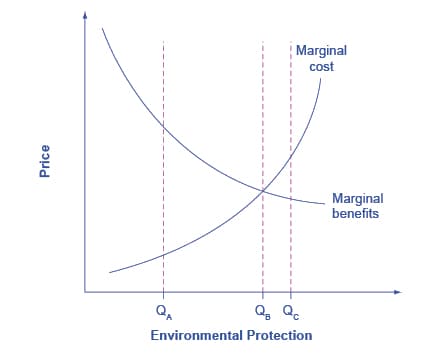
The core framework for thinking about how much pollution to reduce uses two curves:
- Marginal Abatement Cost (MAC): The cost of reducing one additional unit of pollution. This curve slopes upward because firms use the cheapest cleanup methods first. Each additional unit of reduction gets progressively more expensive.
- Marginal Social Benefit (MSB): The benefit to society from reducing one additional unit of pollution. This curve slopes downward because the most harmful pollution gets addressed first. Each additional unit of reduction yields a smaller health or environmental gain.
The optimal level of pollution reduction occurs where . At this point, total net benefits to society (total benefits minus total costs) are maximized.
To see why this is the sweet spot:
- If , society gains more from additional cleanup than it costs. We should reduce pollution further.
- If , the last unit of cleanup costs more than it's worth. We've gone too far.
- At , the next unit of reduction would cost exactly as much as it benefits society. That's the efficient stopping point.
Getting to the Optimal Level with Policy
Environmental regulations should aim to push pollution reduction toward that point. Market-based instruments are particularly effective at this:
- Pollution taxes (Pigouvian taxes): Set a tax per unit of pollution. Each firm reduces emissions until its own MAC equals the tax rate, because it's cheaper to clean up than to pay the tax. Once MAC exceeds the tax, the firm pays instead.
- Tradable permits (cap-and-trade): The government sets a total cap on emissions and issues permits. Firms with low abatement costs sell their extra permits to firms with high abatement costs. The permit price naturally settles where it equals the MAC across firms.
Both approaches achieve the same result: polluters with the lowest cleanup costs do the most reducing, which minimizes the total cost of reaching any given pollution target. This is more efficient than command-and-control regulations (like requiring every firm to cut emissions by the same percentage), which ignore differences in abatement costs across firms.
See Fiveable more often in Google
Mark Fiveable as a preferred source and Google is more likely to show you our guides in Top Stories, with a "preferred" badge in AI Mode and AI Overviews.