12.1 The Economics of Pollution

🛒Principles of Microeconomics Unit 12 Review
12.1 The Economics of Pollution
🛒 Principles of Microeconomics
Pollution and Negative Externalities

Top images from around the web for Negative Externalities
Why is there pollution and what can we do about it? – Economics for the Greater Good View original
Is this image relevant?
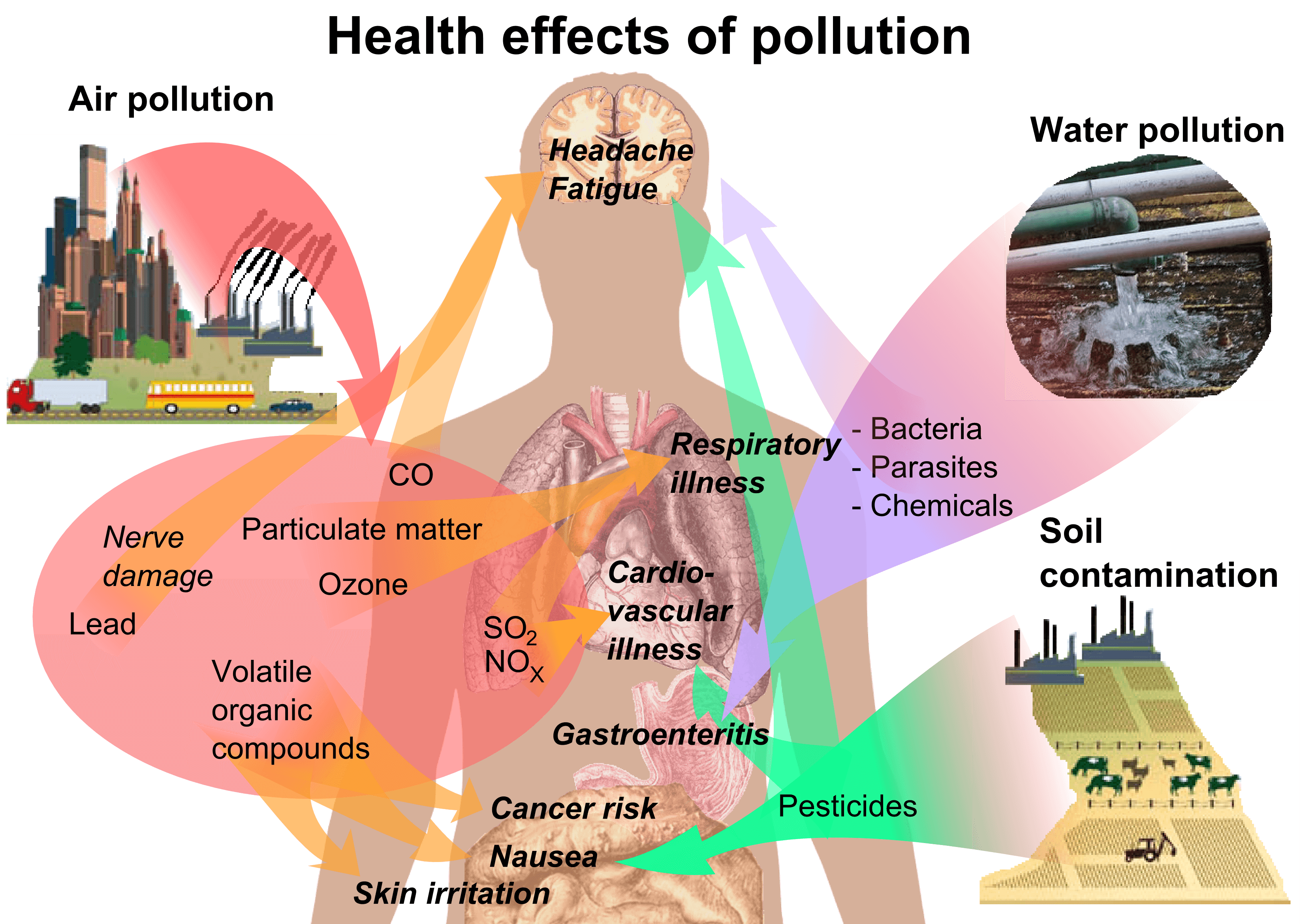
File:Health effects of pollution.png - Wikipedia View original
Is this image relevant?
Negative Externalities: Pollution | Microeconomics View original
Is this image relevant?
Why is there pollution and what can we do about it? – Economics for the Greater Good View original
Is this image relevant?
File:Health effects of pollution.png - Wikipedia View original
Is this image relevant?
Negative Externalities
A negative externality occurs when an economic activity imposes costs on third parties who weren't part of the transaction. Pollution is the textbook example: a factory dumping waste into a river harms downstream residents and wildlife, but neither the factory nor its customers pay for that damage.
This creates market inefficiency. Because producers don't bear the full costs of their actions, they overproduce. The market equilibrium quantity ends up higher than the socially optimal level, generating deadweight loss.
Pollution-related externalities show up in several forms:
- Health problems like respiratory illness, cancer, and birth defects
- Environmental degradation including acid rain, habitat destruction, and climate change
- Property damage and reduced property values near polluted areas
- Increased government spending on healthcare and environmental cleanup
The Supply Curve Shift
When firms are forced to account for pollution damages, their marginal costs rise. This shifts the supply curve to the left, from to , where reflects the true marginal social cost of production rather than just the private cost.
The new equilibrium has a higher price () and a lower quantity (). Consumers pay more, and less of the good is produced and consumed. That's the point: the original equilibrium was "too much" production because pollution costs were being ignored.
This shift moves the market closer to allocative efficiency, where . Deadweight loss shrinks, though it may not disappear entirely since it's difficult to measure and internalize every external cost precisely.
Why the Market Fails
The core issue is a gap between private cost and social cost:
At the unregulated market equilibrium, marginal social cost (MSC) exceeds marginal social benefit (MSB). The market treats pollution as "free" for the producer, so output overshoots the efficient level. The resulting deadweight loss (DWL) represents the net loss in social welfare from that overproduction.
Policy Tools for Internalizing Pollution Costs
Governments have four main approaches to make firms account for pollution's true costs. Each shifts the supply curve leftward, but they differ in how they get there.
1. Pigouvian Taxes
A Pigouvian tax is a per-unit tax set equal to the marginal external cost at the efficient output level. It directly raises the firm's marginal cost, shifting supply left.
- Example: A carbon tax on fossil fuel companies that charges a dollar amount per ton of emitted, reflecting estimated climate change damages.
- Advantage: Provides a clear price signal and lets firms decide how to reduce emissions most cheaply.
- Challenge: Requires accurate estimation of the marginal external cost, which is hard to pin down.
2. Tradable Pollution Permits (Cap-and-Trade)
The government sets a cap on total allowable pollution and issues permits that firms can buy and sell.
Here's how it works:
- The government determines the total acceptable level of emissions and distributes that many permits.
- Firms with low abatement costs find it cheaper to cut emissions, so they reduce pollution below their permit level and sell the extras.
- Firms with high abatement costs buy those permits instead of making expensive reductions.
The result is that pollution gets reduced where it's cheapest to do so, lowering the total cost of hitting the emissions target.

3. Command-and-Control Regulations
These are direct rules: emission limits, technology mandates, or outright bans on certain pollutants.
- Example: Requiring coal-fired power plants to install scrubbers to reduce sulfur dioxide emissions, or setting tailpipe emission standards for vehicles.
- Advantage: Straightforward and enforceable. The government knows exactly what standard firms must meet.
- Disadvantage: Less efficient than market-based approaches because every firm faces the same rule regardless of their individual abatement costs. A firm that could cheaply cut emissions far below the standard has no incentive to do so.
4. Subsidies for Clean Technologies
Financial incentives encourage firms to adopt cleaner production methods, lowering the marginal cost of pollution abatement.
- Example: Tax credits for installing solar panels or purchasing electric vehicles.
- Advantage: Encourages innovation and adoption of green technology without directly penalizing firms.
- Disadvantage: Costs the government revenue, and subsidies can create market distortions if poorly targeted.
Comparing the Approaches
Market-based tools (Pigouvian taxes and cap-and-trade) give firms flexibility to find the cheapest way to reduce pollution. They tend to be more economically efficient.
Command-and-control regulations can be effective at achieving specific targets but often don't minimize the total cost of pollution reduction.
Subsidies promote cleaner alternatives but require significant government spending and don't directly penalize polluters.
No single policy is perfect. The best choice depends on how measurable the pollution is, how many firms are involved, and what's politically feasible.
See Fiveable more often in Google
Mark Fiveable as a preferred source and Google is more likely to show you our guides in Top Stories, with a "preferred" badge in AI Mode and AI Overviews.