17.2 How Households Supply Financial Capital

🛒Principles of Microeconomics Unit 17 Review
17.2 How Households Supply Financial Capital
🛒 Principles of Microeconomics
Financial Intermediaries and Assets

Top images from around the web for Financial Intermediaries
Banks As Financial Intermediaries | Introduction to Business View original
Is this image relevant?
U.S. Financial Institutions | OpenStax Intro to Business View original
Is this image relevant?
Reading: Banks As Financial Intermediaries | Ivy Tech Introduction to Business View original
Is this image relevant?
Banks As Financial Intermediaries | Introduction to Business View original
Is this image relevant?
U.S. Financial Institutions | OpenStax Intro to Business View original
Is this image relevant?
Financial Intermediaries
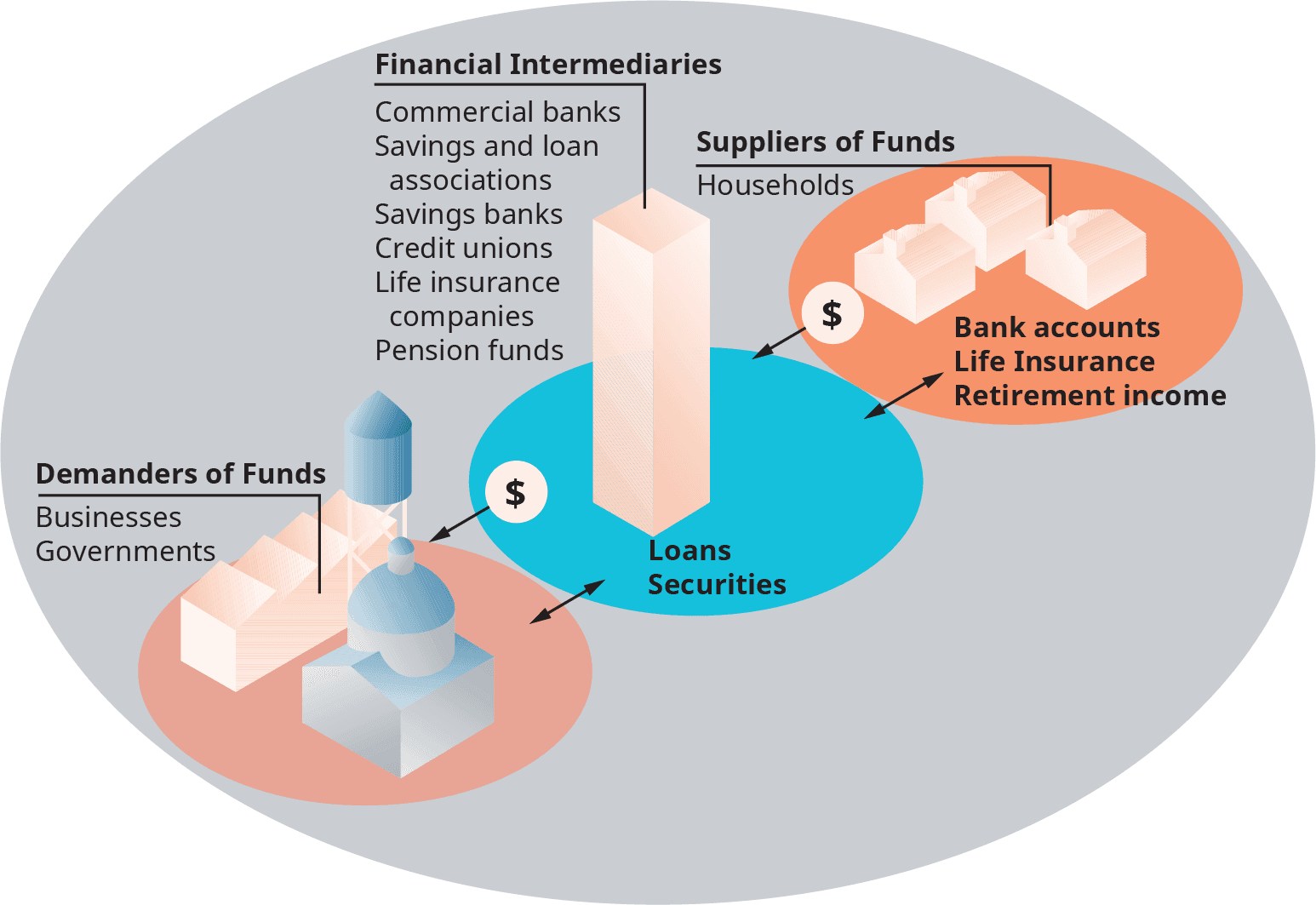
Households supply financial capital by saving money and placing it with financial intermediaries, which are institutions that act as middlemen between savers and borrowers. Without them, every person who wanted to save would need to find a borrower on their own, and every borrower would need to track down individual savers. Financial intermediaries solve that problem.
Banks are the most familiar example. They accept deposits from savers, pay interest on those deposits, and then lend that money out to borrowers at a higher interest rate. The difference between the interest they charge borrowers and the interest they pay savers is how banks earn revenue.
Financial intermediaries also reduce risk through diversification. Rather than lending all your savings to one person (who might not pay you back), a bank lends to thousands of different borrowers. If a few default, the bank can absorb the loss because the rest are still paying. This spreads the risk across many loans instead of concentrating it in one.

Financial Assets
When households supply financial capital, they typically purchase one or more types of financial assets. Each type has a different structure, level of risk, and expected return.
Bonds are debt securities. When you buy a bond, you're essentially lending money to the issuer (a corporation or government). In return, the issuer pays you fixed interest payments on a regular schedule and repays the principal (the original amount) on a specified maturity date. Bonds are generally considered lower-risk than stocks, but they also tend to offer lower returns.
Stocks are equity securities, meaning they represent partial ownership in a company. If you own stock in a company, you have a claim on a share of its assets and earnings. Unlike bonds, stocks have no maturity date and no guaranteed payments. Companies may pay dividends (a portion of profits distributed to shareholders), but the amount can vary or be zero. Stocks carry higher risk than bonds, but historically they've also delivered higher average returns over long periods.
Mutual funds pool money from many investors and use it to buy a diversified portfolio of stocks, bonds, or both. The main advantages are diversification and professional management. Instead of picking individual stocks or bonds yourself, a fund manager does it for you. The risk and return of a mutual fund depend on what it holds: a stock-heavy fund will behave more like stocks, while a bond-heavy fund will behave more like bonds.

Return and Risk Tradeoffs
A core principle in financial markets is that risk and expected return are positively related. Assets that offer higher potential returns generally come with greater risk of losing value, while safer assets tend to produce more modest returns. There's no free lunch: if an investment promises high returns with no risk, something is probably wrong.
Two factors shape how individual households navigate this tradeoff:
- Time horizon: Investors with longer time horizons (say, a 25-year-old saving for retirement) can afford to take on more risk because they have decades for short-term losses to recover and for returns to compound. Investors with shorter time horizons (someone retiring next year) typically choose more conservative, lower-risk assets.
- Risk tolerance: This varies from person to person. A risk-averse investor prefers lower-risk, lower-return options and would rather avoid the chance of large losses. A risk-neutral investor cares only about expected return and is indifferent to the level of risk. A risk-seeking investor is willing to accept higher risk for the chance of higher returns.
The key takeaway: how a household supplies financial capital depends on its time horizon and risk tolerance. Younger savers with decades ahead often lean toward stocks. Older savers approaching retirement often shift toward bonds. Mutual funds offer a middle path by combining both.
See Fiveable more often in Google
Mark Fiveable as a preferred source and Google is more likely to show you our guides in Top Stories, with a "preferred" badge in AI Mode and AI Overviews.